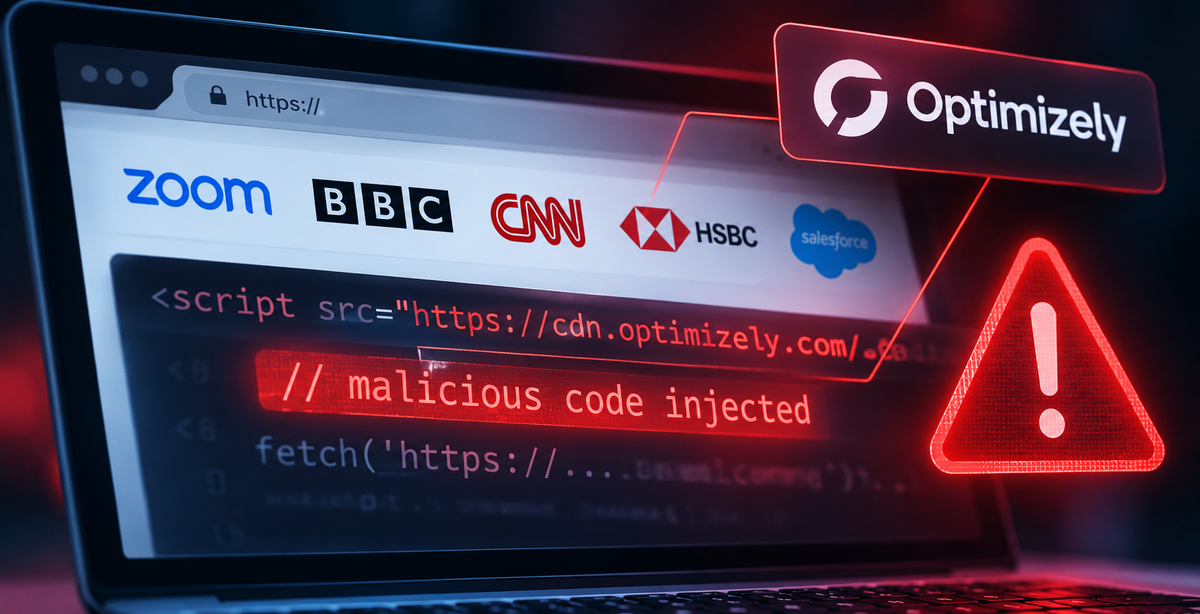
Malicious JavaScript was delivered to visitors of websites operated by at least 178 organisations through Optimizely’s Web Experimentation service on 16 November, according to an investigation by UK web-security firm Report URI. Its list includes the BBC, CNN, HSBC, Zoom, Salesforce and IKEA. The scale makes this a significant third-party software incident, but inclusion on the list does not prove that every visitor was infected or that every organisation lost data.
In a detailed technical account, Report URI says it identified 188 affected Optimizely code snippets associated with those 178 organisations. The attacker inserted code into the Project JavaScript field used by customer projects. The modified snippets were then served from Optimizely’s own domain, which many customer websites already trusted.
Optimizely Web allows sites to run experiments by loading a small script. That script can contain custom project code alongside Optimizely’s functionality. A website owner can keep its own server secure and still expose visitors if the external script it loads is changed upstream. In this case, the source looked familiar to the browser even when the content was not.
Report URI says the malicious code could swap cryptocurrency wallet addresses, capture payment-card details, steal browser cookies and direct some Apple devices towards exploit kits. The firm says it verified cryptocurrency transfers to attacker-controlled wallets. Those are findings about the campaign and its capabilities, not evidence that all listed brands suffered each form of theft.
The researchers found that the number of infected snippets had fallen sharply by late on 16 November. Their last cited check found one remaining affected snippet out of 188. That is an observation at a particular time, not a guarantee that every customer has completed its own investigation or notification process.
Organisations using Optimizely Web should review project-level custom JavaScript, access to their Optimizely accounts and any suspicious changes during the incident window. They should examine browser-side logs and content security policy reports, assess whether payment forms or session data were exposed, and rotate relevant credentials where their own evidence warrants it. A restrictive content security policy can limit which new scripts load and where data can be sent, although a policy must be tested against the site’s legitimate functions.
For visitors, sensible checks depend on what they did on an affected site. Someone who entered card details should monitor the account and follow guidance from the merchant or bank. A person who made a cryptocurrency transfer should verify the destination address in the final transaction record. Device updates remain important, particularly when a campaign includes mobile exploit code.
The incident illustrates a wider supply-chain problem. TechBooky recently covered a separate supplier-linked exposure affecting Notion AI users. The mechanisms differ, but both show that a company’s security boundary extends beyond the systems it directly operates.
The key unanswered questions are how the attacker gained the ability to alter project code, how many visitors actually encountered the payload and what each affected organisation found in its own logs. Those answers will determine the eventual impact beyond the striking count of exposed websites.
Related Reading
More contextual TechBooky stories selected from tags, categories and article context.
Paul Femi Balo is the founder and publisher of TechBooky. He covers artificial intelligence, African technology, digital infrastructure, enterprise technology and the global digital economy.
We use cookies to ensure that we give you the best experience on our website. If you continue to use this site we will assume that you are happy with it.