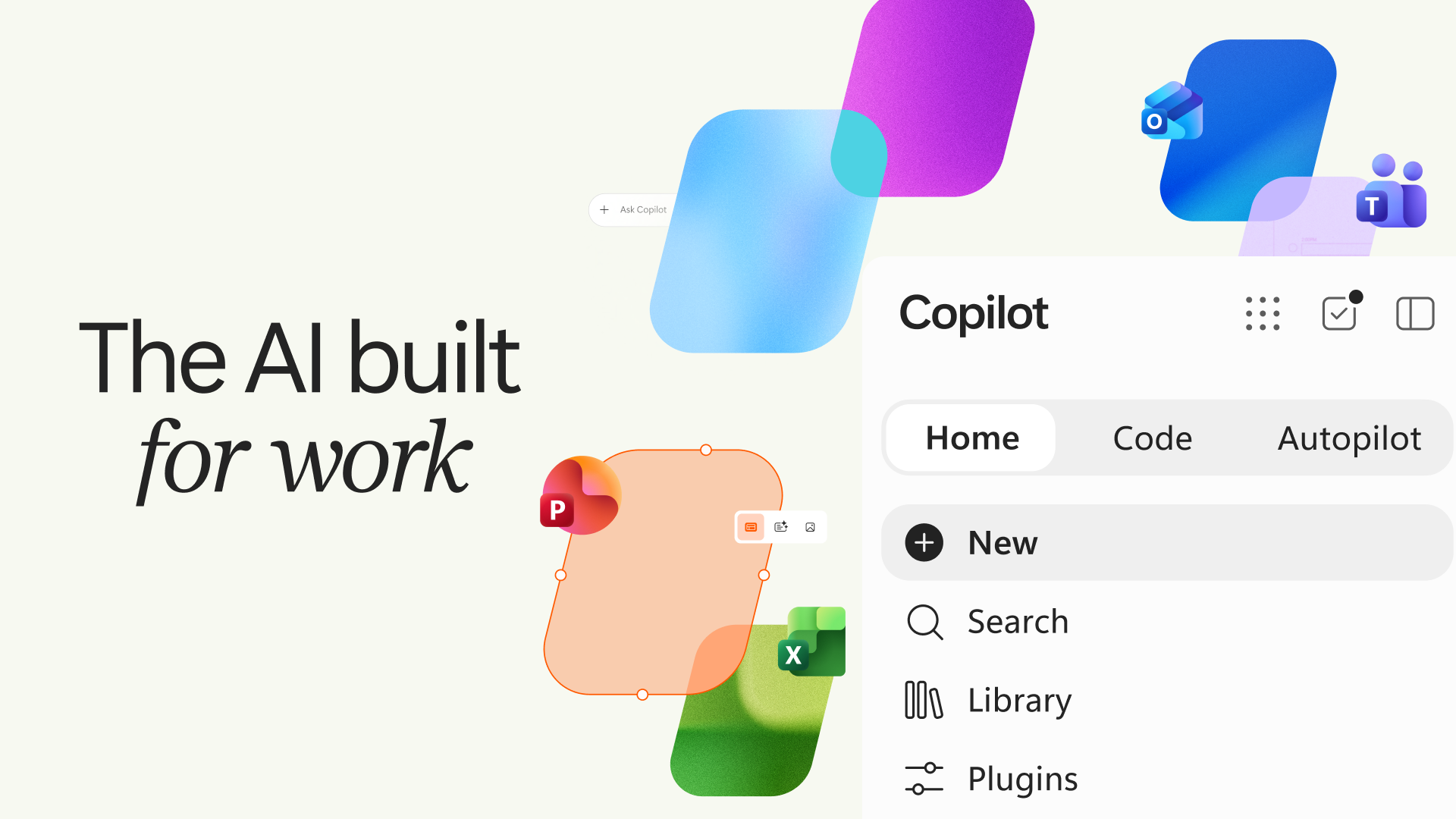
Microsoft is giving Copilot a bigger job than answering questions. The company has unveiled a redesigned work app that brings document creation, small custom applications and a persistent AI agent into the same place. It is calling the three parts Home, Code and Autopilot, a move that puts Copilot closer to the centre of a working day rather than at the edge of a Word document.
The changes were detailed in Microsoft’s September 25 announcement. Home combines chat with Cowork, its tool for handing over longer tasks, and puts Word, Excel and PowerPoint inside Copilot. Microsoft says users will be able to create or revise editable Office files with colleagues instead of exporting an AI answer and rebuilding the formatting themselves.
Code is the more ambitious addition. A user can describe an app, tracker, dashboard or workflow in ordinary language and ask Copilot to build it. Microsoft says the result could be a desktop widget, an interactive dashboard or an internal application hosted in the company’s own environment. This is aimed at employees who know what they need but do not have a software team available for every small problem.
That does not make every employee a software engineer. A tool that generates an app still has to be checked for errors, data access and maintenance. Microsoft is trying to address part of that concern with Copilot Managed Runtime, which it says lets organizations host and govern these applications within their Microsoft 365 environment. The runtime is in preview, so its performance in ordinary workplaces remains to be seen.
Autopilot takes a different step. Formerly called Scout, it is designed as a persistent agent with its own identity, memory, computer and workspace. Microsoft says a business can give it a role and goal, then have it watch channels, follow up with colleagues and keep a project moving while its owner is away. It is intended to operate through familiar surfaces including Teams and Outlook, subject to permissions and auditing.
That will sound useful to anyone whose day is spent chasing updates. It also raises practical questions. Who is accountable when an agent sends the wrong message, uses stale information or acts on a request it misunderstood? Microsoft describes boundaries and controls, but organizations will need to test them against real work, not just a staged demonstration. The earlier Scout concept hinted at this direction; the new Copilot announcement gives it a clearer place in Microsoft’s product line-up.
There is an important distinction between an announcement and a finished rollout. Microsoft says Home and Code will begin reaching its Frontier programme in the coming weeks. Autopilot is due to expand to a private preview at the end of September. Code is also expected to enter preview for Microsoft 365 Premium and Pro subscribers later this year. The full experience is not suddenly available to every Copilot user today.
Microsoft is also changing how some of this work is paid for. Routine AI use remains tied to a subscription, while longer-running agent tasks, Code and Autopilot are slated for usage-based billing. That could make the value of these features easier to measure, but it also means companies should watch costs as agents take on more work.
The wider contest is about where work happens. Chatbots can write a draft; an integrated tool that can edit the actual file, build a working app and follow up on unfinished tasks is harder to ignore. Microsoft has the advantage of being embedded in offices already. Whether that turns Copilot into a dependable teammate will depend on the rollout, its safeguards and whether the output saves more time than it takes to review.
Related Reading
More contextual TechBooky stories selected from tags, categories and article context.
Paul Balo is the founder of TechBooky and a highly skilled wireless communications professional with a strong background in cloud computing, offering extensive experience in designing, implementing, and managing wireless communication systems.
We use cookies to ensure that we give you the best experience on our website. If you continue to use this site we will assume that you are happy with it.