OpenAI is giving businesses a more direct way to manage how they appear inside ChatGPT. Its new Businesses in ChatGPT beta combines a Business Hub for claiming and updating a company profile with Business Agents that can answer customer questions. The distinction is important: eligible businesses in markets where ChatGPT is available can apply to claim a profile, but Business Agents are initially available only to eligible ecommerce and online service companies in the United States.
In its 10 November announcement, OpenAI says ChatGPT has 1.2 billion weekly users. That is the company’s own figure, but it explains why a managed presence inside the assistant could matter to retailers and service providers. If people increasingly compare products and ask for recommendations through a conversation, a business will want its prices, availability and basic information to be current at the point of discovery.
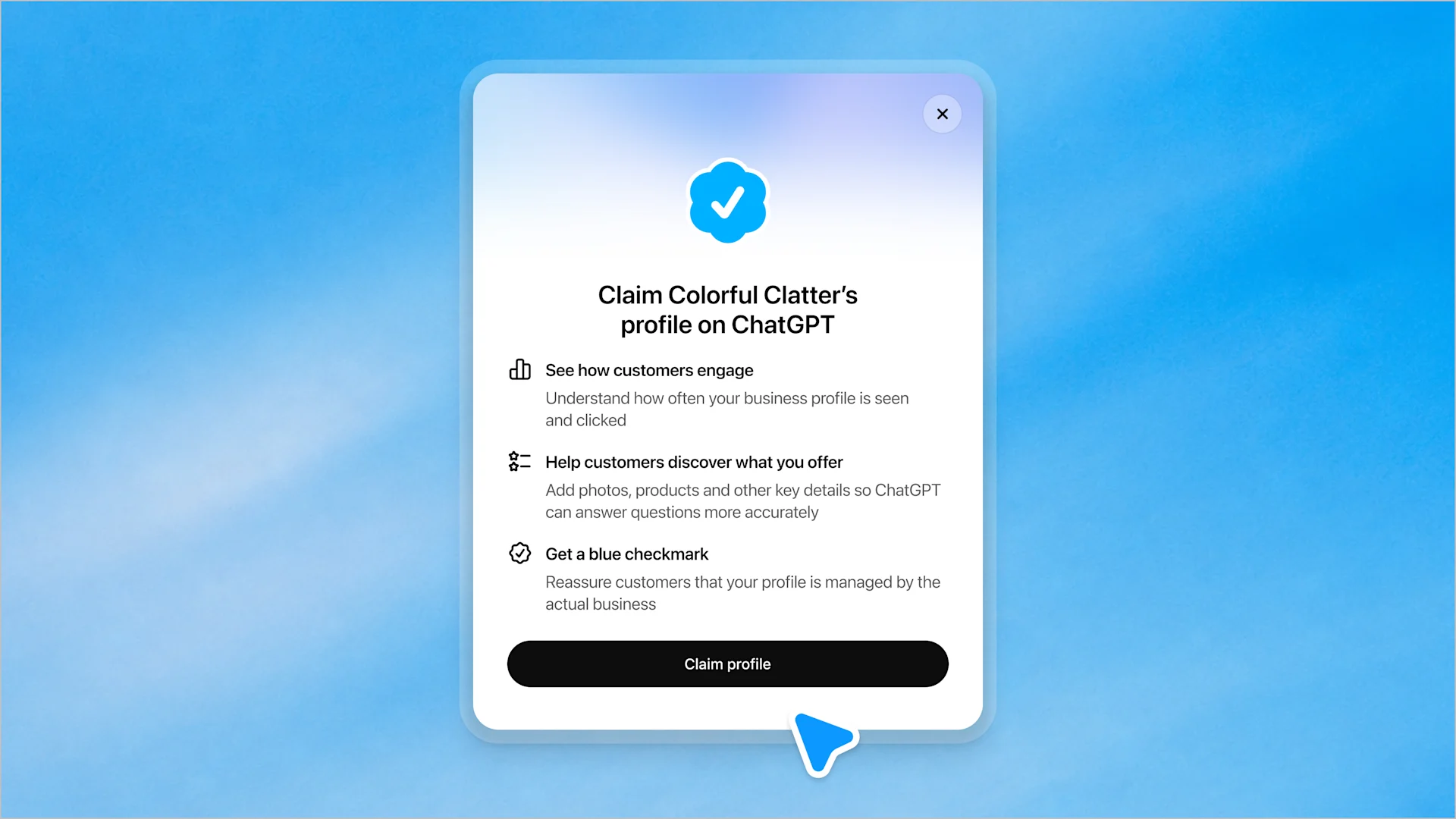
A company can claim its organisation in Business Hub, complete verification and update key details. It can also add self-service product feeds with pricing and availability. OpenAI says Shopify merchants can connect a store through Business Hub or the Shopify admin to simplify verification, and that eligible Shopify products are already included through Shopify Catalog. Claiming a business should not be confused with buying an advertisement or gaining control over ChatGPT’s independent answers.
Business Hub also provides aggregated measures of how often a business is mentioned and how many website clicks it receives from ChatGPT. It can show discovery topics, meaning broad themes in conversations where the company’s website is cited. Those figures could help a marketing team spot stale information or recurring customer questions, but they are not a transcript of what individual users said. OpenAI says it does not share private conversations or Business Agent chats with businesses and only shows insights when activity meets its privacy thresholds.
After a business has claimed its profile, an eligible organisation can build and test a Business Agent. If that business appears in a ChatGPT answer, a user may open its profile and choose to ask the agent more specific questions about its products or services. OpenAI says this exchange is labelled and separate from the original conversation, making it distinct from ChatGPT’s own response. That separation is crucial when the business itself supplies the information used to discuss its offerings.
Now in beta: Businesses in ChatGPT.
Claim your business, manage your information, and get insights on how people engage with you.
The first Business Agents are restricted to eligible US ecommerce and online service businesses. OpenAI says it intends to expand the programme to more categories and markets, but has not announced a date. A Nigerian shop, for example, should not read the general Business Hub eligibility as confirmation that it can launch a customer-facing agent today. Eligibility and verification still have to be checked in the product.
OpenAI is also offering a commercial route. Businesses can sponsor their Business Agent and use it as a destination for ChatGPT Ads. The company says sponsored placements will be clearly labelled and kept separate from ChatGPT’s answers. That makes the launch more than a directory of business listings: it is an attempt to connect discovery, customer conversation and paid reach in one interface.
This builds on the advertising expansion TechBooky reported in Nigeria and South Africa, although that wider ad rollout does not change the US-only start for Business Agents. It also follows integrations such as Etsy’s ChatGPT shopping app. The new Business Hub broadens the opportunity beyond a handful of large partners by letting eligible companies manage their own presence.
There are still questions that a launch page cannot settle. Businesses will want to know how consistently their updates appear in relevant answers, whether aggregated insights translate into useful traffic and how clearly users distinguish an independent answer from a business-operated agent or paid placement. OpenAI has set out the product boundaries; the test now is whether those boundaries remain obvious in a real shopping or service conversation.
Related Reading
More contextual TechBooky stories selected from tags, categories and article context.
Paul Femi Balo is the founder and publisher of TechBooky. He covers artificial intelligence, African technology, digital infrastructure, enterprise technology and the global digital economy.
We use cookies to ensure that we give you the best experience on our website. If you continue to use this site we will assume that you are happy with it.