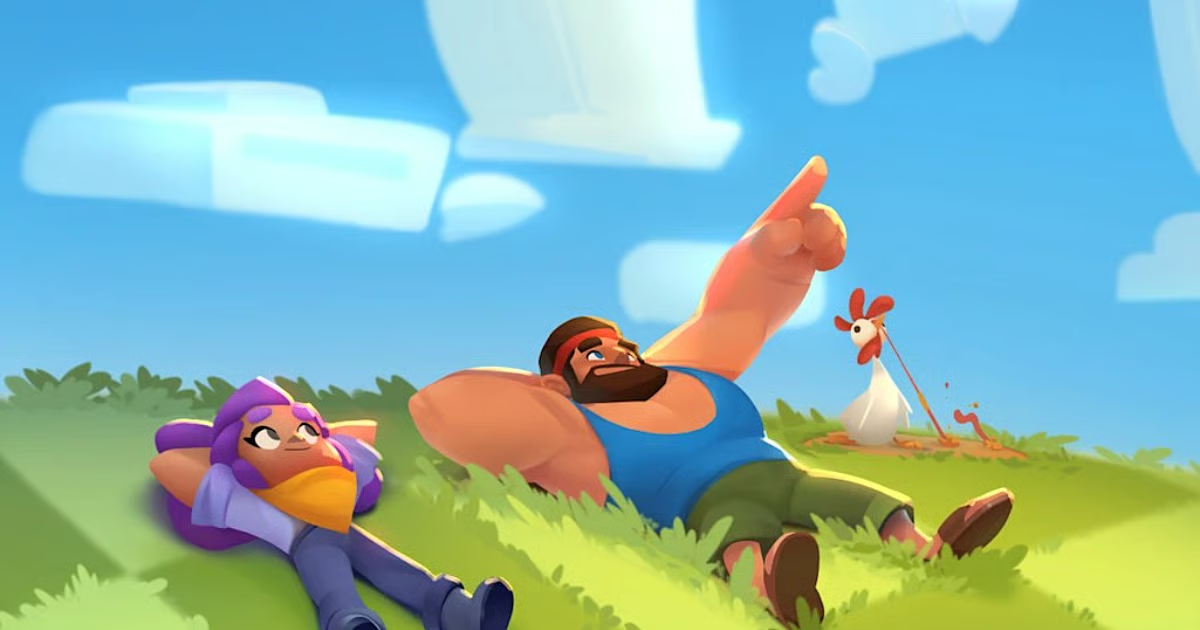
Supercell, the Finnish game company behind Clash of Clans, Hay Day and Clash Royale, has opened applications for its first Developer Grants Program for African game development studios.
The programme offers equity-free funding of between US$20,000 and US$200,000 to legally registered studios whose main operations and most of their teams are based in Africa, according to TechCabal. Supercell plans to select three to five studios for the first cohort, with applications closing on August 9, shortlisted teams expected in October and funding expected to begin in December.
For Africa’s gaming ecosystem, the most important phrase is equity-free. Many early game studios need enough money to pay developers, artists, testers, contractors and marketing partners, but giving up ownership too early can weaken long-term control of the studio and its intellectual property.
TechBooky has followed Africa’s growing game and entertainment-tech potential through stories like PUBG Mobile launching African servers. Supercell’s programme points to the next layer of the market: not just Africans playing global games, but African teams building games that can travel.
Africa has young audiences, strong mobile adoption and deep storytelling cultures. Those are useful ingredients for gaming. What the ecosystem often lacks is patient early capital, experienced production support and a clearer path from prototype to live game.
Game development is expensive in ways that outsiders often underestimate. A studio may need months of iteration before a game is fun enough to retain players. It may need user testing, art direction, backend infrastructure, community management, analytics, live operations and marketing before revenue becomes meaningful.
That is why a grant can be more useful than a small investment with heavy strings attached. Non-dilutive funding lets a studio build momentum without immediately defending a valuation or surrendering creative ownership.
Applicants can submit pitch decks, gameplay trailers, links to previous games and a funding plan. Supercell says it will evaluate the team, the originality of the creative vision, evidence of player engagement, the studio’s potential to build a sustainable business and the clarity of how the money will accelerate growth.
The programme is open across platforms and business models, which is sensible for Africa. Mobile games will likely dominate because of device availability, but PC, console, web and hybrid models also have room depending on the audience and distribution strategy.
Africa’s gaming opportunity should not be reduced to local folklore with better graphics. The stronger opportunity is for African studios to build original worlds, mechanics and live communities that can compete globally while still carrying local texture.
Supercell’s involvement matters because it is one of the few gaming companies that understands how small teams can build long-lasting mobile games. If the programme brings more than money and includes mentorship, product discipline and distribution knowledge, the impact could be larger than the grant amount.
The challenge is that three to five studios will not transform the ecosystem by themselves. But they can create examples, and examples matter. A single breakout African game can change investor confidence, talent ambition and the way global publishers look at the continent.
Related Reading
More contextual TechBooky stories selected from tags, categories and article context.
Paul Balo is the founder of TechBooky and a highly skilled wireless communications professional with a strong background in cloud computing, offering extensive experience in designing, implementing, and managing wireless communication systems.
We use cookies to ensure that we give you the best experience on our website. If you continue to use this site we will assume that you are happy with it.