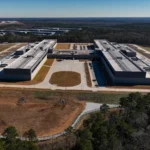
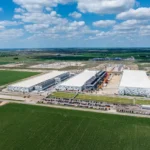
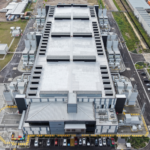
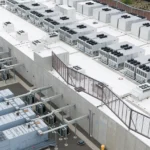
Modern Data Technology Center Server Racks in Dark Room with VFX. Visualization Concept of Internet of Things, Data Flow, Digitalization of Internet Traffic. Electric Equipment Warehouse.
New York has become the first US state to put a statewide pause on new large data centre projects, a move that turns the AI infrastructure boom into a direct fight over power prices, climate impact and local control.
Governor Kathy Hochul signed an executive action blocking new environmental permits for data centres above 50 megawatts for up to a year, according to The Verge. The pause is meant to give state regulators time to assess how hyperscale data centre construction affects energy bills, water use and air quality.
The timing is important. AI companies are racing to build larger facilities because model training and inference now demand vast amounts of compute. But those facilities do not exist in a vacuum. They need land, transmission capacity, electricity, water, tax incentives and community approval.
AI infrastructure has become the physical layer of the AI economy. Every chatbot, coding assistant, image generator and enterprise AI system depends on servers that require power and cooling. The more companies promise AI everywhere, the more communities are asked to host the infrastructure behind it.
That trade-off is becoming harder to ignore. Supporters argue that data centres bring investment, jobs and digital competitiveness. Critics worry about electricity demand, higher utility bills, water consumption, noise, tax breaks and whether local communities receive enough benefit for the burden they carry.
New York’s order also lands as other states and regions are competing aggressively for AI infrastructure. Meta is expanding its Louisiana AI data centre ambitions, while other hyperscalers are searching for places with enough power and fewer permitting delays. The contrast is sharp: some jurisdictions want to accelerate, while others now want a timeout.
The most difficult part of the AI data centre debate is electricity. A 50MW facility is already large. Hyperscale campuses can run far beyond that, especially when designed for AI training clusters. Once a single industry starts competing with homes, factories and public services for grid capacity, politics follows quickly.
For AI companies, the message is that compute strategy now includes energy diplomacy. They will need to show how they will fund grid upgrades, use renewable power, reduce water impact and give local communities a reason to support projects.
The New York pause does not mean the AI infrastructure boom is ending. It means the easy phase is over. Building models is one challenge. Building the physical footprint behind those models without provoking public resistance is another.
For Africa and other emerging markets, there is a lesson here too. AI infrastructure opportunities will come with big promises, but regulators should ask early questions about power, water, local jobs, data sovereignty and who pays when the grid needs upgrading.
AI may feel digital on the screen, but New York’s moratorium is a reminder that it is deeply physical underneath. The future of AI will be shaped as much by energy policy and local politics as by model benchmarks.
Related Reading
More contextual TechBooky stories selected from tags, categories and article context.
Paul Balo is the founder of TechBooky and a highly skilled wireless communications professional with a strong background in cloud computing, offering extensive experience in designing, implementing, and managing wireless communication systems.
We use cookies to ensure that we give you the best experience on our website. If you continue to use this site we will assume that you are happy with it.