Thinking Machines Lab has finally put a real product behind the attention around Mira Murati’s post-OpenAI company. Its first major release is Inkling, an open-weight multimodal AI model built for developers, researchers and companies that want to customise AI around their own workflows.
That positioning matters. The AI market is increasingly splitting between giant closed models sold through APIs and open-weight models that organisations can inspect, fine-tune and deploy with more control. Inkling sits firmly in the second camp, even though its scale is anything but small. The model card lists 975 billion total parameters, 41 billion active parameters, an Apache 2.0 licence and support for text, image and audio inputs.
For enterprises, the most interesting part may not be the headline parameter count. It is the idea that a large model can be shaped around a company’s own data, vocabulary and risk tolerance. That is where Thinking Machines is trying to make its argument: AI should not simply be rented as a one-size-fits-all service, especially in industries where expertise, compliance and proprietary knowledge matter.
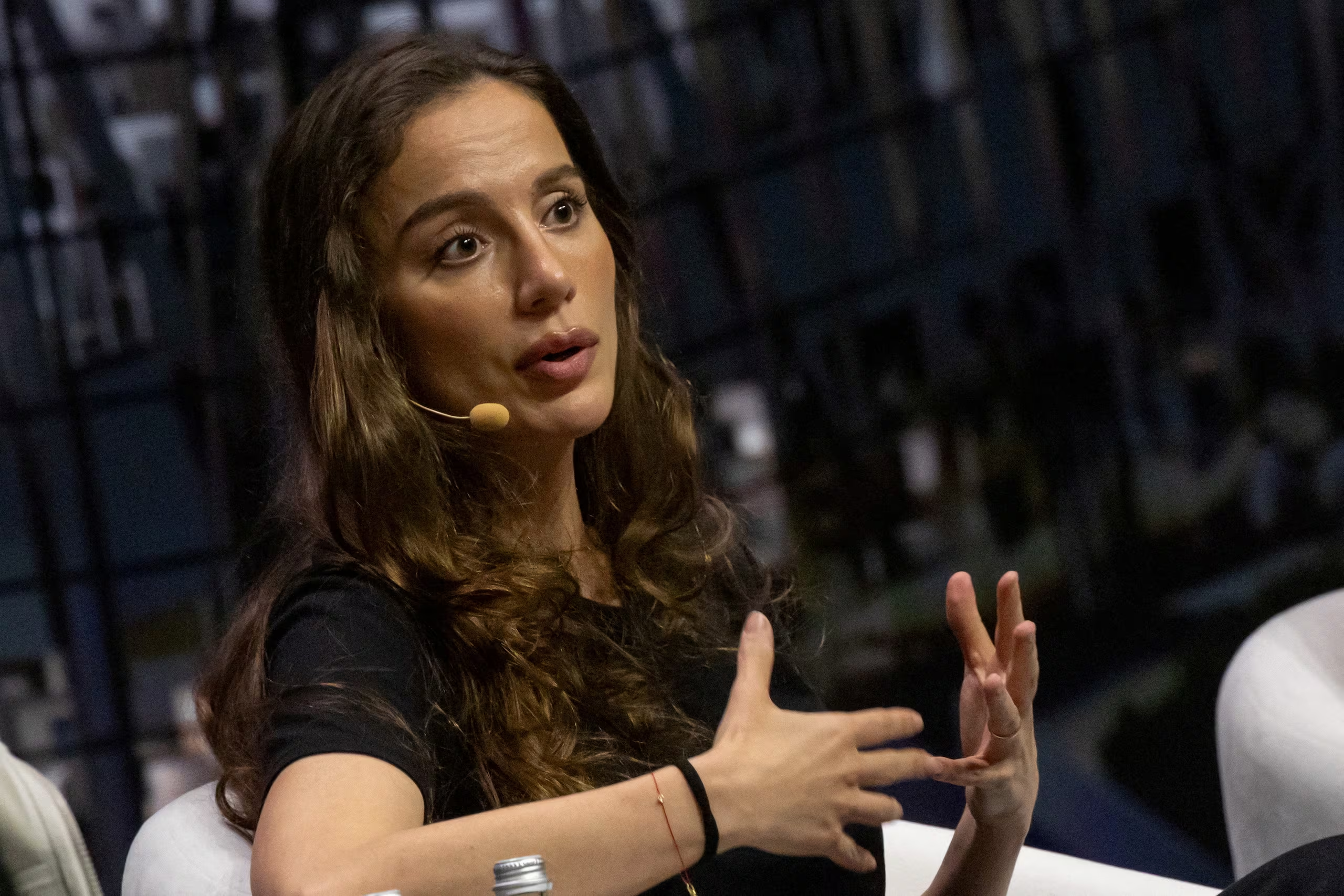
Inkling comes from a team with serious AI pedigree. Murati, OpenAI’s former chief technology officer, started Thinking Machines with other well-known AI researchers and executives. The company raised heavily before launching a model, which made this release an important credibility test. An AI startup can attract capital on talent and vision, but eventually the market wants to see the model.
The release also comes at a time when open-weight AI has become much more competitive. Chinese labs, U.S. startups and open-source communities have shown that closed frontier labs no longer have a monopoly on useful AI. That does not mean open models are always stronger, safer or cheaper in practice. It means customers now have a real choice between convenience and control.
Thinking Machines says Inkling was designed for reasoning across modalities and for domain adaptation through fine-tuning. The model can run with a very large context window of up to 1 million tokens, while full weights are available through Hugging Face. It is also available through Tinker, the company’s fine-tuning platform, with 64K and 256K context options.
For many businesses, the AI question is no longer whether a model can write an email or summarise a document. The bigger question is whether the model can understand a company’s messy, specific world: its support history, internal jargon, customer patterns, product defects, regional realities and compliance boundaries. A generic model can be impressive in a demo and still feel shallow when the task requires real institutional memory.
That is why Inkling is more interesting as infrastructure than as a chatbot launch. If developers can take the model, fine-tune it responsibly and deploy it in controlled environments, it could become part of a broader move away from purely centralised AI. It also puts pressure on closed providers to explain why customers should accept less transparency, less portability and higher switching costs.
A recent piece from us on OpenAI’s possible first consumer device shows how much attention still goes to hardware and consumer interfaces. Enterprise buyers, however, are often moving in another direction: toward models they can embed deep inside their own systems.
There is still a practical catch. A model of this scale is not something most startups will run casually on a single machine. Thinking Machines says the BF16 checkpoint needs at least 2TB of aggregated VRAM, while a quantised NVFP4 checkpoint lowers the requirement but still expects serious hardware. For many companies, managed inference partners and fine-tuning platforms will remain the realistic route.
Safety is another open question. Open weights can improve scrutiny and experimentation, but they also shift responsibility to developers, enterprise teams and hosting providers. Thinking Machines says it evaluated Inkling across dangerous capability areas and human-AI threat vectors. That matters because open-weight models are increasingly being used in agentic systems that can browse, code, call tools and act on business data.
The bigger point is that Inkling makes the open-versus-closed AI debate more practical. This is not simply an ideological release. It is a business bet that custom AI, not just bigger general-purpose AI, will define the next phase of adoption. If that bet is right, Inkling may be remembered less as a model launch and more as a marker of where enterprise AI is heading.
Related Reading
More contextual TechBooky stories selected from tags, categories and article context.
Paul Balo is the founder of TechBooky and a highly skilled wireless communications professional with a strong background in cloud computing, offering extensive experience in designing, implementing, and managing wireless communication systems.
We use cookies to ensure that we give you the best experience on our website. If you continue to use this site we will assume that you are happy with it.