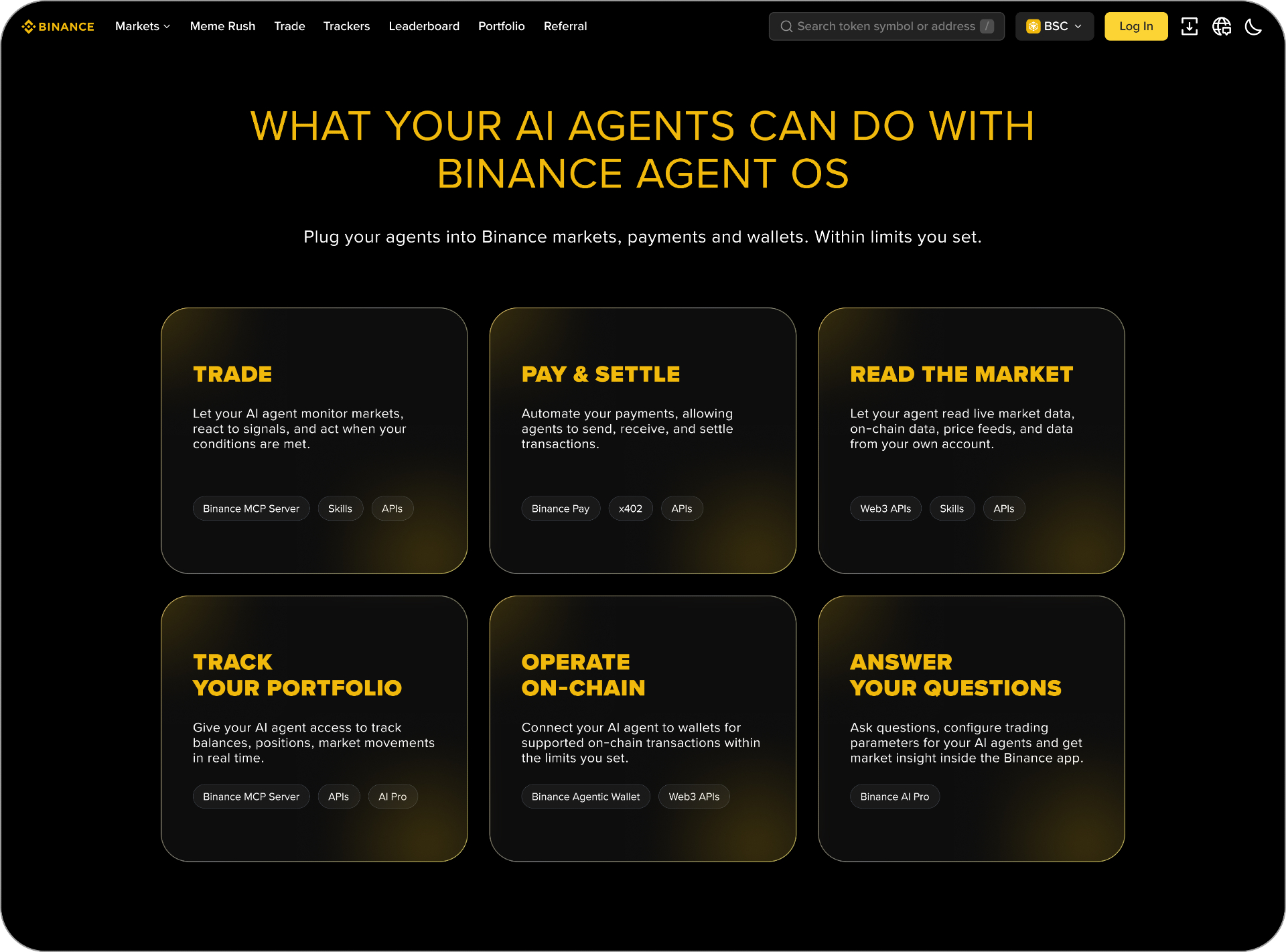
Binance has launched Agent OS, and the announcement moves AI agents from a productivity story into something much more sensitive: real financial execution.
The company said in an August 20 announcement that Agent OS is a developer platform and standardized access layer connecting AI applications to Binance trading, market data, wallets, payments and on-chain capabilities across crypto and traditional markets.
In plain terms, Binance wants AI applications to plug into financial infrastructure. That means an agent could access market data, read account information and, where permission is granted, help place trades or interact with on-chain tools. This is not just another chatbot wrapper. It is infrastructure for agents that can act inside financial systems.
That is why the risk conversation matters. AI agents can be useful when they summarise markets, monitor portfolios, compare prices or alert users to unusual movement. But once they can execute trades, the stakes change. A bad instruction, poor model reasoning, manipulated data source or compromised agent could lead to real financial loss.
Binance is not alone in moving toward this world. Robinhood has already explored agentic trading features, while OKX has been pushing AI agents that can hire, pay and transact with one another. The direction is clear: financial platforms are preparing for users who bring software agents, not only human clicks.
The useful version of this is obvious. A trader could ask an agent to watch liquidity, compare fees, rebalance a small position, prepare a strategy or execute within strict limits. Businesses could use agents to handle payments, treasury tasks or on-chain workflows. Developers could build new interfaces on top of exchange infrastructure without rebuilding everything from scratch.
The dangerous version is also obvious. Crypto markets move quickly, fraud is common, and malicious actors already use bots, fake tokens, phishing and social engineering. AI agents connected to wallets and trading systems give attackers a new target and users a new way to make mistakes at machine speed.
That is why controls will define whether Agent OS becomes useful infrastructure or a risky experiment. Users need spending limits, approval steps, revocation tools, audit logs, clear notifications and strong permission boundaries. Developers need to design agents that fail safely, not agents that keep trading after the context has gone wrong.
Binance’s Agent OS is a sign of where fintech is going. The question is not whether AI agents will touch money. They already are. The question is whether exchanges, developers and users can keep enough human control around agents before autonomous finance becomes too easy to misuse.
Related Reading
More contextual TechBooky stories selected from tags, categories and article context.
Paul Balo is the founder of TechBooky and a highly skilled wireless communications professional with a strong background in cloud computing, offering extensive experience in designing, implementing, and managing wireless communication systems.
We use cookies to ensure that we give you the best experience on our website. If you continue to use this site we will assume that you are happy with it.