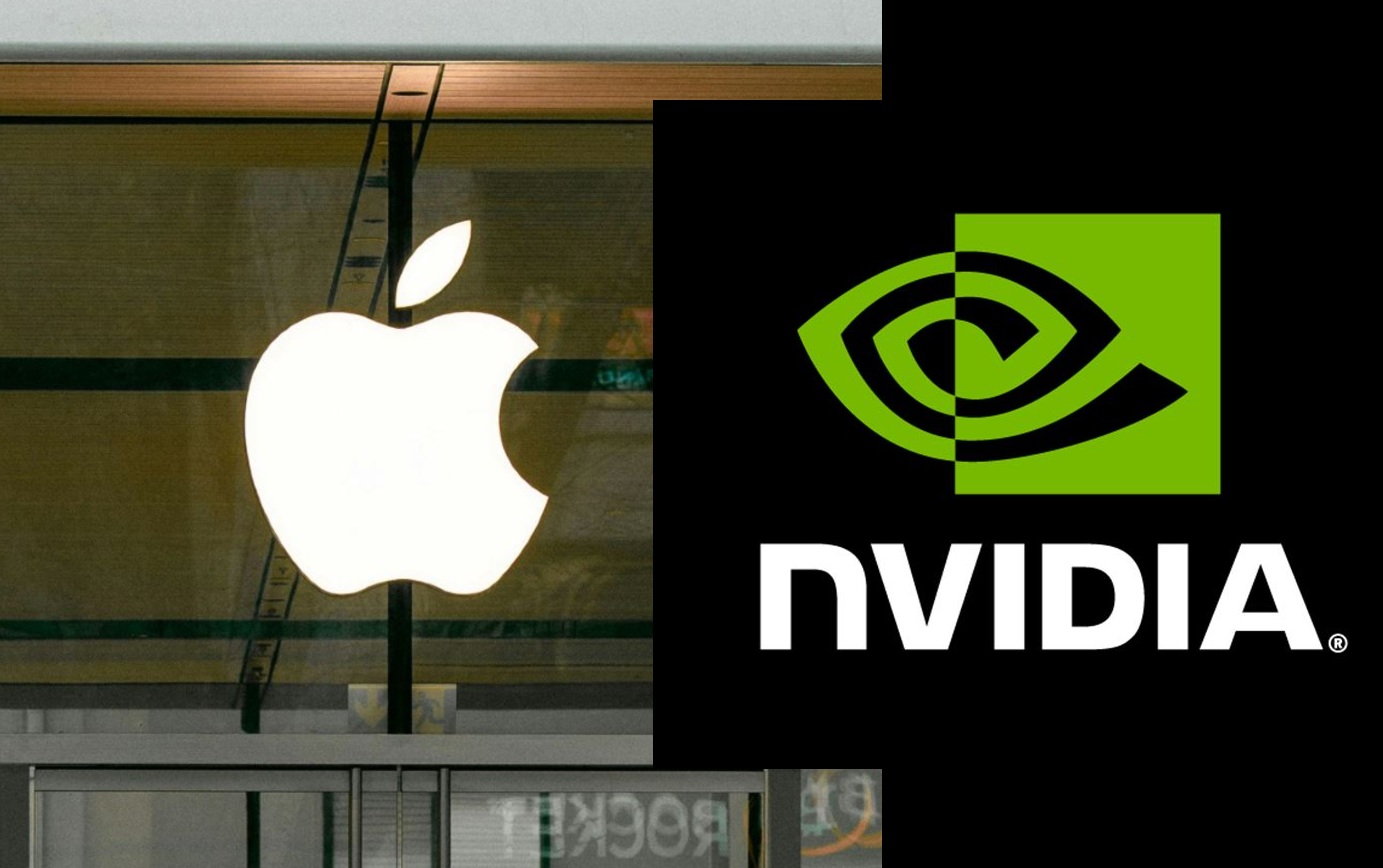
Apple has reclaimed the title of the world’s most valuable company, at least in Friday’s intraday trading, after a sharp pullback in Nvidia shares knocked the AI chip leader from the top spot. The move is a striking reversal in a market that has spent most of the past year treating Nvidia as the cleanest way to bet on the artificial intelligence boom.
Market data on Friday showed Apple valued at roughly US$4.88 trillion to US$4.92 trillion, while Nvidia slipped to about US$4.86 trillion after its shares fell more than 3 percent. Because both stocks are still trading, the ranking can change before the close. But the shift is important because it shows investors are beginning to reassess the AI trade that made Nvidia the market’s most powerful company.
This is not simply Apple rising on its own. It is also Nvidia falling as chip and AI infrastructure stocks come under pressure. Investors have started asking whether the enormous spending on AI chips, data centres and compute capacity can keep expanding at the pace implied by Nvidia’s valuation.
Apple’s return to the top of the market-cap table comes after a strong rally in its shares, helped by confidence around iPhone demand, services revenue, buybacks and renewed optimism around Apple Intelligence. The company has also benefited from its ability to generate massive cash flow even when product cycles look less dramatic than Nvidia’s AI surge.
Apple remains a very different kind of tech giant from Nvidia. Nvidia sells the engines of the AI boom: GPUs, networking, systems and software for data centres. Apple controls one of the world’s most valuable consumer ecosystems, with hardware, services, payments, wearables and software tied together through more than a billion active devices.
That ecosystem is why Apple can regain the crown even without dominating the AI infrastructure conversation. Its recent Apple Intelligence approval in China with Alibaba’s Qwen AI inside gives investors another reason to believe the company can bring AI into its device base without having to build every model or data-centre layer itself.
Nvidia is still one of the most important companies in the world, and one bad trading day does not change its role in AI. The company remains central to cloud AI training, inference, sovereign AI projects, robotics, autonomous systems and data-centre buildouts. But the stock has become so closely tied to AI optimism that any doubt about the trade can hit hard.
The pressure is coming from several directions. Semiconductor shares have weakened. Investors are taking profit after huge gains. Questions are growing around whether hyperscalers are overbuilding AI capacity. China’s AI labs are pushing cheaper and increasingly capable models. And if models become more efficient, the market may start asking whether GPU demand can keep surprising to the upside forever.
That does not mean Nvidia’s business is suddenly weak. Recent industry signals around TSMC’s AI chip demand and ASML’s stronger 2026 outlook still show a supply chain benefiting from the AI buildout. The question is valuation, not relevance.
For much of the past year, the market treated the AI trade as fairly simple: buy the companies selling compute, especially Nvidia. That trade worked because demand for GPUs, memory, networking and data-centre capacity kept growing faster than most forecasts.
Now the story is becoming more complicated. The rise of China’s open and cheaper models is putting pressure on the assumption that AI progress must always require ever-larger compute budgets. Moonshot AI’s Kimi K3 topping a frontend coding leaderboard is one example of how the model race is widening beyond U.S. labs and their preferred infrastructure narratives.
That is why Apple’s return to No. 1 is symbolic. Apple represents distribution, devices, services and consumer lock-in. Nvidia represents the AI infrastructure buildout. If investors start rotating from pure AI infrastructure into companies with broader cash flow and consumer ecosystems, the leadership table can change quickly.
The market-cap race between Apple, Nvidia and Microsoft is now a real-time referendum on what investors value most in technology: AI infrastructure, enterprise software, cloud platforms or consumer ecosystems. Nvidia’s rise showed how powerful infrastructure can be when the whole industry needs chips. Apple’s comeback shows that durable consumer platforms still matter.
Microsoft remains close in the wider race as well, because it has a different AI story built around cloud, enterprise software, OpenAI integration and productivity tools. The top of the market is no longer a simple iPhone-versus-Windows story. It is a contest between the companies that control devices, chips, cloud, models and daily workflows.
For Africa and other emerging markets, the shift matters because these companies shape the cost and availability of digital tools. Nvidia’s chips influence AI infrastructure prices. Apple’s devices and services influence consumer AI adoption. Microsoft and Google shape enterprise AI access. Their market-cap rankings may feel abstract, but their strategy affects what startups, developers and users can build with.
Apple dethroning Nvidia is therefore more than a scoreboard moment. It is a reminder that the AI boom is entering a more selective phase. Investors still believe in AI, but they are beginning to ask harder questions about who captures the value, how quickly, and at what price.
Related Reading
More contextual TechBooky stories selected from tags, categories and article context.
Paul Balo is the founder of TechBooky and a highly skilled wireless communications professional with a strong background in cloud computing, offering extensive experience in designing, implementing, and managing wireless communication systems.
We use cookies to ensure that we give you the best experience on our website. If you continue to use this site we will assume that you are happy with it.