Arm has delivered another reminder that the AI chip boom is not only about the companies selling the most expensive accelerators. The architecture underneath many of those systems is becoming a bigger earnings story of its own.
The chip design company said in its first-quarter fiscal 2027 update that revenue rose 22 percent year over year to $1.29 billion, ahead of analyst expectations. Net income increased to $270 million, or 25 cents per share, while adjusted earnings reached 45 cents per share. That was also ahead of the 40 cents analysts had expected.
The result matters because Arm sits in a different part of the semiconductor chain. It does not manufacture chips in the way TSMC does, and it does not sell finished AI accelerators in the way Nvidia does. Instead, Arm licenses chip designs and collects royalties when partners ship products based on its technology. When more cloud, smartphone, automotive and edge devices use Arm-based designs, that royalty stream becomes more valuable.
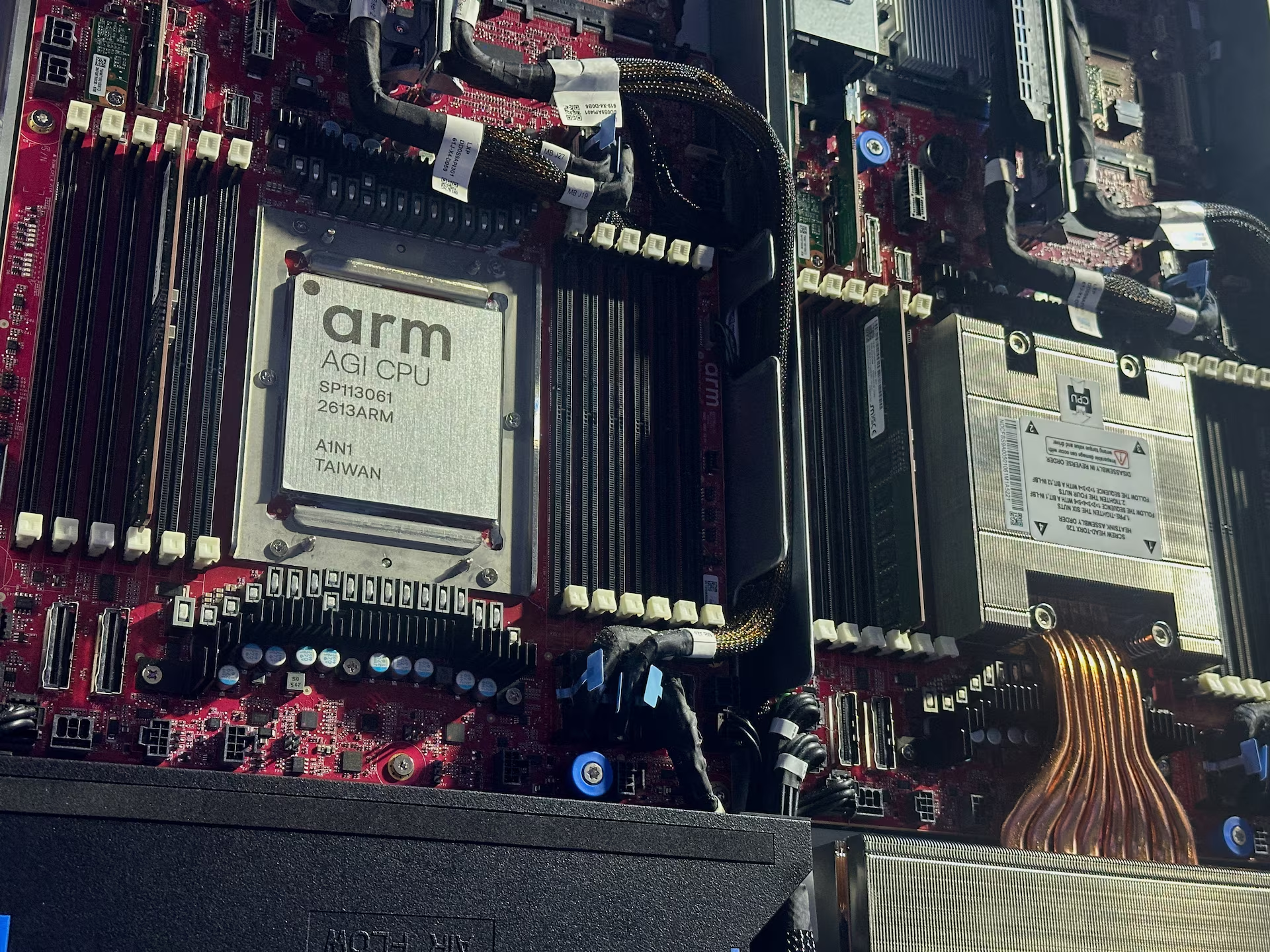
AI infrastructure is now making that model more interesting. Arm said both royalty and licensing revenue grew strongly, with data centre demand becoming a larger part of the conversation. Management also pointed to stronger demand for Arm-based server and AI infrastructure products, including its newer CPU roadmap. That is why the quarter is being read as more than a clean earnings beat.
The company guided for the next quarter to revenue of $1.33 billion to $1.43 billion and adjusted EPS of 43 cents to 51 cents. That outlook suggests Arm expects demand to keep building as cloud companies, chipmakers and device manufacturers look for more efficient compute designs. In an AI market where power consumption and cooling are now board-level issues, efficiency is not a secondary feature anymore.
That is the part investors are watching closely. Nvidia remains the loudest name in AI chips, but data centres are increasingly being built as systems, not just as GPU clusters. CPUs, networking, memory, storage and software all have to work together. That is why the earnings strength we have seen from TSMC’s AI chip demand and the memory boom around SK Hynix matters for Arm as well. The entire stack is being repriced around AI workloads.
Arm’s advantage is that its designs are already widely used in smartphones and low-power devices, but the growth story investors care about is increasingly in servers, cloud AI, cars and custom chips. If more hyperscalers and semiconductor partners build Arm-based systems for data centres, the company gets to participate in the AI buildout without owning the most capital-intensive parts of production.
That does not remove risk. Arm’s valuation already assumes a lot of future growth, and licensing cycles can be uneven. The company also has to prove that AI infrastructure demand can become a durable royalty stream rather than a short burst tied to a few product launches. Competition from x86, RISC-V and custom silicon will not disappear just because Arm had a strong quarter.
But this result strengthens Arm’s case. Revenue beat expectations, profit improved and the guidance points to continued demand. In a market still trying to separate real AI earnings from AI promises, Arm has something useful to show. Its technology is increasingly present in the places where the AI economy is being built, and that is starting to show up in the numbers.
Related Reading
More contextual TechBooky stories selected from tags, categories and article context.
Paul Balo is the founder of TechBooky and a highly skilled wireless communications professional with a strong background in cloud computing, offering extensive experience in designing, implementing, and managing wireless communication systems.
We use cookies to ensure that we give you the best experience on our website. If you continue to use this site we will assume that you are happy with it.