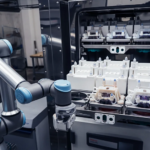
Over the last few decades, the need for more automation and quicker size changes in tires has resulted in a manufacturing transformation in the tire industry.
Over the last few decades, the need for more automation and quicker size changes in tires has resulted in a manufacturing transformation in the tire industry. This transition has resulted in improvements in factory design, as well as changes in tire manufacturing machinery, process equipment, and tire design. Regulations increased OEM and customer efficiency standards, and new tire materials have all contributed to some of the improvements. The latest Smithers Rapra market study, “The Future of Tire Manufacturing to 2024,” details these and other advancements in tire manufacturing.
Manufacturing process improvements have been underway since the first tire factories, and have intensified in the last decade as a result of a greater emphasis on environmental issues. The construction of new factories would help meet that demand and make it easier to manage new machinery. Automation advancements have also aided greatly, though there are still substantial cost reductions to be realized, as well as rising environmental regulations to comply with. As a result of these factors, tire manufacturers will continue to concentrate on increasing production performance.
DEVELOPMENTS IN REGIONAL AREA Tire demand and industry growth are propelling regional and global manufacturing expansion. Local tire demand from OEM and replacement market buyers, as well as favourable costs of production factors, form the distribution of tire manufacturing capability and production across the world’s major regions.
According to “The Future of Tire Manufacturing to 2024,” tire manufacturers prefer to build local factories in their most relevant sales areas, with Asia being the most recent priority. The opposite is also true, with Asian manufacturers locating production near important customers such as U.S.-based OEMs. As a result, North American tire production is expanding, while the aging European industry is expected to lose market share over the next five years. The cost of raw materials is relatively consistent across the world, but labour and energy costs differ by region or country.
MANUFACTURING OF TIRE DEMAND DRIVES
The ultimate driver of tire production is global tire demand, with both existing vehicles producing ongoing tire wear and repair needs and new vehicle purchases necessitating the installation of OEM tires. In unit terms, global tire demand is projected to rise at a rate of 4% per year from 2019 to 24.
The global tire industry, as calculated by production tonnage, is expected to reach 19.25 million tons in 2019 and rise at a 3.4 percent compound annual growth rate to 22.75 million tons by 2024.
At the global, regional, and national levels, a variety of economic, technological, regulatory, demographic, and consumer trends, such as alternative powertrains and autonomous vehicles, improvements in materials, including renewable alternatives, and changing customer requirements, such as greater fuel efficiency with lower emissions, are driving and shaping this development. Although tire companies adjust to customer labelling schemes in Europe and, increasingly, elsewhere, there is a continuing high-performance trend toward larger OEM tire sizes/rim diameters, as well as ongoing pressure on automakers to meet emissions and fuel efficiency requirements for individual vehicles as well as fleets.
THE IMPACT OF VEHICLE TYPE AND DESIGN
Trends in both traditional and evolving segments of the automotive industry have a significant impact on tire requirements and production, necessitating a great deal of preparation and versatility. For example, in developed markets, a continuing move away from passenger cars toward light trucks coexists with growth in emerging markets in entry-level vehicle segments. The changes at the OEM level have been taking place for years, as shown by the continued high growth of high-performance vehicles as well as environmentally friendly vehicles and fleets.
TIRE DESIGN AND TYPE CHANGES Protection, stability, wet and dry traction, snow performance/wet performance, handling, high rolling efficiency, noise, and life (miles)/longevity are some of the main necessary or desirable characteristics of a tire. New tire inventions are continuously being made, and every year there are significant improvements. Tread/shape, material shapes, and material chemistry are only a few of the tire properties that are in flux, and that doesn’t even include the numerous model tires.
Tiremakers have made a pledge to manufacture ever more technically advanced tires (e.g., with sensors to monitor tread depth, temperature, and provide real-time warnings to drivers), run-flat tires (including self-sealing tires, self-inflating tires, air-free tire technologies, and reduced noise or noise-dampening tire technology), and run-flat tires (including self-sealing tires, self-inflating tires, air-free tire technologies, and noise-dampening tire (important for quiet electric vehicles).
New molds, laser cutting tools, new test equipment (especially for noise), and material changes such as different resins, silica, and aramid fibres have all had an effect on tire manufacturing in order to manufacture these technically advanced tires.
REQUIREMENTS FOR EV TIRE The use of electric vehicles (EVs) is growing, and one noticeable result of this growth is the increased complexity of tire varieties. This involves increased variety in OE tire types and sizes (for sizes you can check wheel fitment calculator), which will result in further SKU (stocking unit). proliferation. Since traditional tires wear 30 percent faster on EVs than they do on conventional vehicles, higher wear resistance is important.
To prevent uneven wear, EV tires must have an optimized footprint shape and contact pressure distribution. To maximize battery range, rolling resistance must be reduced further, and the additional weight of EVs can necessitate even lighter tires. In addition to the current pressure from labelling systems, quiet electric vehicles necessitate a focus on noise reduction.
EVOLUTION OF AV TIRE Many EV tire changes also refer to autonomous vehicles (which are likely to be all or mostly electric), but as autonomous driving becomes further common, more changes will emerge, which will need to be scaled up alongside conventional manufacturing.
At both the OE and aftermarket levels, tire sensing and communication capabilities are becoming more popular. Various types of tire condition and wear sensors, as well as intelligent tires, are being developed, with some nearing market readiness ahead of the major shift to autonomous vehicles in the future.
Tire-vehicle communication will become more relevant as autonomous self-steering cars become more common, necessitating the use of tire sensors. Path sensing, vehicle activity, and predictive maintenance (wear/damage sensing) would all benefit from connected tires.
Low noise and high ride quality will be prioritized. The demand for run-flat tires and eventually non-pneumatics will grow as reliability requirements rise. As autonomous vehicles become more common, light vehicle tires can be distinguished by their tall and skinny shape (for aerodynamics and other attributes), sensor technology, no speed rating (driving speeds may be programmed and limited), improved ride, and reduced NVH (noise, vibration, and harshness), ultra-low rolling resistance (improving fuel economy), and possible run-flat technology (if lightweight enough).
Related Reading
More contextual TechBooky stories selected from tags, categories and article context.
We use cookies to ensure that we give you the best experience on our website. If you continue to use this site we will assume that you are happy with it.