GitHub has launched Copilot Fusion, a system that decides which AI models should handle a coding request and whether a second model should review the work. The pitch is straightforward. Developers choose how much effort they want to spend on a task, while Fusion handles the model choices that have become increasingly complicated as coding assistants add more providers and price tiers.
The launch at GitHub Universe on 28 October is a step beyond the familiar model picker. Selecting a single model leaves a developer to decide when to move to a stronger or cheaper one. Fusion can make that decision during a task and, when needed, use more than one model to produce a single final response. It is generally available across VS Code, Copilot CLI, the GitHub Copilot app and JetBrains IDEs, according to GitHub’s documentation.
This is a distinct product move within GitHub’s wider Universe announcement, which also covered agent projects, automations and a large infrastructure expansion. As AI tools make it easier to produce code, the contest is shifting towards who can organise the models, control the cost and check the result.
How Fusion chooses its models
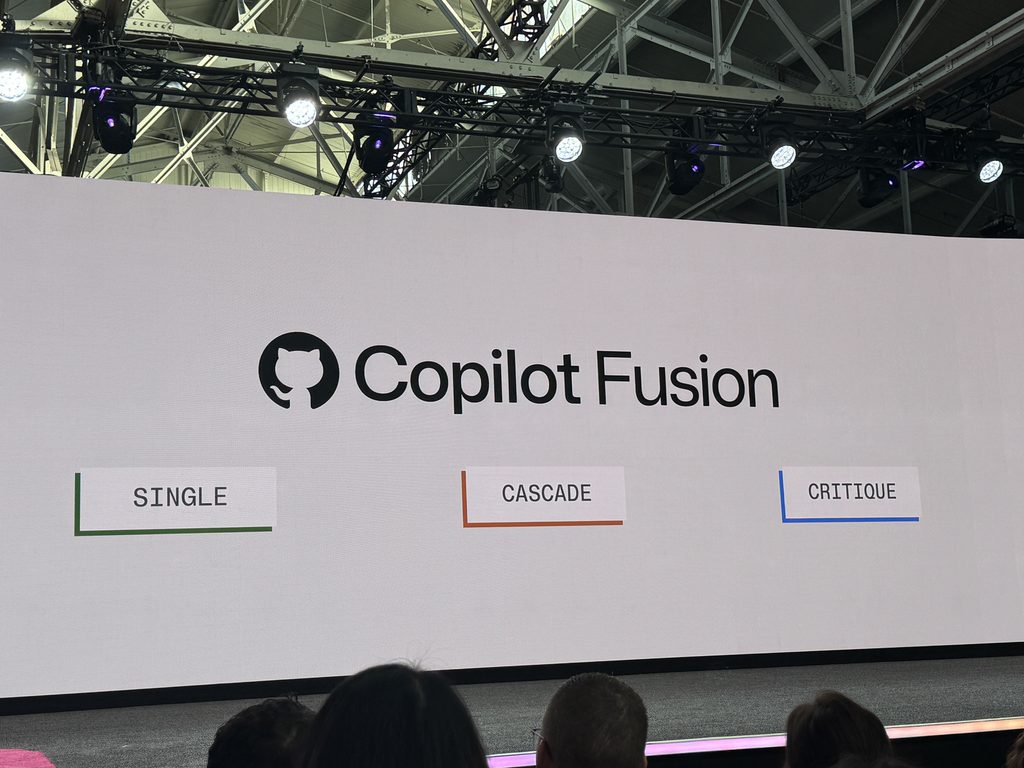
Fusion evaluates a request for the reasoning, code generation, debugging and tool use it requires. GitHub describes three ways it can respond. A simple task may go to one model. For a more demanding job, an efficient model can prepare a draft that a judge either accepts or escalates to a stronger model. A third pattern lets several models critique a draft in parallel before it is revised.
That does not mean every prompt triggers an expensive committee of models. GitHub says Fusion selects an execution pattern for each prompt and adds review calls only when it judges them worthwhile. A follow-up in the same conversation can therefore take a different route from the original request. Developers can see the progress of each step and the models used, although the system presents one final response rather than every intermediate draft.
The choice left to the user is an effort setting. Fusion Standard is intended for everyday work and selects one model for a task. Fusion High is aimed at substantial but defined coding jobs, where extra review may justify more time and credits. Fusion Max is reserved for the deepest reasoning and analysis. GitHub says Standard is included across all Copilot plans, while High and Max require eligible paid plans.
GitHub’s most striking comparison concerns Fusion Max. The company says it scored within two points of Claude Code using Opus 5.5 Max on the Artificial Analysis Coding Agent Index, while taking about 40% less time and costing about half as much in average API costs per task. That is a claim about a specified benchmark and cost measure, not proof that Fusion is cheaper or better for every coding job. The exact bill depends on the models used, the tokens consumed and a customer’s plan.
The distinction matters because a lower benchmark API cost is not the same as a guaranteed reduction in a team’s Copilot spend. GitHub says each model used by Fusion is charged at its standard rate, with no separate Fusion fee. High and Max can consume more AI credits than Standard because they may call several models. Paid Copilot users are offered a 30% discount on model costs through 30 November 2026.
There are controls for organisations that do not want an unrestricted model pool. Administrators can exclude models through policy, and Fusion will respect plan limits as well as data-residency or compliance restrictions. The available models can change as GitHub evaluates new options. That flexibility may help developers avoid becoming attached to a single model, but it also means teams need clear visibility into cost, data handling and the route a task took.
GitHub also cautions that Fusion does not create subagents. If it rejects an intermediate draft, file edits already made in a developer’s workspace are not automatically undone. A developer still has to inspect changes before committing them. That warning is a useful counterweight to the idea that model orchestration removes human responsibility.
The technology grew out of Project HydraFusion, introduced in research preview in September. The new release combines that orchestration work with automatic model selection, moving the complexity of choosing and coordinating AI systems into Copilot itself.
GitHub is facing pressure on more than one front. Its former chief executive Thomas Dohmke has launched Entire, a rival focused on reviewing agent-written code. Fusion addresses a different part of that workflow, deciding which models do the writing and checking. Together, the announcements show how the AI coding market is moving beyond a contest between individual chatbots and towards whole systems for planning, building, reviewing and shipping software.
Related Reading
More contextual TechBooky stories selected from tags, categories and article context.
Paul Femi Balo is the founder and publisher of TechBooky. He covers artificial intelligence, African technology, digital infrastructure, enterprise technology and the global digital economy.
We use cookies to ensure that we give you the best experience on our website. If you continue to use this site we will assume that you are happy with it.