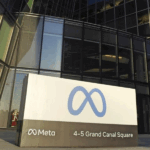
Meta’s latest results left investors with a sharper question than whether Facebook and Instagram can still sell advertising. They can. The question is how long that cash engine can carry an AI build-out whose costs arrive well before its more ambitious products earn meaningful revenue. Meta shares fell after Wednesday’s earnings announcement despite strong sales, as the market weighed a bigger spending commitment and a new way for the company to finance growth.
The market reaction matters because it contrasts with the headline figures. Meta reported third-quarter revenue of $64.60 billion, up 26% year on year. Ad impressions increased 10% and the average price per ad rose 14%. Yet the company spent $34.91 billion on capital projects in the quarter, more than the $32.79 billion it generated from operating activities. Its results put free cash flow at negative $2.12 billion. One quarter does not establish a permanent funding problem, but it illustrates the scale of the investment now sitting alongside the advertising business.
Meta lifted the lower end of its 2026 capital expenditure forecast to $135 billion, leaving the upper end at $145 billion. It has not given a full-year 2027 revenue outlook and says next year’s capacity and budget plans are still being developed. Management argues that AI is already improving recommendations, engagement and advertising monetisation. It also expects newer model and product investments to take longer to produce returns. That gap between visible expenditure and less certain future income is the heart of the investment debate.
The reported profit figure needs care. Meta booked a $9.89 billion charge connected to its settlement with US state attorneys general over teen mental health and social media. The company says diluted earnings per share would have been $7.40 without that charge, compared with the reported $3.83. It would be misleading to treat the legal charge as an AI expense. It would be equally misleading to ignore the separate cash demands of data centres, servers and other infrastructure. TechBooky’s earnings report breaks down those results; the issue now is the financing strategy behind the next phase.
Alongside the results, Meta’s board approved a publicly listed, non-voting Class C share class. It plans a one-time dividend of one Class C share for each existing Class A or Class B share after the new class takes effect, currently expected in January 2027. Meta says the arrangement should have the economic effect of a two-for-one split while leaving existing voting power unchanged. The dates are not final, and the announcement is not itself a completed capital raise.
Why create those shares? Meta explicitly lists future capital raising, employee compensation, possible acquisitions and other corporate purposes. Non-voting stock could give it greater flexibility to issue equity without surrendering voting control held by founder Mark Zuckerberg. Issuing shares later could still dilute existing investors’ economic stake. The trade-off is therefore not free finance, but access to another funding tool while retaining the founder-led governance structure.
The plan also tells investors something about how Meta views the AI race. Its existing advertising business remains highly profitable, but leadership is preparing for a period in which computing infrastructure, talent and products may require more capital than even a large technology company wants to fund from quarterly cash flow alone. Reuters reported that shares declined as investors balanced growing interest in Meta’s Muse agent against the cost of its expansion.
The near-term measures are more concrete than a broad promise of superintelligence. Investors can watch whether AI-driven improvements keep lifting advertising revenue, whether capital spending continues to outrun operating cash generation, and whether products such as Muse develop a business model of their own. They can also watch how, and whether, Meta eventually uses Class C shares to raise funds. Strong adoption alone will not answer the return-on-investment question.
Meta has the scale and audience to make an unusually large AI bet. Its latest results show why it can afford to try. The share reaction shows that the market is no longer content to judge the bet solely by sales growth. The next test is whether Meta can turn that spending into durable returns without asking shareholders to shoulder an ever larger bill.
Related Reading
More contextual TechBooky stories selected from tags, categories and article context.
Paul Femi Balo is the founder and publisher of TechBooky. He covers artificial intelligence, African technology, digital infrastructure, enterprise technology and the global digital economy.
We use cookies to ensure that we give you the best experience on our website. If you continue to use this site we will assume that you are happy with it.