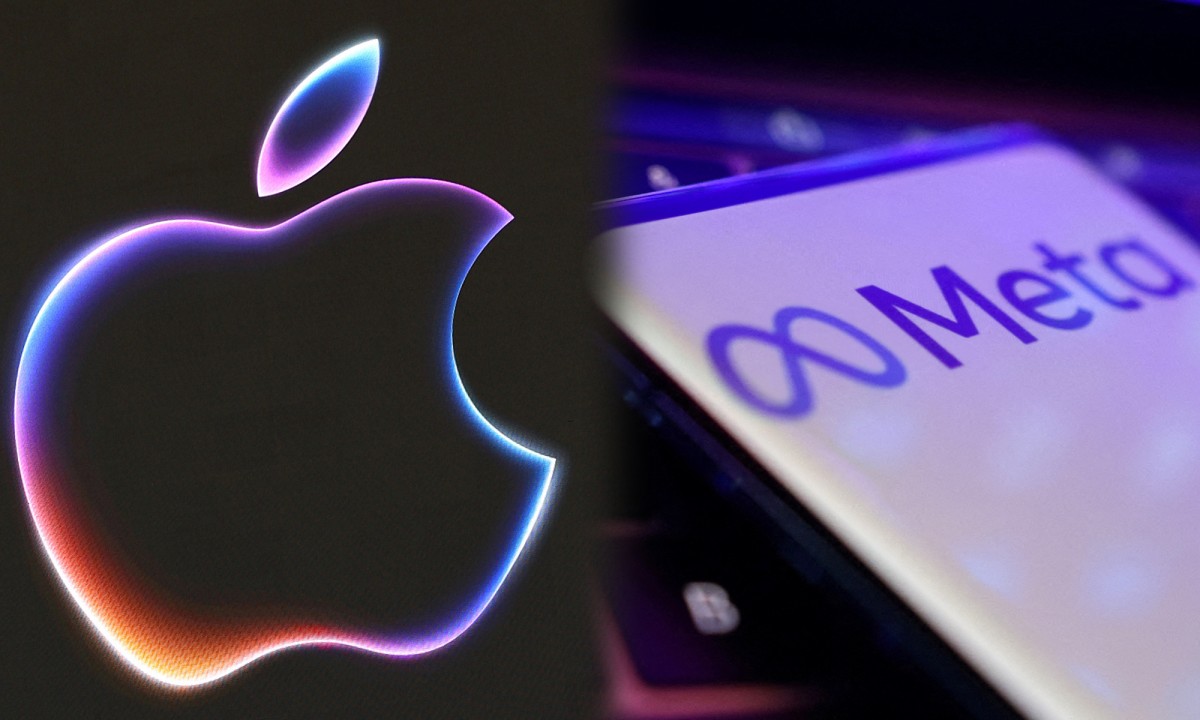
Apple and Meta have worked together on a striking demonstration of local AI. Apple’s researchers say Meta’s newly released Muse Spark Open model, with 816 billion parameters, can run across a cluster of Mac Studio computers using Apple’s open-source MLX framework. In tests published Thursday, four M5 Ultra Mac Studios generated more than 36 tokens a second at an 8,192-token context length. That is a research benchmark, not a promise that the model will run on a standard MacBook.
The collaboration is notable because Apple and Meta compete for people’s attention across devices, apps and AI assistants. Here, their interests meet in a different place: developers who want to run a powerful model on hardware they control rather than send every request to a cloud provider. CNBC reported the partnership as the companies made the work public.
Muse Spark Open is a mixture-of-experts model. It has 816 billion parameters in total, although Apple says roughly 42 billion are active for a given token. The size is still formidable. Apple estimates the model would need more than 1.6TB of memory for its parameters at its native precision. Compressing it into a four-bit format brings the footprint to about 493GB, before accounting for the memory used while generating an answer. That is why even a Mac Studio configured with up to 512GB of unified memory cannot handle this setup alone.
Apple’s solution is to split the work between machines. Its MLX software uses a low-latency RDMA connection over Thunderbolt 5, allowing multiple Mac Studios to share the inference workload. The company tested pipeline and tensor parallel approaches and reported its headline speed with four M5 Ultra systems. The published figure measures output speed under a specified test configuration; it does not establish the cost, latency or reliability of every real-world application built on the model.
This is also an important distinction for readers who have heard that an AI model is “open.” Open weights mean developers can obtain the trained model and run it on their own infrastructure, subject to its licence. It does not necessarily mean every part of the training process is public. TechBooky’s guide to open-weight AI explains why that difference matters for access and control.
For organisations handling sensitive code or data, local inference can offer more control over where prompts and outputs are processed. It can also let researchers inspect and adapt model behaviour without depending entirely on a remote API. Those advantages do not erase the engineering burden. Four high-end desktop machines, fast interconnects, substantial memory and ongoing power costs put this demonstration well beyond a typical consumer setup.
The larger significance is that a frontier-scale model is no longer automatically synonymous with a remote data centre. Apple is using Mac Studio’s memory architecture to argue that local hardware can serve serious AI work, while Meta gains another way for its open-weight model to reach developers. Whether that becomes a practical option for smaller teams will depend on hardware cost, software maturity and how the model performs on tasks beyond the benchmark Apple has published.
Related Reading
More contextual TechBooky stories selected from tags, categories and article context.
Paul Balo is the founder of TechBooky and a highly skilled wireless communications professional with a strong background in cloud computing, offering extensive experience in designing, implementing, and managing wireless communication systems.
We use cookies to ensure that we give you the best experience on our website. If you continue to use this site we will assume that you are happy with it.