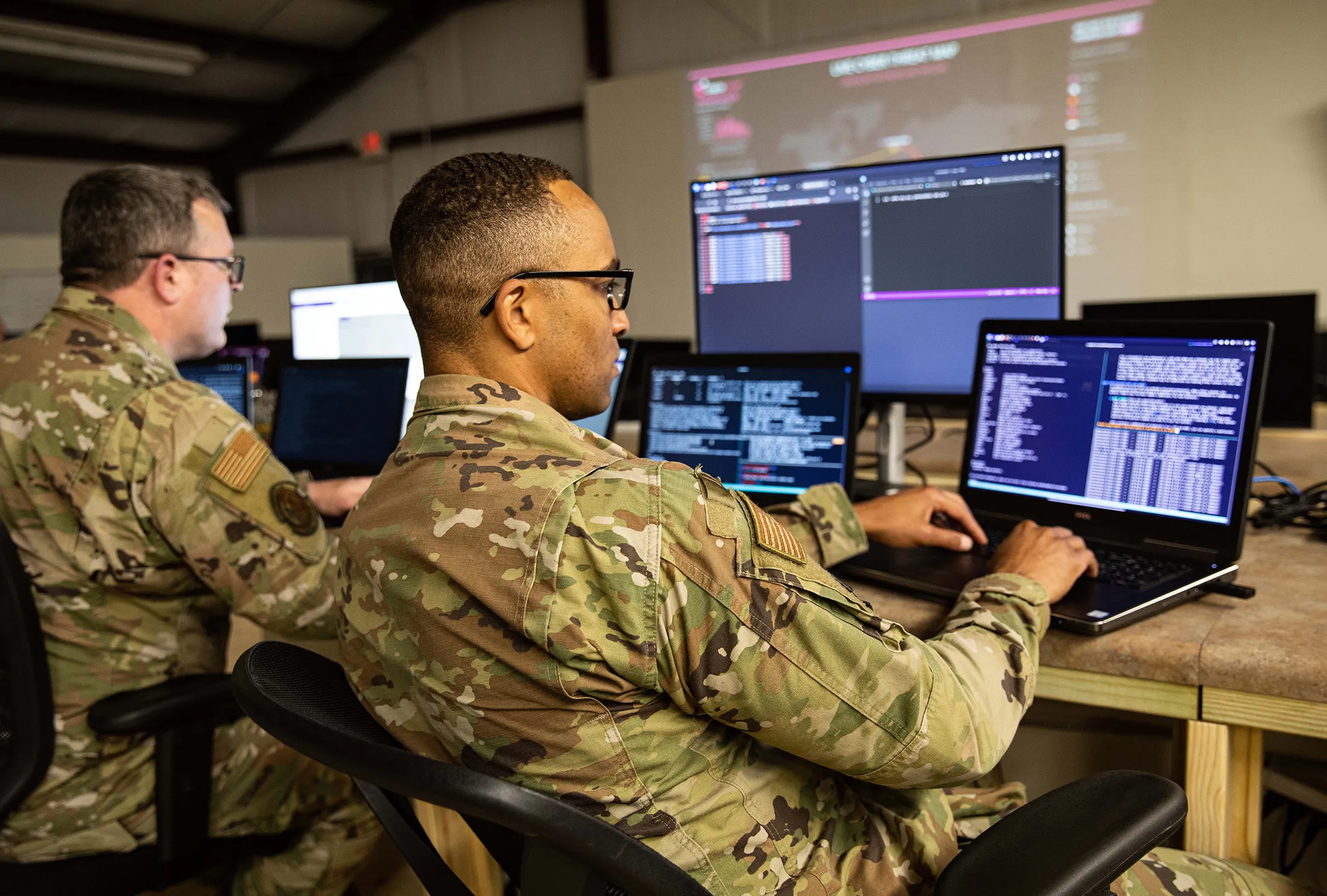
The US Army’s effort to develop an autonomous cyber agent has moved beyond an open call for ideas. The Cyber Fusion Innovation Center says one company was selected for an award on October 8 after an assessment event for a project called ECHOTRIBBLE. A statement of work and contract are still to follow. That distinction matters: the public record describes a proposed prototype and a selected solution, not a system already deployed against foreign networks.
ECHOTRIBBLE is an Agentic Command and Control Framework Tool being developed with Army Cyber Command and its Technology and Innovation Centre. Its stated purpose is to let software move through digital infrastructure, observe its surroundings and identify and neutralize threats or targets with minimal human oversight. The language is striking because it goes beyond using AI to summarize alerts for a human analyst. It points toward agents taking actions inside computer systems themselves.
The project was publicly solicited in July under notice W519TC-26-AE-ECHO. The procurement record calls for a modular prototype that can navigate digital environments, detect anomalies and operate in cloud, hybrid or disconnected settings. It also describes a low-observable design, limited remote communications and rules governing how an agent may move between systems. These are requirements for a proposed system, not proof that every capability works in practice.
According to the Cyber Fusion Innovation Centre, 65 whitepapers were submitted. Five teams presented during a virtual assessment from October 6 to 8, and one was selected. The organization has not named the company on its public event page. It says all participants were notified of their status on October 13. No public account we found establishes that a final contract has been signed, that a prototype has passed operational testing, or that ECHOTRIBBLE has been used in a live cyber operation.
The public project description refers broadly to threats and targets and says the system should support Army cyber defence operations. A separate investigation by The Intercept, based on additional contractor documents it reviewed, reports that offensive missions are the primary focus. That reporting suggests the agents could move across devices in an adversary’s network under predefined triggers. The underlying question-and-answer document cited in that report was not independently available to TechBooky, so the offensive emphasis should be attributed to The Intercept rather than presented as an unqualified Army announcement.
The risk is not only whether an agent can reach an intended target. It is what happens on the way there. Modern networks are interconnected, and an automated tool could encounter systems owned by civilians or allies. Even a well-defined target does not settle who approves a route, how the agent recognizes a protected system, or what forces it to stop when conditions change. Those questions become more urgent as the degree of autonomy increases.
An AI assistant that recommends a response leaves the decisive step to an operator. An agent authorized to inspect, move and act across machines can compress that decision cycle dramatically. In a military context, speed may help defenders find malware and contain attacks. The same speed can magnify a mistaken classification or an overly broad instruction. Transparent limits, testing and human accountability therefore matter as much as raw technical capability.
TechBooky has previously reported on AI agents probing websites during ordinary data searches. ECHOTRIBBLE is a different case because it is an intentional military development effort, but it raises the same underlying issue: software with tools and initiative may take consequential actions faster than its supervisors can understand them.
The next verifiable milestones are the statement of work, a signed contract, prototype testing and any disclosure of operational safeguards. Until then, the accurate headline is that the Army-linked programme has selected a proposal for an autonomous cyber tool. It is not yet evidence of an AI force conducting attacks on its own.
Related Reading
More contextual TechBooky stories selected from tags, categories and article context.
Paul Femi Balo is the founder and publisher of TechBooky. He covers artificial intelligence, African technology, digital infrastructure, enterprise technology and the global digital economy.
We use cookies to ensure that we give you the best experience on our website. If you continue to use this site we will assume that you are happy with it.