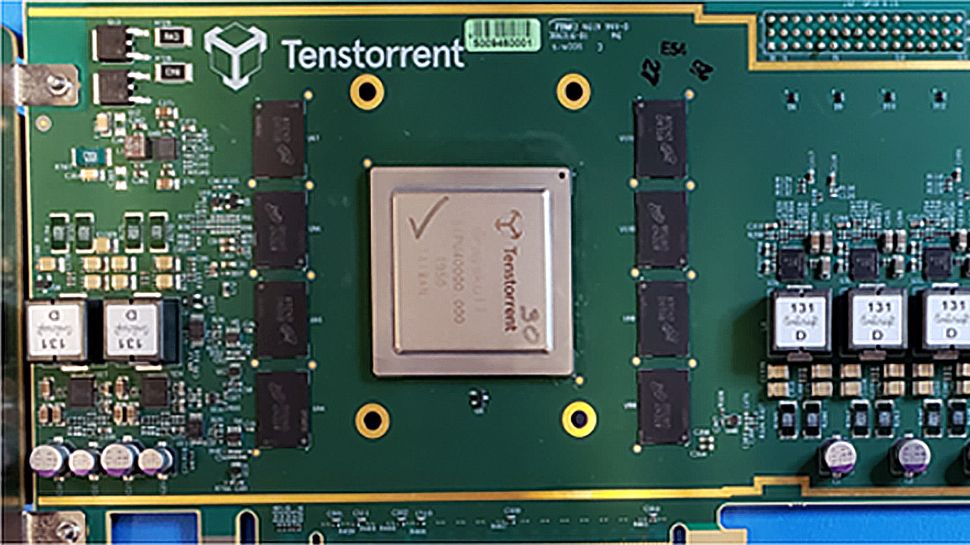
Tenstorrent has raised $1.5 billion in a Series E round, valuing the AI chip company at $6.2 billion after the investment. The financing gives a well-funded challenger to Nvidia more room to manufacture and sell its hardware, but the larger test is whether customers will adopt its systems and software at scale.
The company announced the deal on October 19. Trace Capital and Innovation X led the round, with participation from investors including ARK Invest, Fidelity Management & Research Company, Morgan Stanley, Sandisk and Tether Investments. Tenstorrent said it will use the proceeds to expand manufacturing and commercial deployment of its Galaxy servers, support open-weight language and video models, and develop chip designs that other companies can license.
The market for AI computing is still dominated by Nvidia, whose chips and software have become the default for many large model developers and cloud providers. Tenstorrent is taking a different route. It sells accelerator cards, workstations and servers, while also licensing processor designs to customers that want to build their own silicon. Its products use RISC-V technology, an open instruction-set architecture that gives chip designers more flexibility than a closed processor ecosystem.
That combination could appeal to companies and governments seeking greater control over the infrastructure behind their AI services. Some customers want models to run on their own premises or on systems built for a particular workload, rather than depend entirely on the largest cloud platforms. Tenstorrent is betting that an open software stack and licensable hardware will make those options more practical.
CEO Jim Keller has worked on prominent chip projects at Apple, AMD and Tesla. Tenstorrent says it licenses its TT-Ascalon CPU and Tensix AI cores to chip designers including Samsung and LG. The new funds are intended to turn that technical ambition into higher-volume production and broader sales, not merely another laboratory demonstration.
A large funding round does not establish that a newcomer can replace Nvidia in the workloads enterprises already run. Buyers care about developer tools, compatibility, reliability, supply and the cost of operating complete systems. Nvidia’s CUDA software ecosystem remains a formidable advantage, even as more startups pitch alternatives. TechBooky has covered a similar question in Positron’s effort to challenge Nvidia in AI inference.
Tenstorrent also faces a changing AI market. Demand is shifting from training ever-larger models toward running them efficiently for millions of users. That opens space for specialized inference hardware, but it also raises the bar for price, power use and deployment support. The company has not disclosed enough in its announcement to judge how much of the new capital is committed to server manufacturing versus research, or how quickly its customers will deploy the products.
The $6.2 billion valuation shows investors are willing to pay for a credible alternative as AI infrastructure spending spreads beyond a handful of suppliers. The outcome will depend less on the size of the round than on whether Tenstorrent can ship Galaxy systems in volume, give developers tools they can use without friction, and win repeat customers. For the wider market, that is the interesting part: more competition could eventually lower the cost and widen access to AI computing, but financing alone cannot deliver it.
Related Reading
More contextual TechBooky stories selected from tags, categories and article context.
Paul Balo is the founder of TechBooky and a highly skilled wireless communications professional with a strong background in cloud computing, offering extensive experience in designing, implementing, and managing wireless communication systems.
We use cookies to ensure that we give you the best experience on our website. If you continue to use this site we will assume that you are happy with it.