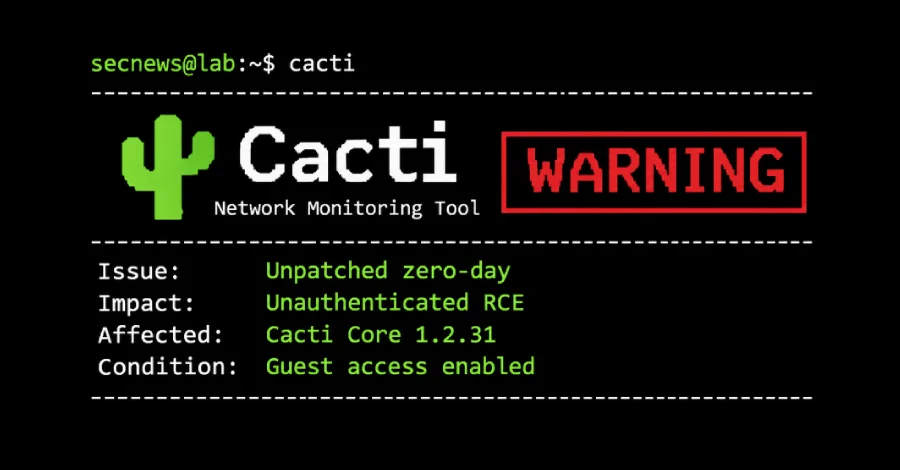
Administrators running Cacti have a newly disclosed security problem to assess. A public proof-of-concept exploit shows how an attacker can reach command execution on a vulnerable Cacti monitoring server without logging in, provided its guest account is enabled. As of 27 November, researchers say there is no confirmed vendor patch and no reported exploitation in the wild.
The issue was made public on 26 November by a researcher using the name ek0ms savi0r. Security firm watchTowr’s technical assessment says the demonstrated chain affects Cacti Core 1.2.31 with guest access enabled. BleepingComputer reports that earlier versions have not yet been ruled in or out.
What is the Cacti zero-day?
The exploit, called 4HTTP2SHELL or 4HTTP2ROOT, starts from an unauthenticated guest session. It abuses insufficient validation of a graph-display preference, allowing a value stored in Cacti’s database to influence a later query. The chain then changes a poller setting so that an operating-system command can run. The researcher demonstrated the route in four HTTP requests on a test installation.
This does not mean every Cacti deployment is vulnerable or that every successful exploit grants root access. The disclosed chain requires guest access, and the resulting privileges depend on the account running the web server and poller. On many systems that account is less privileged than root. Nevertheless, code execution on a monitoring server is serious because such servers can hold credentials and connection details for other network devices.
What should administrators do now?
Until Cacti publishes and confirms a fix, watchTowr advises administrators to disable the guest account and limit access to the Cacti web interface to trusted networks. Teams should also inspect poller settings for unexpected commands and review logs for warnings involving non-numeric graph-display values. These steps are mitigations, not a substitute for installing a verified vendor update when one becomes available.
Operators should first establish whether they use Cacti Core 1.2.31, whether guest access is enabled and whether the interface can be reached from the internet or other untrusted networks. A network inventory matters here. An old monitoring instance can be easy to overlook even when it has privileged visibility into routers, switches and servers.
The public proof of concept raises the urgency, but there is an important difference between a working demonstration and evidence of attacks in the wild. Neither watchTowr nor BleepingComputer had reported confirmed exploitation by 27 November. TechBooky has previously examined the wider challenge of protecting unpatched systems while vendors work on fixes.
Administrators should watch Cacti’s official release channels for a fixed version and reassess their exposure as more technical detail emerges. The immediate, defensible response is to remove guest access, narrow network reachability and check for signs that poller configuration has been changed. Claims that the flaw has already been exploited, or that it always provides root access, go beyond the evidence currently available.
Related Reading
More contextual TechBooky stories selected from tags, categories and article context.
Paul Femi Balo is the founder and publisher of TechBooky. He covers artificial intelligence, African technology, digital infrastructure, enterprise technology and the global digital economy.
We use cookies to ensure that we give you the best experience on our website. If you continue to use this site we will assume that you are happy with it.