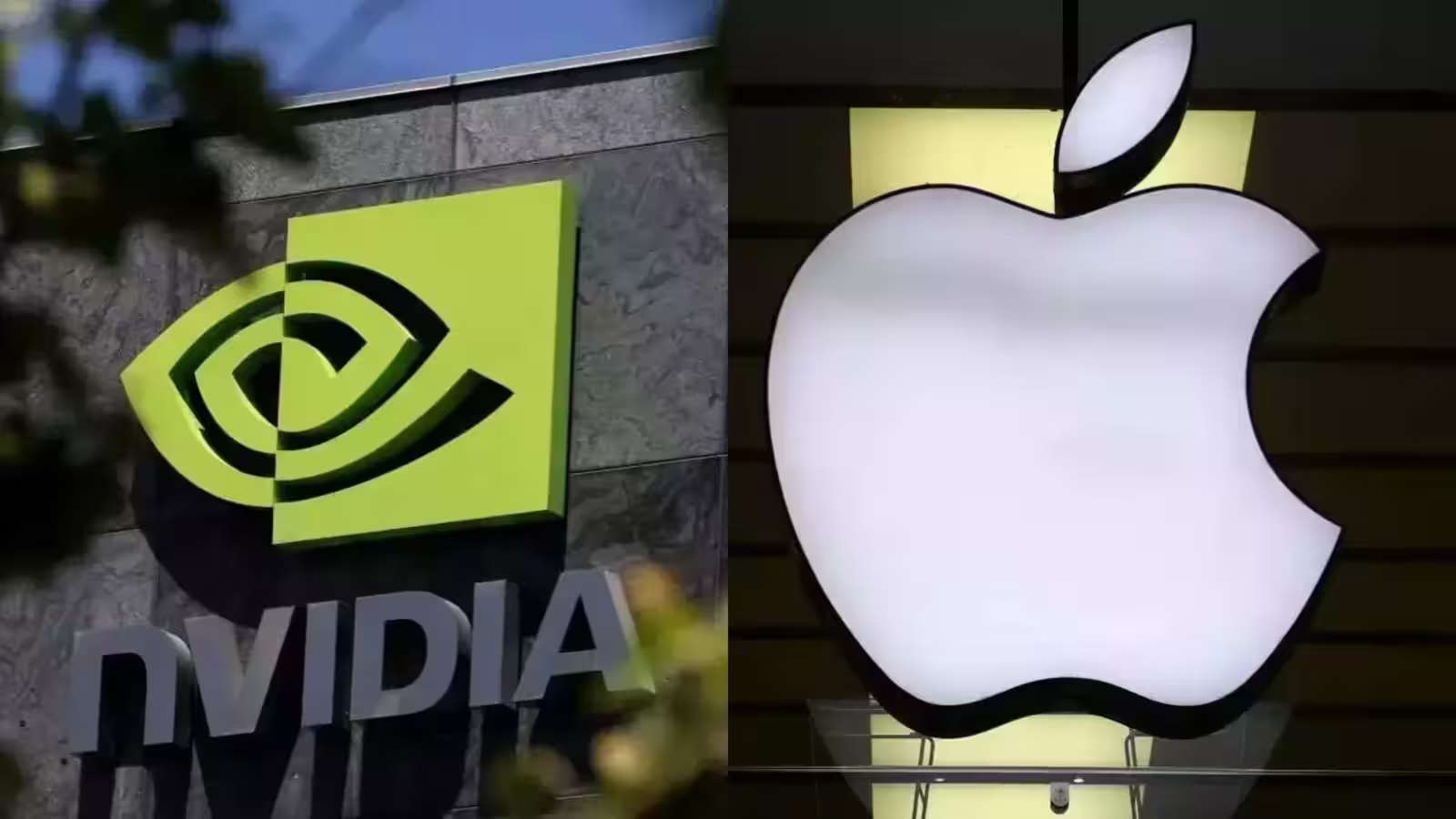
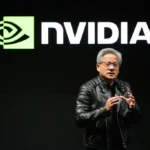
Apple and Nvidia spent Friday trading places at the top of Wall Street, a fitting snapshot of how unsettled the AI market has become. Apple briefly overtook Nvidia as the world’s most valuable company earlier in the session, only for Nvidia to regain the crown later as investors kept rotating between consumer tech stability and AI infrastructure risk.
Market reports put Apple’s value around US$4.91 trillion at one point on July 17, 2026, while Nvidia slipped below it before clawing back the lead. The final ranking can change with a few ticks in either stock, but the larger message is harder to miss: the market is no longer treating Nvidia’s AI-chip lead as an untouchable story.
That is why this follow-up matters. Apple did not simply win a scoreboard moment. Nvidia did not suddenly lose its strategic importance. What happened is more interesting: investors are now debating whether the next phase of AI value belongs mainly to infrastructure companies selling compute, or to platform companies that can put AI into devices, services and daily consumer habits.
Nvidia led the market because the AI boom needed chips, and no company captured that demand more directly. Cloud providers, AI labs, governments, startups and enterprise customers all needed GPUs, networking and systems to train and run models. Nvidia became the clearest public-market symbol of that buildout.
Apple’s path is different. Its value comes from a massive installed base, iPhone sales, services revenue, buybacks and the expectation that AI will eventually strengthen its ecosystem rather than replace it. Strong iPhone 17 demand and confidence around the next Siri and Apple Intelligence cycle have helped the stock regain momentum.
None of this makes Nvidia weak. The company remains central to AI training, inference, robotics, autonomous systems and data-centre expansion. Its products still sit inside the infrastructure layer powering much of the industry’s current AI ambition.
The concern is valuation and expectations. When a company becomes the market’s default AI bet, even good news can stop being enough. Investors begin asking whether hyperscalers are overbuilding, whether margins can stay high, whether rivals will catch up and whether model efficiency will reduce the need for endless compute growth.
That debate is now more visible because the AI model race is widening. Moonshot AI’s Kimi K3 topping a frontend coding leaderboard is one sign that the market must account for cheaper and increasingly capable models from China, not only U.S. labs running on the most expensive infrastructure.
Apple and Nvidia swapping places should not be read as a permanent verdict. It is better understood as a market signal. Investors still believe in AI, but they are becoming more selective about which companies deserve the highest valuations.
Chip suppliers are still seeing strong demand. The broader supply chain remains supported by the kind of momentum visible in TSMC’s AI chip demand and ASML’s stronger outlook. But stock prices often move ahead of fundamentals, and the AI trade has become crowded.
For Big Tech, the race at the top now reflects four competing strengths: Apple’s devices, Nvidia’s chips, Microsoft’s enterprise AI stack and Alphabet’s search, cloud and model ambitions. The most valuable company title may keep changing, but the underlying battle is about who captures the most durable profit from AI.
For now, the crown is no longer settled. Apple’s brief return to the top and Nvidia’s quick recovery show that the AI era is not removing volatility from tech. It is concentrating it at the very top of the market.
Related Reading
More contextual TechBooky stories selected from tags, categories and article context.
Paul Balo is the founder of TechBooky and a highly skilled wireless communications professional with a strong background in cloud computing, offering extensive experience in designing, implementing, and managing wireless communication systems.
We use cookies to ensure that we give you the best experience on our website. If you continue to use this site we will assume that you are happy with it.