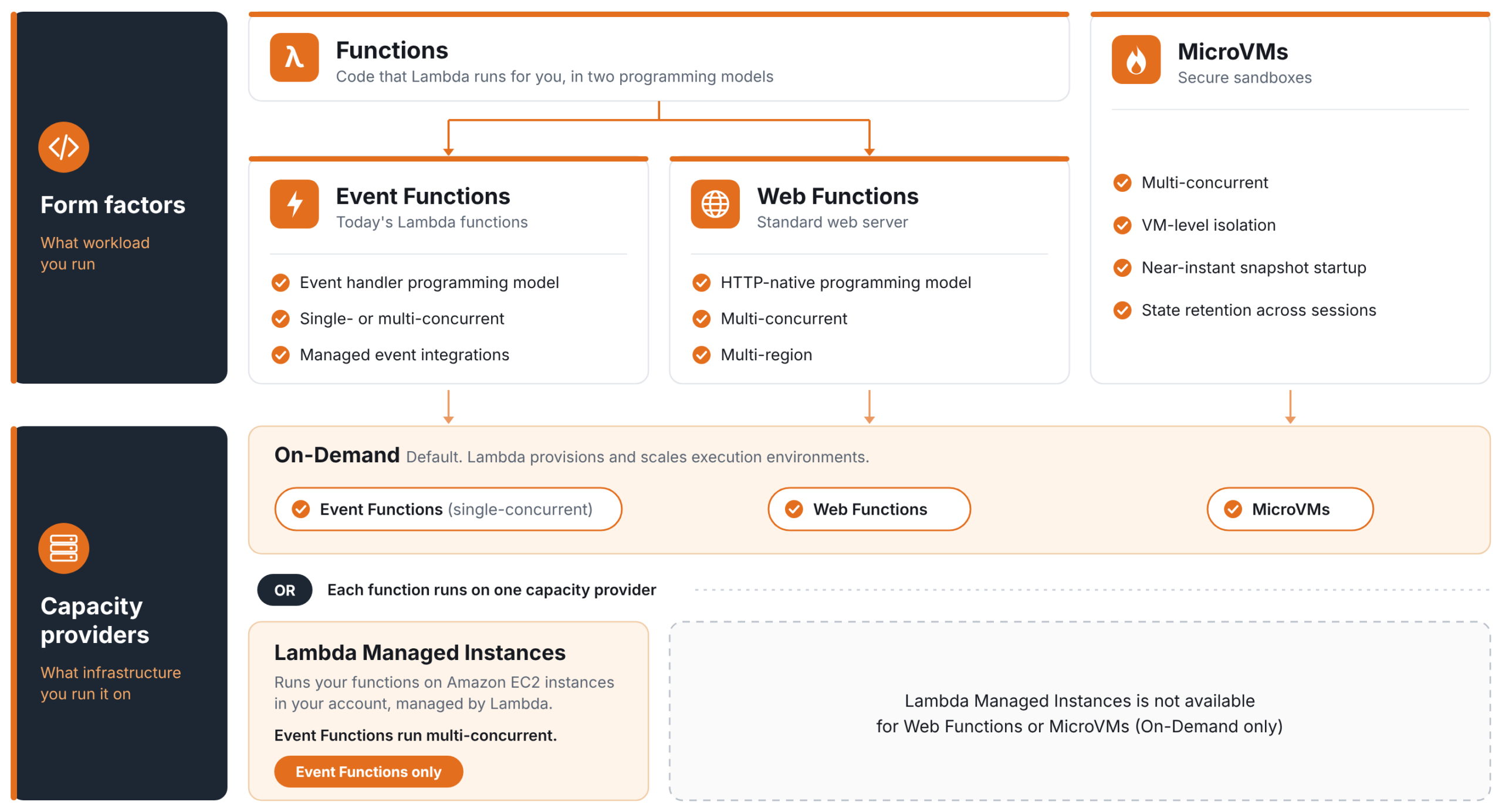
Amazon Web Services has doubled the maximum runtime for on-demand AWS Lambda Event Functions from 15 to 30 minutes. The change, announced on 19 November, gives developers more room to run lengthy serverless jobs without splitting a single task across several invocations.
The new ceiling applies to synchronous and asynchronous invocations and event source mappings for on-demand Event Functions. AWS says it is available in all commercial regions under standard Lambda pricing. It does not automatically extend existing functions, however. Developers must change the configured timeout if they want a function to run longer than its present limit.
AWS points to workloads such as AI inference, data processing and complex integrations. A developer might use the extra time to process a large document, transform a batch of records or complete a third-party workflow that regularly outlasted 15 minutes. The change may reduce the need to orchestrate some jobs through multiple Lambda calls, although it does not replace Step Functions or other tools where a workflow genuinely has several stages.
The AWS technical explanation also discusses integrations with Step Functions Standard and durable invocations. Teams should check the limits of the entire request chain, not just Lambda. An API, queue consumer, client connection or downstream service may still time out before a 30-minute function finishes.
A higher ceiling can make a design simpler, but it can also increase the cost and risk of a stalled invocation. Lambda billing continues for the duration a function runs, and long-running work holds concurrency for longer. If an event is retried after a failure, an expensive job may run again unless it has been designed to handle duplicates safely. Monitoring, cancellation behaviour and alert thresholds therefore become more important when a timeout is increased.
There are exceptions. AWS says Lambda Managed Instances support a 30-minute maximum for synchronous calls, while their asynchronous and event source mapping limits remain at 90 minutes. Some event sources have their own, shorter limits. The AWS documentation names Amazon MQ and DocumentDB among those still subject to a 14-minute ceiling, while older Kafka event source mappings may require separate treatment.
For developers, the practical takeaway is straightforward. The 30-minute option removes a familiar serverless constraint for many event-driven applications, but it is a configuration choice rather than a reason to let every function run longer. Teams should test the end-to-end path and use the extra time only where it clearly improves the design.
Related Reading
More contextual TechBooky stories selected from tags, categories and article context.
Paul Femi Balo is the founder and publisher of TechBooky. He covers artificial intelligence, African technology, digital infrastructure, enterprise technology and the global digital economy.
We use cookies to ensure that we give you the best experience on our website. If you continue to use this site we will assume that you are happy with it.