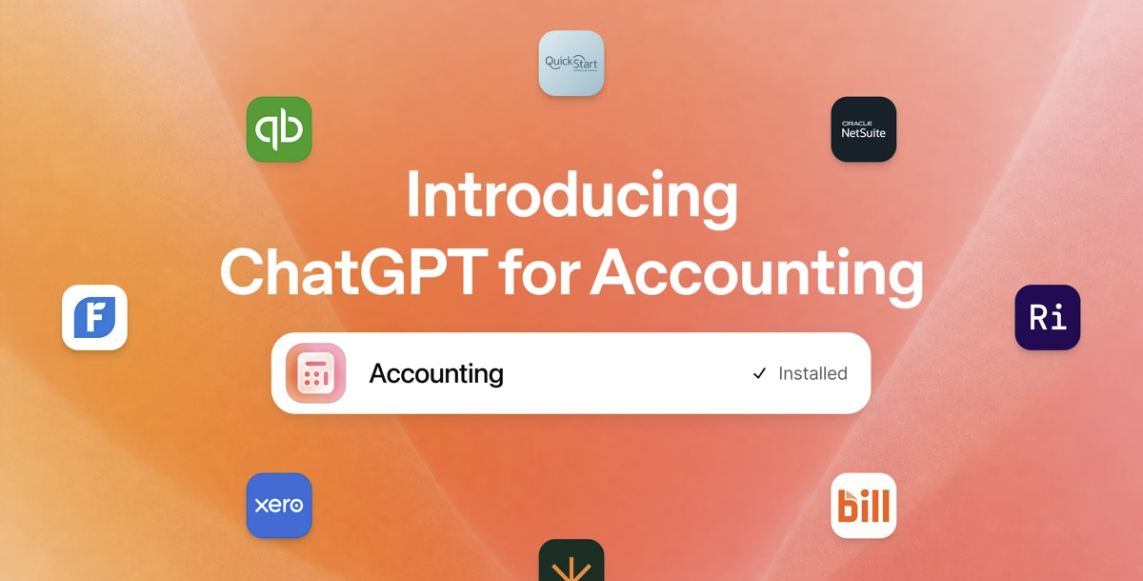
OpenAI has introduced ChatGPT for Accounting, a collection of tools intended to help finance teams work through invoices, reconciliations, month-end reporting and audit preparation with less manual handling. The offering combines an OpenAI-built Accounting plugin with separate partner plugins that connect ChatGPT to accounting systems including Intuit QuickBooks, Xero, Oracle NetSuite, BILL, FreshBooks, Rillet and Campfire.
The distinction matters. The Accounting plugin supplies guidance for accounting tasks, while the partner connections determine what records ChatGPT can access and which actions it can take in a particular service. It is not a single new accounting system, and installing the main plugin does not automatically grant access to every company’s books.
According to OpenAI’s product page, users can bring together invoices, bank statements, payment records and workbooks to prepare draft entries, reports and reconciliations. ChatGPT can suggest account coding, identify missing details and compare workpapers with supporting records to flag possible duplicates or unexplained differences. It can also reuse templates and review checks for recurring monthly work.
A practical example is bank reconciliation. A finance team could provide a bank statement and its general ledger for the same period, then ask ChatGPT to identify unmatched transactions, distinguish timing differences from likely errors and explain what remains unresolved. Another is a month-end workbook review, where the assistant can look for broken formulas or inconsistent totals and point the accountant to the cells requiring attention. These are aids to review, not a substitute for sign-off.
The Accounting plugin listing includes integrations for QuickBooks, Xero, NetSuite, BILL, FreshBooks, Rillet and Campfire. OpenAI’s setup guidance says availability depends on the user’s plan, plugin and workspace settings. ChatGPT Business members can install Accounting without prior administrator approval, while an Enterprise administrator must approve it for their workspace. Individual app connections can require further permissions or approval.
Accounting work carries consequences that are different from drafting an ordinary document. An incorrectly coded invoice or incomplete reconciliation can flow into management reporting, tax work and audits. OpenAI says users should review source records, calculations and suggested entries before approving them. Workspace administrators choose which apps are enabled, and connected tools respect the permissions users already have.
OpenAI says data from ChatGPT Business and Enterprise is not used to train its models by default. That does not remove the need for a company to assess each partner plugin’s access, data handling and supported actions before connecting financial records. A read-only connection is materially different from one that can create or change entries.
The launch extends OpenAI’s effort to make ChatGPT a place where business work is completed, not merely discussed. TechBooky previously covered its move to let companies build a presence and agents inside ChatGPT. Accounting gives that broader strategy a specific, high-stakes workflow. Its appeal will depend on whether it saves time while leaving finance professionals with a clear audit trail and the final judgement.
Related Reading
More contextual TechBooky stories selected from tags, categories and article context.
Paul Femi Balo is the founder and publisher of TechBooky. He covers artificial intelligence, African technology, digital infrastructure, enterprise technology and the global digital economy.
We use cookies to ensure that we give you the best experience on our website. If you continue to use this site we will assume that you are happy with it.