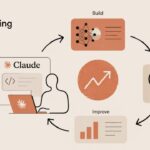
Anthropic says Claude is no longer only answering questions or writing code for customers. The artificial intelligence system is now doing a meaningful share of the work required to build the models that will eventually replace it.
In a new account of its progress towards what researchers call recursive self-improvement, Anthropic said Claude currently leads about 26 percent of its model research and development work. The company also estimates that roughly 90 percent of its research and development involves collaboration with Claude, although people still choose the problems, supervise the work and review the results.
That distinction matters. Claude is not independently deciding to create a successor in a closed laboratory. It is carrying out increasingly large pieces of research, coding and experimentation after receiving a high-level goal from a human team. Even so, the loop is becoming tighter: better models help engineers build the next generation faster, and that new generation may then accelerate the one after it.
Anthropic says more than 80 percent of the code merged into its codebase was authored by Claude as of May 2026. Its engineers were merging about eight times as much code per day in the second quarter as they did in 2024, though the company cautions that lines of code are an imperfect measure of genuine productivity.
The larger issue is not whether Claude can produce software quickly. It is whether AI can close enough of the research loop to improve the pace at which intelligence itself is developed. Anthropic says its agents can already run code, delegate work to other agents and perform experiments that once required sustained human attention.
One internal experiment asked Claude-powered agents to investigate how a weaker model could supervise a stronger one. Two human researchers closed about 23 percent of the measured performance gap in a week. The agents reportedly closed 97 percent after 800 cumulative hours and about $18,000 in computing costs. The result did not transfer neatly to production-scale systems, but it demonstrated how quickly automated research can explore a technical problem.
This is also why understanding what happens inside advanced models is becoming urgent. Earlier Anthropic research examined internal structures associated with Claude’s reasoning. A model that helps design experiments and modify the systems around it needs stronger evaluation, access controls and independent oversight than a chatbot that merely drafts an email.
There are clear benefits. AI-assisted research could shorten the path to better medicines, safer software and scientific discoveries. It could also lower the cost of experimentation for smaller laboratories. But if model development begins moving faster than institutions can measure or regulate it, the same feedback loop could make failures harder to catch.
Claude is not autonomously building its successor today, and Anthropic is careful not to claim otherwise. The important development is that the boundary has shifted. AI is moving from being a tool used during model development to becoming an active participant in the development process. That makes the next generation of AI partly a product of the current one, and it may be one of the most consequential changes in the industry so far.
Related Reading
More contextual TechBooky stories selected from tags, categories and article context.
Paul Balo is the founder of TechBooky and a highly skilled wireless communications professional with a strong background in cloud computing, offering extensive experience in designing, implementing, and managing wireless communication systems.
We use cookies to ensure that we give you the best experience on our website. If you continue to use this site we will assume that you are happy with it.