Anthropic has published a useful look at one of the biggest questions in AI: what happens when AI systems begin helping build better AI systems?
The company says Claude now writes a significant share of Anthropic’s own code. In its research note on recursive self-improvement, Anthropic says that as of May 2026, more than 80 percent of code merged into its codebase was authored by Claude, a sharp jump from the low single digits before Claude Code entered research preview in February 2025.
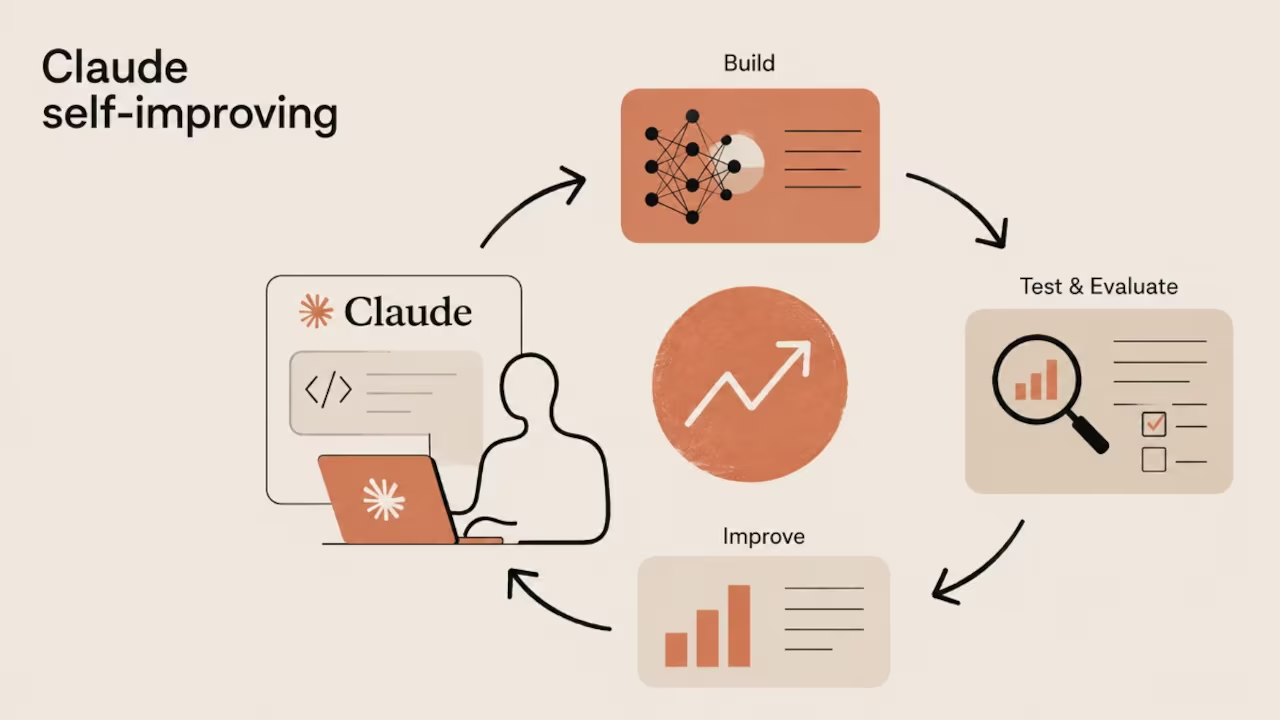
Recursive self-improvement sounds dramatic, but the basic idea is simple. If AI helps researchers write code, debug models, run experiments, analyse results and design better tools, then AI development itself speeds up. The system is not necessarily waking up and improving itself without humans. But it may be making the humans who build AI much faster.
That difference matters. The scary version of the story is a runaway machine that autonomously builds a more powerful successor and quickly escapes human control. The more realistic near-term version is quieter: AI labs use coding agents and research assistants to increase engineering output, test more ideas and shorten development cycles. That may still be transformative.
Anthropic’s point is that the feedback loop is already visible inside AI labs. Claude helps write the tools and code used to train, evaluate and deploy future AI systems. If that assistance improves model development, then better models may improve the assistance, which then speeds development again. That is the loop researchers are watching.
The company is careful not to say that runaway self-improvement has arrived. That caution is useful. A high percentage of AI-authored code does not mean the AI understands the whole research agenda, makes strategic decisions alone or can safely replace human judgment. Code volume is not the same as scientific autonomy.
Still, the direction is important. We have already seen AI agents become powerful enough to create security concerns when given tools and goals. We have also seen loss-of-control incidents rise as more people experiment with autonomous systems. If the same agentic abilities are used inside frontier AI development, oversight becomes even more important.
The business implications are also large. If one lab can use its own models to make its engineers several times more productive, the AI race accelerates. Smaller teams can do more. Large labs can test more ideas. Compute becomes even more valuable because the bottleneck shifts from human coding time to experiments, data, evaluation and infrastructure.
That is why this story connects with open-weight AI too. If AI-assisted development becomes widely available, more researchers outside the largest labs may be able to build useful systems. But the most advanced labs will still have the advantage of compute, proprietary data, talent and deployment scale.
The policy question is whether society can keep up with the feedback loop. If AI development cycles shorten, regulation, safety testing and public understanding may lag even further behind. Anthropic is right to draw attention to recursive improvement before it becomes a crisis slogan. The world needs to understand the ordinary, practical version first.
The most interesting conclusion is not that AI is about to build itself without humans. It is that humans building AI may soon look very different from humans building old software. They will supervise agents, shape experiments, audit outputs and decide when to trust the machine’s work. That is still human-led, but it is a new kind of human-led development.
Related Reading
More contextual TechBooky stories selected from tags, categories and article context.
Paul Balo is the founder of TechBooky and a highly skilled wireless communications professional with a strong background in cloud computing, offering extensive experience in designing, implementing, and managing wireless communication systems.
We use cookies to ensure that we give you the best experience on our website. If you continue to use this site we will assume that you are happy with it.