Bangladesh is witnessing an unprecedented digital payment revolution. A country of over 170 million people, where currencies reigned only a decade prior, now exhibits phenomenal growth in cashless transactions. Payments in Bangladesh by 2026 are helping millions to make it a part of their life.
Mobile financial service platforms have a significant role in this transformation. Services such as bKash, Nagad and others have transformed basic money transfer into complete financial ecosystems. This provided new avenues for business: a growing number of merchants are looking at scalablebangladesh payment gateway that offers wallets and card acquiring in a single stack.
The Local Ecosystem and the Role of Mobile Financial Service
Leading Digital Payment Providers in Bangladesh: bKash, Nagad & Rocket
The e-payment market has great decorum in Bangladesh. Three players are in the catbird seat:
bKash — the undisputed leader with multi-million audience. Introduced in 2011, the service became virtually synonymous with mobile money for Bangladeshis.
Nagad — the postal department’s market-cracking project which struck gold in a matter of years through aggressive marketing and nominal fees.
Rocket — a mobile finance pioneer of Dutch-Bangla Bank, holding strong positions.
Transaction through MFS is more than 1 billion dollars a month, according to Bangladesh Bank. These are not mere numbers — this is a testament to how digital financial services have reached every nook and cranny of the country.
How MFS Platforms are Cutting the Cash Cycle
Bangladesh was typically a cash-based economy. People were paid in cash, paid for goods in cash, saved money under mattress. MFS platforms broke this cycle. Now migrant workers can transfer money to villages in seconds, and their relatives can get cash without journeys into the city.
This is particularly relevant as mobile financial service solved the problem of “last mile”. bKash or Nagad agents can be found even in the most remote and inaccessible places, where there are no bank branches. This is true inclusive finance — everyone, everywhere has access to financial services.
How QR-based Payments Changed Small Merchants
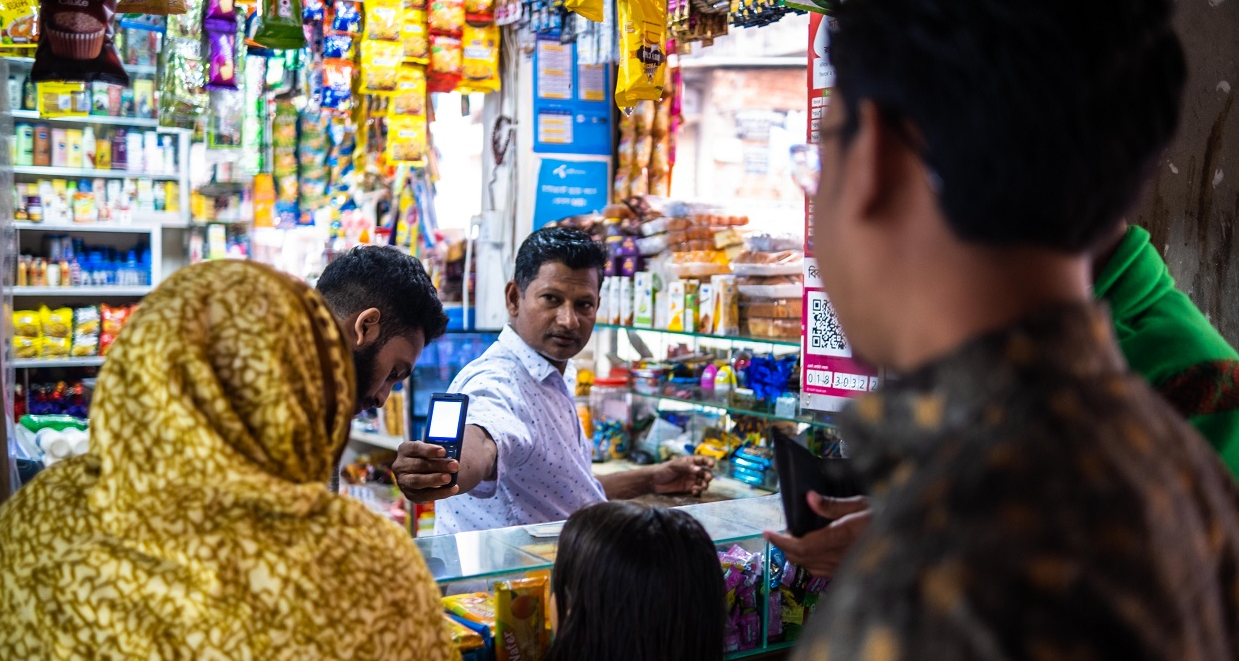
QR code payments are the next evolutionary step. Small shops, street vendors, rickshaws — they all began accepting digital payments through basic QR stickers. The customer scans the code, and boom, seller gets money. No terminals, no complexity.
For small merchants, this means:
No need to carry cash
Reduced risk of robberies
Transparent revenue accounting
Access to micro-lending based on transaction history
Digital Financial Services: Things Beyond Payments
How Digital Financial Solutions for Businesses Have Evolved
While earlier MFS were limited to P2P transfers, nowadays digital payment platforms feature a full stack of B2B solutions. Companies can:
Direct payment of employee salaries into wallets
Pay supplier bills
Accept payments from customers online
Integrate e-commerce platforms with a payment gateway
The evolution of online payments is particularly illustrative. Consumers in Bangladesh increasingly purchase goods from social networks (F-commerce) and pay through bKash or Nagad. This spawned a whole industry of dropshipping and small business online.
Digital Payment Platforms for Savings, Micro-loans and Insurance
MFS was no longer just a transfer tool. Today they offer:
Product
How it works
Impact
Savings accounts
You store money in a wallet and get a percentage on the deposits
Forming a saving habit
Micro-loans
Based on transaction history, short term loans are extended
Enabling access to capital for small business
Insurance
Provide micro insurance, premiums debited from the wallet
Protect against unexpected costs
Welcoming such initiatives, Bangladesh Bank considers it a tool to include people in the formal economy and actively gives support.
Improving User Experience in Digital Financial Services
Success factor of MFS is simplicity. The interfaces of mobile apps are customized for users with any level of digital literacy. USSD codes allow operations even on basic phones. This is particularly vital for rural people and the elderly.
The Role of Infrastructure and Regulation on Payments in Bangladesh
The Growing Trend of Account-to-Account and Interoperable Payments
According to Bangladesh Bank, they are continually heading towards an interoperable payment system. A2A (account-to-account) mechanism enables users to transfer money without intermediaries between different MFS. For users, this means:
Instant transfers to any wallet
All operators accept unified QR codes
Lower fees
Regulatory Framework for Sustainable Digital Payments in Bangladesh
Bangladesh regulatory landscape is developing rapidly. Bangladesh Bank implemented:
Tight KYC rules
Limits on transactions to prevent money laundering
Mandatory certification of security measures for MFS
Consumer protection rules
This engenders trust in digital payment services. Users can be confident their money is protected and that if things go wrong, they can talk to the regulator.
Simplifying Cross-Border Finance and Inward Remittances
Bangladesh is among the countries with the largest remittance receiving from labour migrants. Over $20 billion comes into the country every year. Traditionally, that money passed through banks and Western transfer systems, which is costly and time-consuming.
Today, digital payment platforms are emerging as key players in inbound remittances. Partnerships with international providers enable direct crediting of money to recipients’ wallets. This:
Reduces transaction costs
Accelerates crediting (minutes rather than days)
Brings recipients into the digital economy
Market Challenges: Breaking the Cash-Out Cycle
International Gateway Limitations
Global gateways such as PayPal and Stripe are not integrated with Bangladesh’s MFS giants like bKash and Nagad. Merchant dollar inflows are similarly constrained because stringent Bangladesh Bank forex controls, cumbersome cross-border compliance, and poor conversion rates compel merchants to search for local options for international payments.
Settlement Challenges
The “cash-out trap” is still in place: users get digital payments, but then cash out because merchants’ acceptance remains patchy. The high withdrawal fees make the services themselves lose value, and the slow B2B settlement cycles together with legacy system integration delays create working capital gaps for businesses. Settling the next day is still the exception, not the rule.
Reimagining Bangladesh’s Digital Payments to Reduce Costs
The challenge of MFS in Bangladesh is the “cash-out trap.” Users actively use wallets to collect money, but prefer cashing it out instead of spending it in a cashless manner. The reason: merchants rarely accept digital payments, or they do so grudgingly.
The answer lies in building accepting infrastructure. As more outlets begin taking QR and mobile payments, the less there is a need for cash-out. bKash and Nagad have already built a network of hundreds of thousands of agents, but there is still a lot left to be done.
Why B2B Payments Are Still a Digital Transformation Challenge
B2B lags behind the consumer segment. Reasons:
Complex integration with legacy accounting systems
Suspicion of digital channels for large sums
Lack of standardized invoice formats
Practice of dealing in checks and cash
However, progress exists. Large organizations are beginning to integrate a bangladesh payment gateway with their ERP systems, and banks offer corporate API solutions.
Security in MFS Transactions: Challenges and Solutions
As volumes of digital payments increase, so do the risks. Fraud, phishing and social engineering are major problems. The response from Bangladesh Bank and MFS operators:
Implementing two-factor authentication
Educational campaigns for users
Real-time fraud monitoring systems
Insurance of funds in accounts
Looking Ahead: The Future of Digital Transformation
Gen Z Together: How Fintech and Banks Can Join Forces for Progress
Bangladesh’s younger generation are digital natives. They don’t know life without smartphones and demand the same ease of access to financial services as they get in social networks. The implication for banks and fintech is the need to collaborate.
Banks have licenses, capital and trust. Fintech has technology, speed and UX. Their collaboration can lead to products that finally leave cash out of daily life. Even now we see examples of successful partnerships when bank cards are associated with MFS wallets.
Impact of AI and Blockchain in Financial Transactions within Bangladesh
Next-gen tech is starting to break into Bangladeshi fintech:
AI is used for borrower scoring, offer personalization, and fraud prevention.
Blockchain serves as a cross-border transfer tool and for transaction transparency.
Biometrics (fingerprints, face recognition) streamline the authentication process.
Bangladesh Bank is assessing the feasibility of introducing a central bank digital currency, which will be the next frontier of the digital revolution.
The digital payment scenario in Bangladesh has changed over the years from cash-dominance to a wide range of digital tools. Mobile financial services emerged as the foundation, giving millions of people access to financial services. Today, payments in Bangladesh are not just transfers but loans, savings, insurance and complex B2B solutions.
But ahead lie other challenges: interoperability, security, business acceptance. But the trend is indubitable — toward a cashless economy. The companies that are able to provide convenient, secure and ubiquitous digital payment solutions will become the leaders of the next decade. And an efficient bangladesh payment gateway blending wallets and cards is an essential tool for this growth.
Related Reading
More contextual TechBooky stories selected from tags, categories and article context.
We use cookies to ensure that we give you the best experience on our website. If you continue to use this site we will assume that you are happy with it.