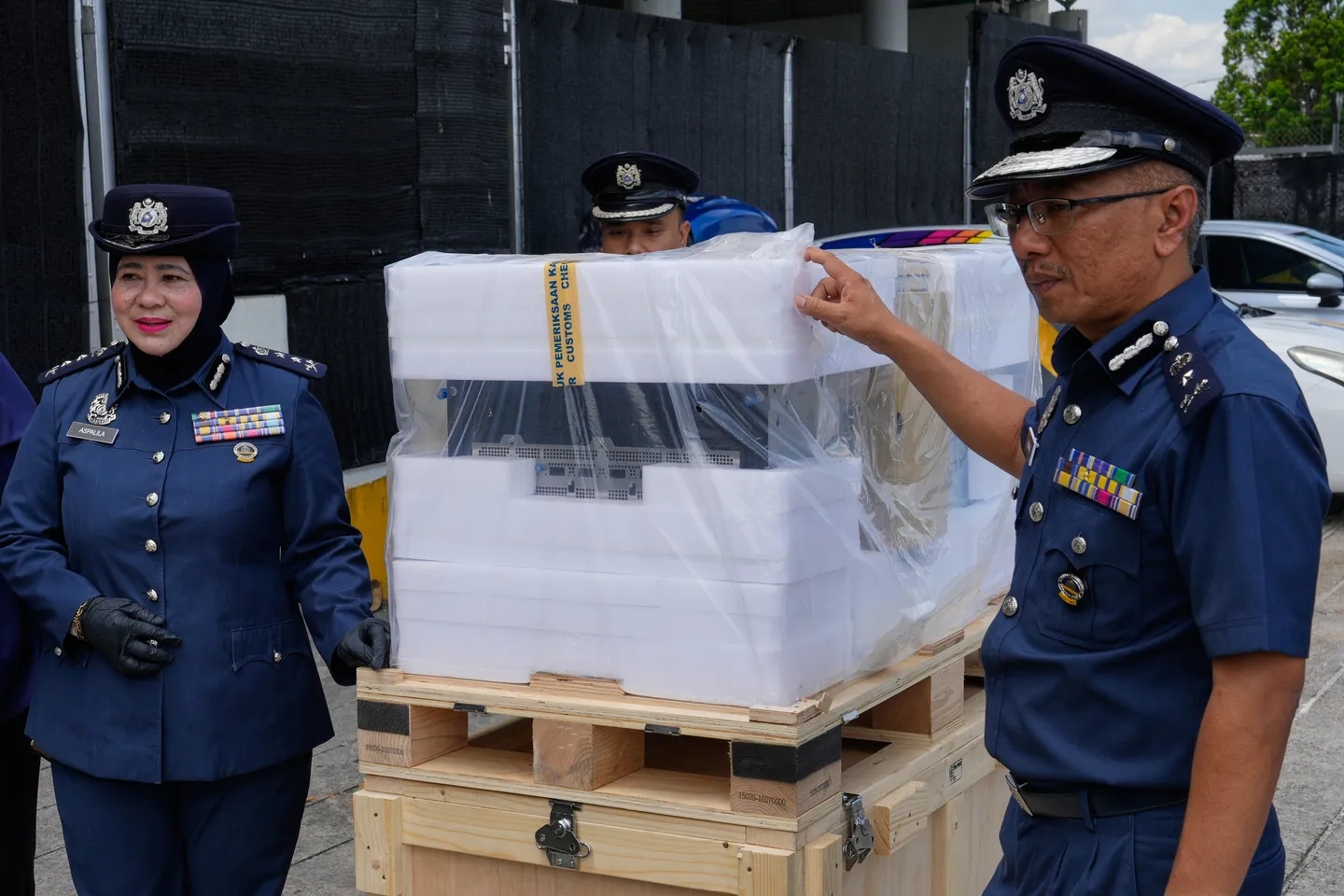
Malaysia’s customs authorities have seized 30 servers containing advanced artificial intelligence chips at Kuala Lumpur International Airport, in a case that puts the country’s role as an AI-hardware transit hub under fresh scrutiny. The shipment was valued at about 49.5 million ringgit, or $12.1 million. Officers inspected and intercepted it on 15 October 2026, but customs disclosed the case at a press briefing on 28 October.
Airport customs director Aspalila Ag Tuah said the servers arrived from one Asian country and were intended for another. They had been declared as ordinary electronic components, according to Reuters’ account of the customs briefing. Investigators suspect that Malaysia was being used as a transit point to move the hardware without the required trade authorisation. The shipment’s country of origin, intended destination and chip brand have not been publicly identified.
Customs believes the latest shipment may be connected to a network implicated in at least five cases this year. The department said the combined value of the seizures exceeds 100 million ringgit. In June, officers at the same airport seized 72 servers containing advanced AI chips in a separate suspected smuggling attempt. A Malaysian company involved in facilitating the October shipment has been asked to assist the investigation, but officials have not identified it publicly.
The allegations remain under investigation. The fact that the servers were seized does not, by itself, establish who bought the chips, where they were made or whether they were ultimately bound for China. Those distinctions matter in a market where legitimate cloud operators, equipment distributors and logistics companies routinely move high-value computing hardware across borders.
The case is about more than an unusual cargo declaration. AI servers contain processors that can be used to train and run powerful models, making access to them a strategic question as well as a commercial one. Washington has restricted some advanced semiconductor exports to China, while companies continue to build computing capacity across Asia. A transit shipment can therefore attract scrutiny even when neither the buyer nor the final destination has been confirmed publicly.
Malaysia has its own rules for this trade. Its Ministry of Investment, Trade and Industry said in July 2025 that exports, transit and transhipment of high-performance AI chips of US origin require a strategic trade permit. The ministry’s industry guidance also tells traders how to assess covered chips and seek a determination before moving them. Because the origin and specifications of the seized chips are undisclosed, it would be premature to state that this particular shipment involved US-made hardware.
The wider policy debate has two sides. Governments want to prevent sensitive technology from being diverted, while businesses need rules that do not treat every cross-border movement of AI equipment as suspect. Clear documentation and reliable end-user checks become more important as more companies ship complete servers rather than individual processors.
TechBooky has previously examined how AI chip export controls shape the global compute race. The Malaysian seizure shows how those rules are tested in practice. Enforcement depends not just on restrictions written in Washington or Kuala Lumpur, but on what customs officers can verify when a shipment crosses a free-trade zone.
For now, the confirmed development is a seizure and an active investigation. Whether prosecutors bring charges, and whether authorities identify the hardware’s manufacturer or intended end user, will determine how much this case reveals about the route advanced AI chips are taking through Southeast Asia.
Related Reading
More contextual TechBooky stories selected from tags, categories and article context.
Paul Femi Balo is the founder and publisher of TechBooky. He covers artificial intelligence, African technology, digital infrastructure, enterprise technology and the global digital economy.
We use cookies to ensure that we give you the best experience on our website. If you continue to use this site we will assume that you are happy with it.