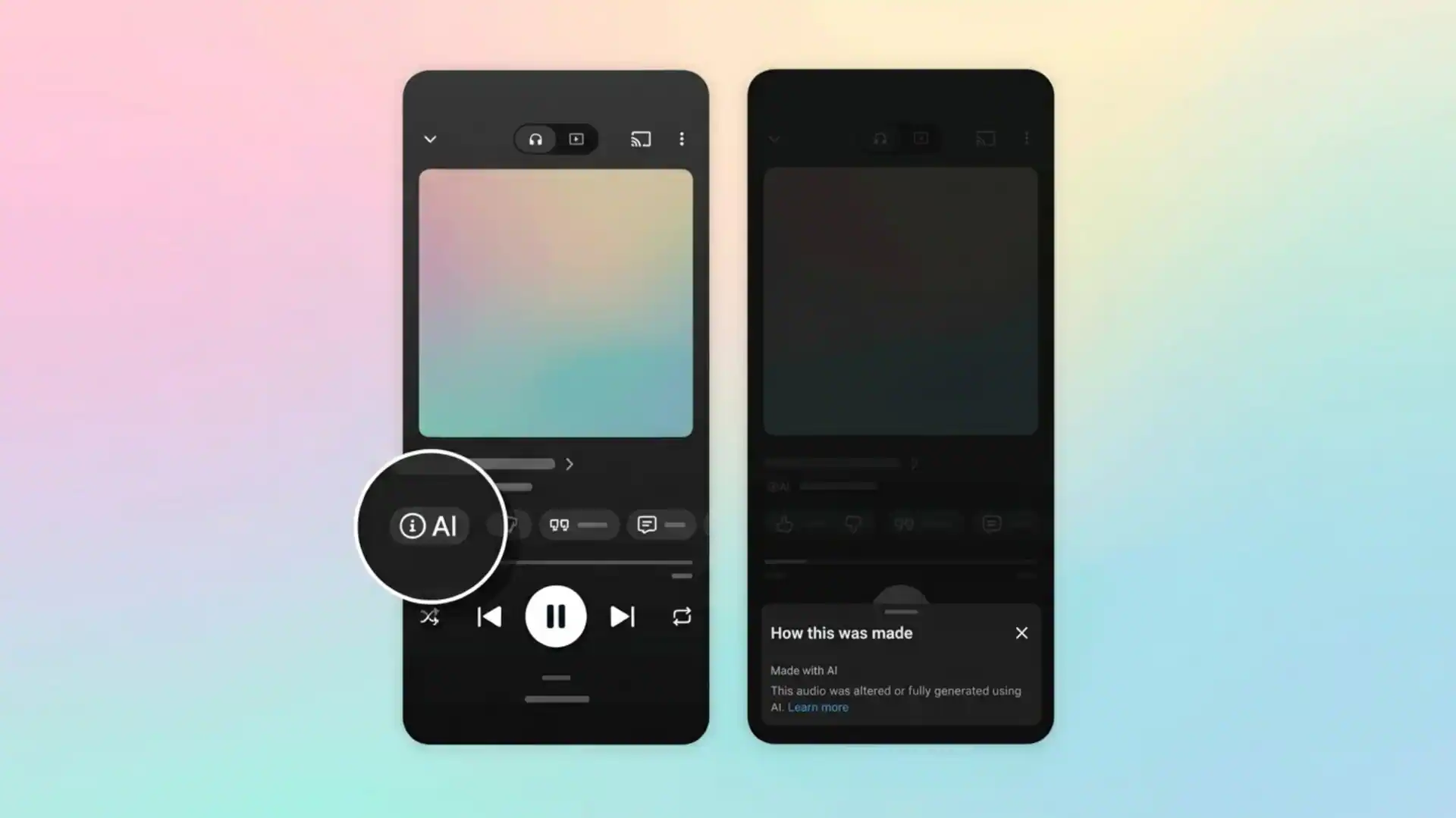
YouTube Music has begun rolling out labels for songs created primarily with generative artificial intelligence, putting a disclosure where listeners will see it while a track plays. The change addresses a simple question that has become harder to answer as AI music tools improve: was the song made by a person, or did a model generate most of what is being heard?
According to YouTube’s October 14 announcement, the label appears on the player page when AI played a significant role in a track. Tapping it opens more information about the song’s AI involvement. YouTube gives the example of a model generating both the composition and vocals. The company says the disclosure will later extend to the main YouTube app.
The wording matters. YouTube says it is targeting music made primarily with generative AI, rather than declaring that every song touched by an AI tool must carry the same label. Musicians already use software for editing, mastering and production. A disclosure system that fails to distinguish assistance from generation could confuse listeners as much as a missing label does. YouTube has not published a comprehensive threshold covering every possible production workflow in its announcement.
YouTube says it will work with music partners and use its own detection tools to identify qualifying tracks. That creates two immediate questions for the rollout. How accurately can the platform identify AI-generated music when uploaders do not disclose it? And what happens when artists disagree with a label? The announcement does not provide an error rate or a detailed appeals process, so the effectiveness of the system will depend on how it performs in practice.
This is becoming an industry-wide contest over trust. AI tools can generate large volumes of songs at low cost, while artists and rights holders want audiences to know how music was made and who should receive credit. A visible label will not resolve copyright, training-data or royalty disputes by itself, but it gives listeners a piece of information that was previously easy to miss. TechBooky has also covered Deezer’s tool for detecting AI-generated tracks and Apple Music’s transparency tags.
For YouTube Music, the challenge now is consistency. The label needs to be understandable, applied fairly and visible across the catalogue, not only on obvious synthetic tracks. If it works, listeners will be better placed to choose what they hear while human and AI-assisted creators compete on the same platform.
Related Reading
More contextual TechBooky stories selected from tags, categories and article context.
Paul Balo is the founder of TechBooky and a highly skilled wireless communications professional with a strong background in cloud computing, offering extensive experience in designing, implementing, and managing wireless communication systems.
We use cookies to ensure that we give you the best experience on our website. If you continue to use this site we will assume that you are happy with it.