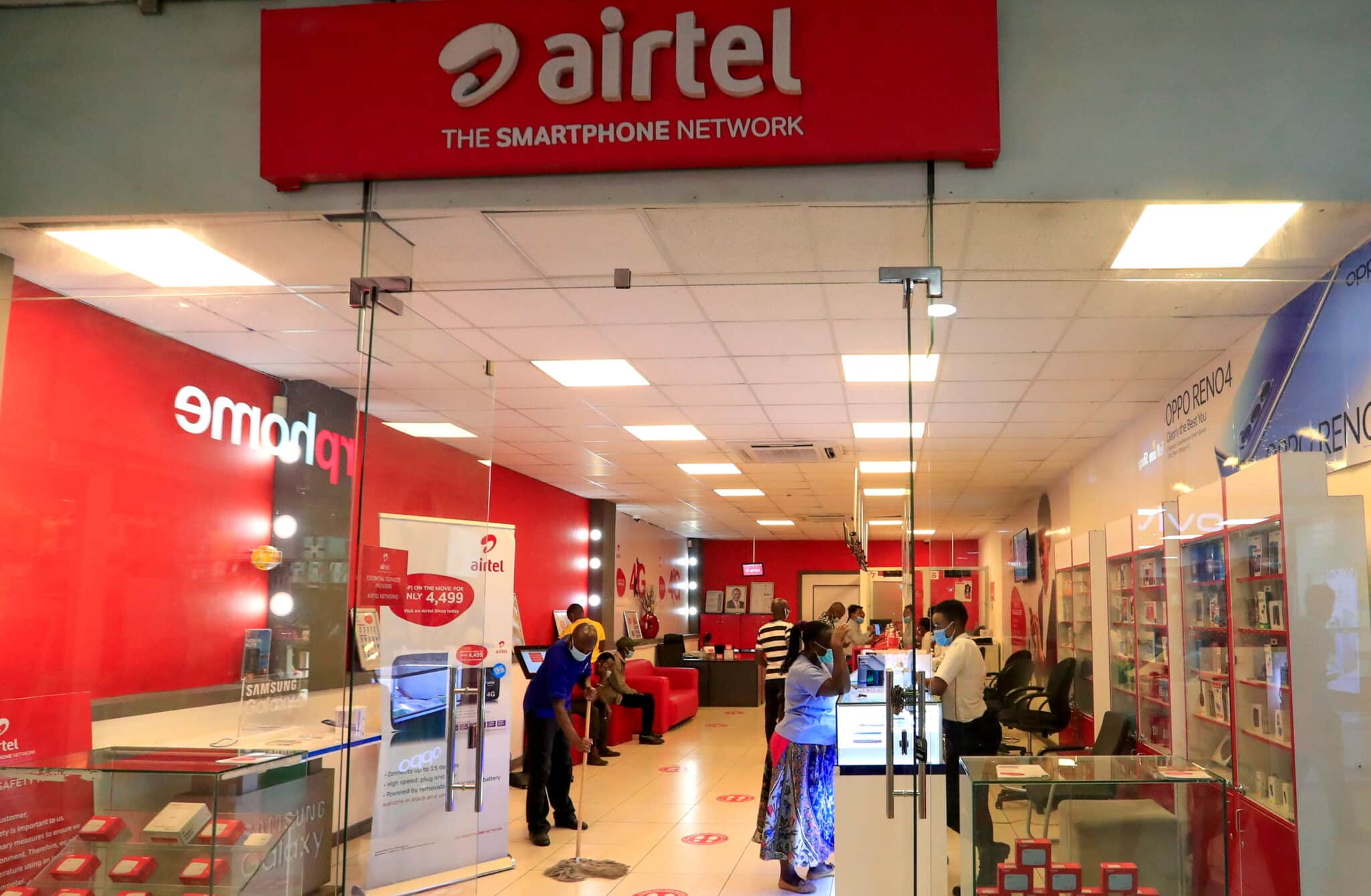
FILE PHOTO: A general view shows customers and employees inside a mobile phone service centre operated by Kenyan telecom operator Airtel Kenya at the Sarit Centre within the Westlands district of Nairobi, Kenya January 29, 2021. REUTERS/Thomas Mukoya
Airtel Africa’s latest quarter is a reminder that the company is no longer only a telecom operator in the old sense. Its growth is being pulled by data usage, smartphone adoption and mobile money, the three layers that now define much of Africa’s digital economy.
In its Q1 results for the quarter ended June 30, 2026, Airtel Africa said its total customer base rose 11.6 percent to 189 million. Data customers climbed 15.5 percent to 87.3 million, while smartphone penetration reached 51 percent. Data usage per customer rose from 7.8GB to 10.6GB per month over the past year, helping push data traffic up 56.3 percent across the network.
Those numbers tell a simple story. More customers are using smartphones, those smartphones are consuming more data, and the network is becoming the channel through which people work, bank, trade, learn and entertain themselves. For African telcos, this is where growth increasingly lives.
The fintech side is just as important. Airtel Money’s annualised total processed value rose 51.5 percent to more than $245 billion, while Airtel Money customers increased 23.3 percent to 56.5 million. That is not a side business anymore. It is a financial rail moving serious value across markets.
Profit also improved. The Economic Times reported that Airtel Africa’s net profit rose 27 percent to $198 million, helped by stronger operating performance even as foreign exchange and derivative losses remained a drag. The broader picture is that revenue quality is improving as the company leans into services with higher digital engagement.
This builds naturally on an earlier TechBooky analysis of how Airtel Africa’s record profit highlighted its fintech shift. At the time, the larger question was when Airtel Money might be ready for a public listing. These Q1 numbers strengthen the argument that Airtel Money is becoming one of the group’s most important growth engines.
The company still faces real pressures. Currency weakness, energy costs, regulation and competition from MTN, Safaricom and local fintechs remain serious challenges. But the direction of travel is clear. Airtel Africa is becoming a telecom-fintech platform built around connectivity, payments, data and smartphone access.
That matters for Africa because the mobile network is still the continent’s most important digital infrastructure. When data usage rises and mobile money value grows at this pace, it says something bigger than one company’s quarter. It says more of the economy is moving through the phone.
Related Reading
More contextual TechBooky stories selected from tags, categories and article context.
Paul Femi Balo is the founder and publisher of TechBooky. He covers artificial intelligence, African technology, digital infrastructure, enterprise technology and the global digital economy.
We use cookies to ensure that we give you the best experience on our website. If you continue to use this site we will assume that you are happy with it.