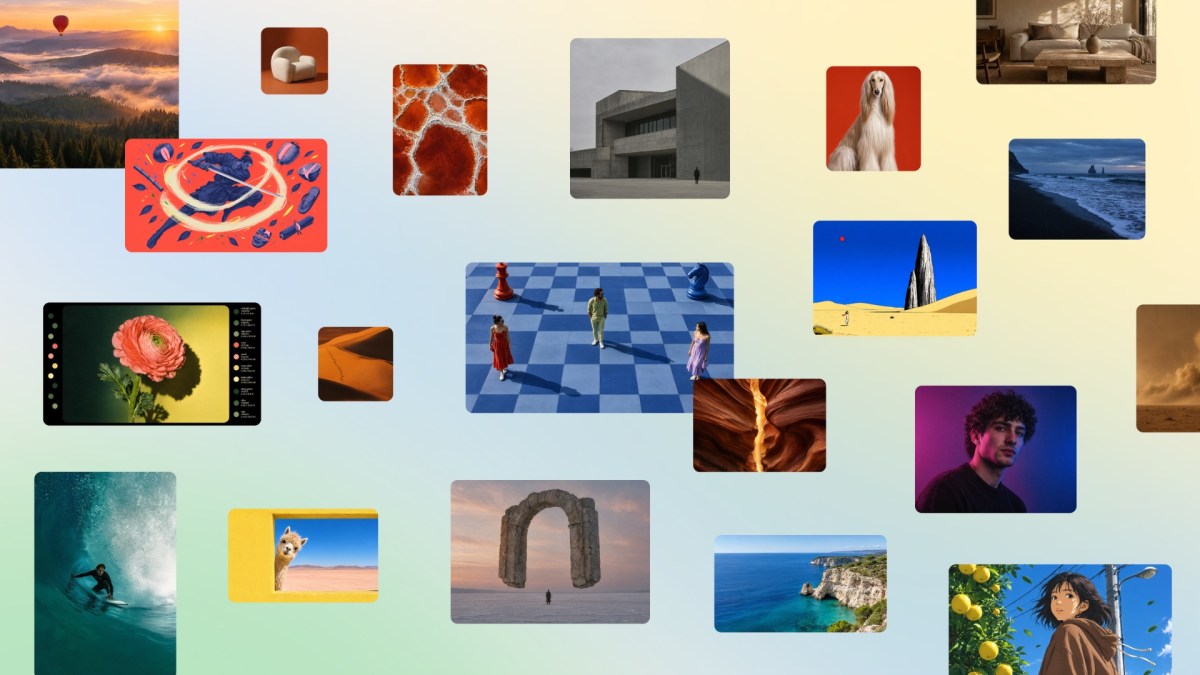
Canva has launched Craft, its first image-generation model built from scratch by its own research team. It is available through Canva’s Dream Lab and a public API, moving the company further from being a design interface that merely integrates other companies’ AI. Canva’s announcement says Craft was trained to handle layouts, typography and editable design elements, not simply to produce a polished image from a prompt.
The model can generate output at up to 2K resolution in a wide range of aspect ratios. Canva says its two-stage system first plans the composition, including the position and scale of objects and text, before rendering the image. The company argues that separating these jobs makes it easier to create visual material that can be refined rather than discarded when one detail is wrong. Those are Canva’s performance claims, and designers will have to judge the quality in their own work.
A small business making a poster may care less about benchmark rankings than whether the price, product name and event date can be corrected without starting again. Canva says Craft works with its Magic Layers system to turn generated images into more editable components. That is a practical distinction in a field where many AI tools still flatten the result into a single picture. It also matters for agencies that need a repeatable brand style and multiple sizes of the same campaign asset.
Canva is presenting the launch as a research milestone. It says Craft ranked highly in a crowdsourced design comparison and performed strongly on portraits and landscapes. Such rankings can show promise but do not settle questions about consistency, unusual prompts or whether generated text survives demanding production work. Canva acknowledges that fine print and technical drawings remain areas for improvement.
The API extends the story beyond Canva’s own users. Developers could embed the model in marketing platforms, e-commerce tools or print workflows. Canva also says an integration for AI assistants through its MCP server is planned, though that connection is not the same as an already available service. If it works well, an agent might be able to produce an editable campaign visual as one step in a longer task.
Canva has been widening its AI capabilities for some time. TechBooky covered its earlier AI, Sheets and Code expansion, which brought generation and automation into a broader visual suite. Building a foundation model gives Canva more direct control over how its core creative tools behave and how much they cost to run, although it also brings the expense of model training and evaluation onto its own books.
For creators, the most useful test is not whether Craft beats a rival on a leaderboard. It is whether a generated design can be edited quickly, exported cleanly and used without awkward surprises in text, layout or licensing. Canva has made the model available for those tests now. Faster versions are promised later, but their speed and economics still need to be demonstrated outside the launch announcement.
Related Reading
More contextual TechBooky stories selected from tags, categories and article context.
Paul Femi Balo is the founder and publisher of TechBooky. He covers artificial intelligence, African technology, digital infrastructure, enterprise technology and the global digital economy.
We use cookies to ensure that we give you the best experience on our website. If you continue to use this site we will assume that you are happy with it.