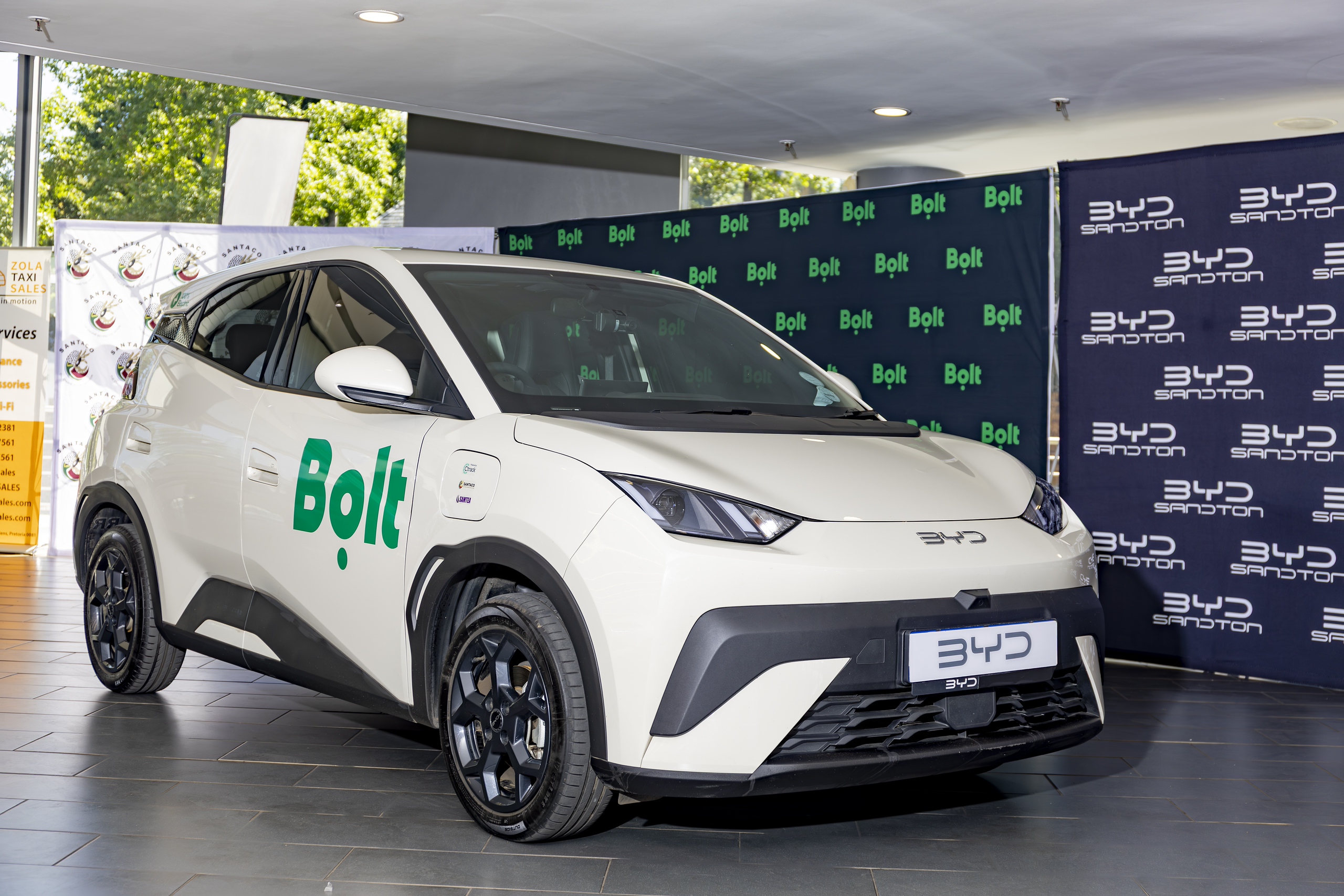
Bolt has brought a dedicated electric-vehicle ride category to Johannesburg, extending a South African programme that began in Cape Town in May. The launch gives some riders a way to select an electric trip in the app, but it is not yet a city-wide fleet transformation. Availability starts in selected areas, and Bolt has not disclosed the number of electric cars currently operating in Johannesburg.
The company is working with electric-vehicle maker BYD and the South African Meter Taxi and E-Hailing Association, or SAMTEA, which is affiliated with the South African National Taxi Council. Bolt’s statement reported by Connecting Africa says the partners are combining the booking platform, vehicle supply and transport-sector representation. It describes a national ambition of 500 electric vehicles by December 2026. That figure is a target for South Africa, not the present Johannesburg fleet size.
The initial service covers Sandton, routes to and from OR Tambo International Airport and parts of Johannesburg East, according to local reporting. BYD Dolphin Surf cars are being used, with rides priced slightly above the standard Bolt category. The geographical limits and fare difference will matter to passengers as much as the environmental pitch: an electric option is useful only when a car is nearby and the premium is acceptable.
For Bolt, the experiment is also about vehicle economics. Electric cars can be cheaper to run and maintain over time, but they require a larger upfront investment and dependable access to charging. A car that spends too long charging or travelling empty to reach a charger may lose the operating advantage suggested by lower energy costs. Fleet management, utilisation and financing therefore matter at least as much as the vehicle badge.
The partnership with SAMTEA makes this more than a software feature. Rather than assuming every independent driver can purchase an EV, the association can organise vehicles and drivers at fleet level. That could make the transition more practical, although the company has not released enough operating data to show whether the Johannesburg model can scale profitably.
Across Africa, the question of who pays for electric fleets is increasingly prominent. TechBooky recently covered Nithio’s proposed financing fund for African electric fleets, which illustrates the gap between demand for cleaner transport and the capital needed to put vehicles on the road. Bolt’s approach addresses a similar problem through partnerships with an established transport association and a manufacturer.
The next measurable tests are straightforward: whether riders can consistently find the category, how many vehicles join it, what drivers earn after charging and financing costs, and whether the 500-vehicle national target is met by December. Until Bolt publishes those numbers, the Johannesburg launch is a concrete expansion of electric ride-hailing, but not proof that electric vehicles have become the default for the city’s commuters.
Related Reading
More contextual TechBooky stories selected from tags, categories and article context.
Paul Femi Balo is the founder and publisher of TechBooky. He covers artificial intelligence, African technology, digital infrastructure, enterprise technology and the global digital economy.
We use cookies to ensure that we give you the best experience on our website. If you continue to use this site we will assume that you are happy with it.