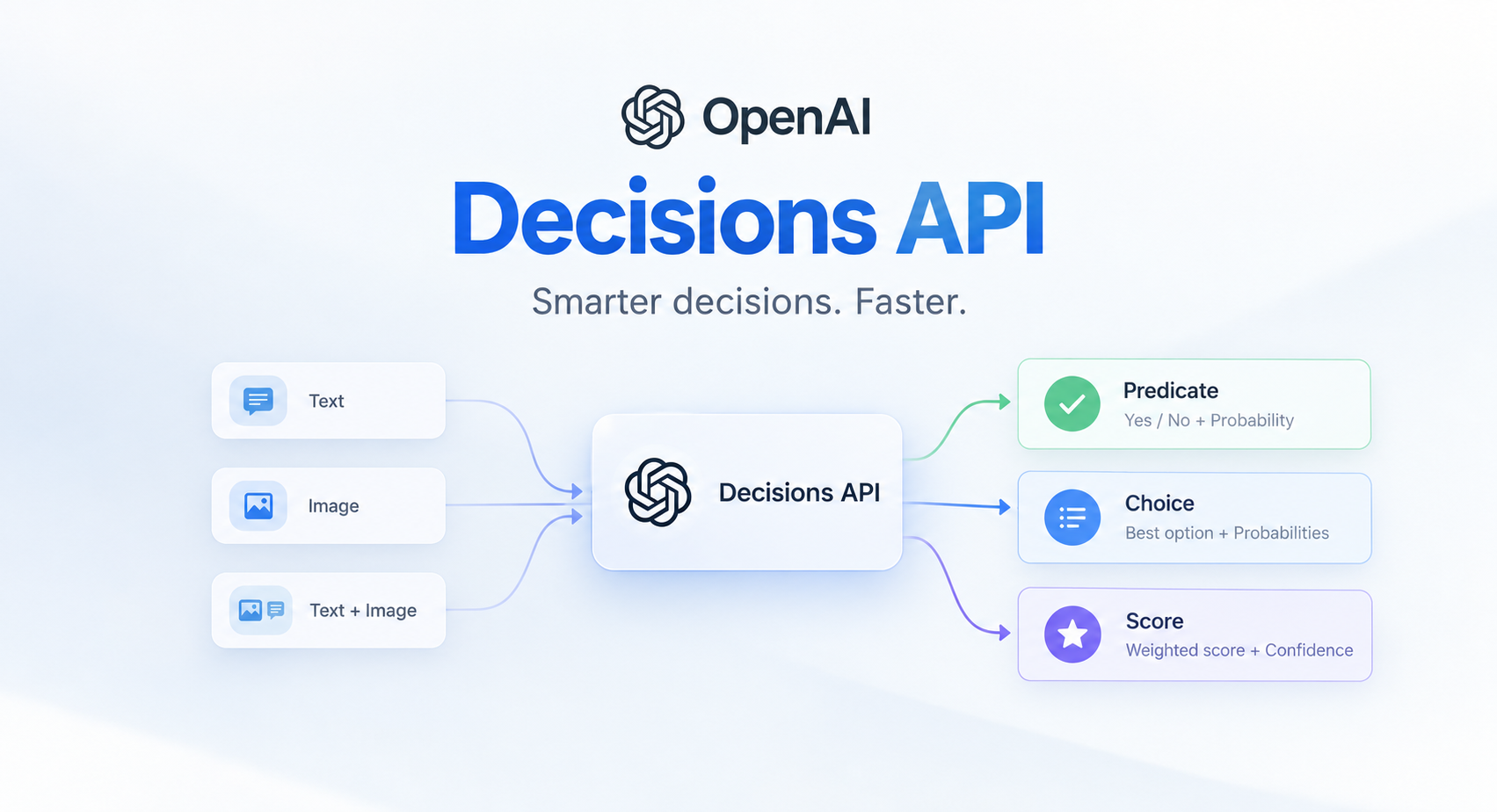
OpenAI has made its Decisions API generally available, offering developers a model designed to answer small, bounded questions quickly rather than generate a long response. A shopping app might classify a request, a support system might route a ticket, and an AI agent might decide which tool to use next. Those choices are individually modest, but their cost and delay add up when software makes thousands of them.
The service runs on GPT-6 Luna through a dedicated endpoint. OpenAI says it can handle text, images and structured input, and can answer up to 400 questions in one request. The company claims responses can be up to ten times faster than using Luna through the general Responses API for comparable bounded tasks. That is a vendor benchmark, not a guarantee for every application or network condition.
Pricing is another part of the pitch. OpenAI lists input at $0.10 per million tokens and cached input at $0.01 per million, with no output-token charge for this product. Developers should still examine the current API documentation and calculate end-to-end costs for their own workloads, including retries, application logic and any other models in a workflow. A low per-token price will matter most where the same simple decision is repeated at scale.
Since the public beta, OpenAI has added integration with GPT-Live for voice applications, prompt caching and regional processing options in the United States and European Union. It also supports JSON input and images in question instructions. These additions suggest the product is aimed at production systems that need predictable answers under tight latency requirements rather than one-off chat experiences.
The design choice is revealing. Much of the AI market has concentrated on larger models that can reason through complex requests and generate detailed output. Many applications, however, spend a surprising share of their time making narrower choices. A capable but smaller and cheaper decision layer can handle those steps while reserving a more expensive model for tasks that genuinely require it. That could make agent systems quicker and easier to budget.
The trade-off is that a bounded answer can be wrong with great speed. Teams should test the decisions against real examples, measure error costs and decide when to escalate to a human or a more capable model. A routing decision that sends a customer to the wrong help queue is an inconvenience. A decision affecting access, safety or financial outcomes needs much tighter controls.
TechBooky has previously covered OpenAI’s tools for building corporate agents. The Decisions API fills a different role in that stack. It does not carry out a whole multi-step task on its own. It helps an application choose the next step efficiently. The release makes that component more widely available, while the burden of evaluating the choices remains with the developer.
Related Reading
More contextual TechBooky stories selected from tags, categories and article context.
Paul Femi Balo is the founder and publisher of TechBooky. He covers artificial intelligence, African technology, digital infrastructure, enterprise technology and the global digital economy.
We use cookies to ensure that we give you the best experience on our website. If you continue to use this site we will assume that you are happy with it.