Google Cloud says its Nvidia Vera Rubin-powered A5X instances will become generally available in November, moving a new generation of AI servers beyond the small group of customers that already have early access. The company announced the timetable at GTC Berlin on 21 October, alongside plans to bring the infrastructure into additional European regions and give organisations more control over where their AI work runs.
The timing matters. A5X was announced earlier this year, and London-based Ineffable Intelligence is already using it. Wednesday’s development is the promised wider launch and an expanded infrastructure package, not the first unveiling of the hardware. Google has not said that every customer can provision the instances today.
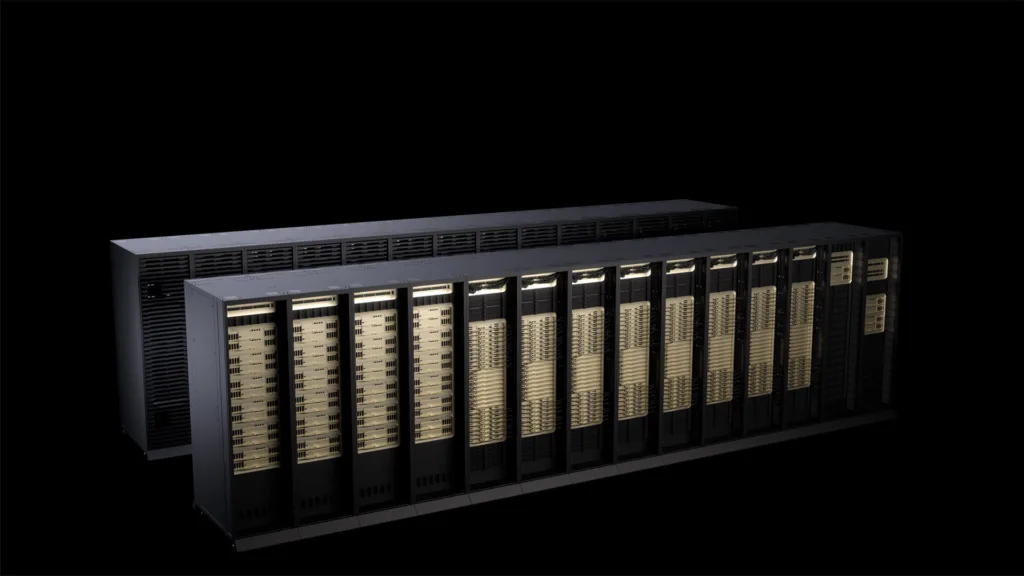
The A5X bare-metal instances combine Nvidia’s Vera Rubin NVL72 systems with ConnectX-9 networking, Google’s Virgo Network and liquid cooling. In its GTC Berlin announcement, Google described an integrated system for training, serving and operating large AI models rather than a simple GPU rental. It is also adding Managed Lustre storage with GPUDirect Storage support, caching for long-running agent conversations and orchestration through Google Kubernetes Engine.
The networking design is intended to allow clusters of as many as 80,000 Rubin GPUs at one site and 960,000 across multiple sites. Those are scaling capabilities described by Google, not a count of GPUs already installed or a confirmed customer order. Actual deployments will depend on capacity, power, networking and demand.
For AI developers, the attraction is less about a single benchmark and more about keeping a complex workload moving. Training an agent through reinforcement learning, for example, means generating experiences, evaluating them and updating its behaviour repeatedly. Delays between the computing, memory, storage and networking layers can become expensive even when the GPU itself is fast. Nvidia says Ineffable Intelligence was the first A5X customer and is using the system for that sort of large-scale research.
Google says it will expand A5X availability into new local regions to address European, Middle Eastern and African data-residency requirements. It has not provided a full list of locations or dates for every region. A European customer may therefore see a clearer route to local capacity, but should not assume a particular region will offer A5X on the first day of general availability.
The company is also widening its sovereign AI offering. Google Distributed Cloud now supports Nvidia Blackwell Ultra GPUs for air-gapped deployments, while its public-cloud options include data-boundary controls and isolated operations with local partners. Separately, confidential G4 virtual machines are generally available, allowing protected AI processing on Nvidia hardware. These are distinct products with different availability and security properties; none should be mistaken for a blanket guarantee that every AI workload is private by default.
That distinction is important for organisations deciding whether to build their own AI infrastructure or rent it. Running models close to sensitive data may be a requirement for banks, public services and healthcare groups. Yet locality alone does not solve governance. Customers still have to assess who controls model weights, logs, encryption keys and administrative access.
The Google-Nvidia announcement also lands in a market already worried about the electricity cost of AI growth. TechBooky recently examined their effort to make data centres more responsive to the power grid. Bigger clusters can create more useful computing capacity, but they also put more pressure on energy supply and cooling. Neither company has published a site-by-site power plan for the maximum-scale configurations described this week.
November will provide the first real test of the new promise. Customers will be able to judge where A5X can actually be provisioned, how much it costs and whether its integrated design improves the economics of their workloads. The headline GPU numbers are striking; the more useful measure will be how reliably developers can turn that capacity into AI products people use.
Related Reading
More contextual TechBooky stories selected from tags, categories and article context.
Paul Femi Balo is the founder and publisher of TechBooky. He covers artificial intelligence, African technology, digital infrastructure, enterprise technology and the global digital economy.
We use cookies to ensure that we give you the best experience on our website. If you continue to use this site we will assume that you are happy with it.