xAI has released Grok 4.6, and the new model looks less like a routine upgrade and more like Elon Musk’s AI company trying to force its way back into the frontier-model conversation.
In its official announcement, xAI says Grok 4.6 builds on Grok 4.5 with a focus on long-running agents, complex coding work, knowledge tasks, interactive projects and visual application building. The company says the model is available now in Grok Build, Cursor, the xAI API and partner platforms including OpenRouter, Vercel and Cloudflare.
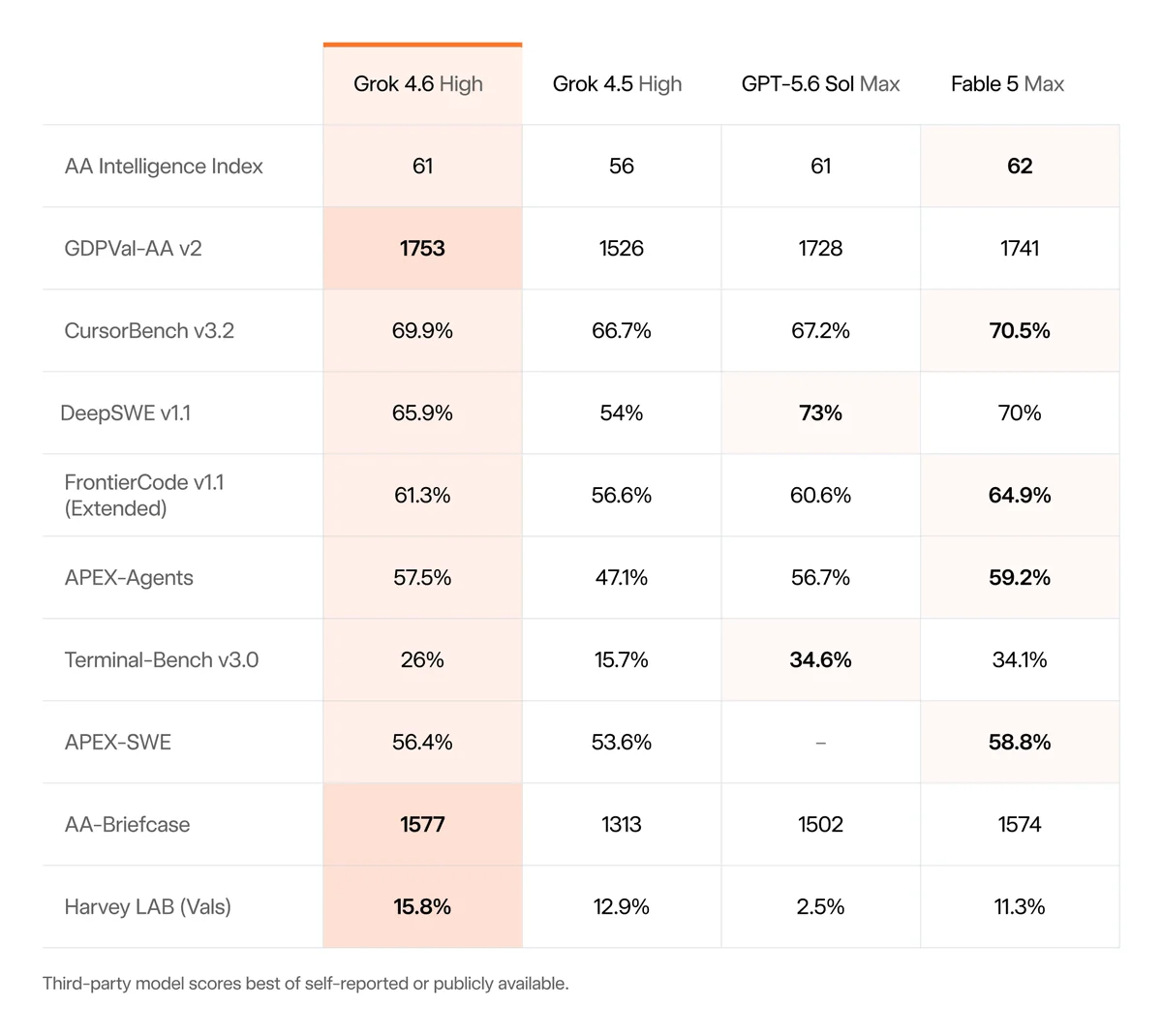
The benchmark headline is what will get the most attention. xAI says Grok 4.6 matches GPT-5.6 Sol on the Artificial Analysis Intelligence Index, a composite score drawn from several benchmark categories. Artificial Analysis puts Grok 4.6 at 61 on its Intelligence Index, in line with GPT-5.6 Sol and behind Anthropic’s leading Claude models, while moving ahead of Kimi K3.
That matters because Kimi K3 has been one of the strongest stories in AI over the past month. Moonshot AI’s model turned into a market headache because it showed how quickly Chinese and open-weight-adjacent systems could close the perceived gap with U.S. frontier labs. We have followed that from the Kimi K3 demand surge to the wider AI market anxiety around China’s model push.
Grok 4.6 gives xAI a cleaner answer. It does not end the China AI debate, and it does not put xAI clearly ahead of Anthropic or OpenAI. But it gives the company a model that independent benchmarking now places back in the top frontier cluster, with particular strength in agentic performance and cost efficiency.
The cost point is important. xAI says Grok 4.6 pricing starts at $2 per million input tokens and $6 per million output tokens, with a fast variant priced at twice that. In a market where enterprise customers are watching inference bills closely, frontier-level performance at lower API cost is not a side detail. It is part of the product argument.
The model’s training story also shows where xAI is aiming. The company says Grok 4.6 went through a longer supplemental training run than Grok 4.5, using curated model-generated data for reasoning and advanced technical concepts, higher-quality engineering data, an improved optimizer and a new training recipe. It also says Grok 4.5 was used to regenerate supervised fine-tuning trajectories across reasoning efforts, agent harnesses, STEM, software engineering and knowledge work.
That sounds technical, but the product message is simple. xAI wants Grok 4.6 to stay with longer work. The company says the model is better at turning broad ideas into working first versions, structuring applications, implementing core interactions, checking its own work and improving through feedback. This sits neatly beside xAI’s Grok Bot push, which is all about always-on AI teammates that can work inside tools.
There is also a safety question. More capable long-running agents create more useful software, research and engineering workflows, but they also create more ways for systems to take action across codebases and tools. We recently wrote about how frontier models can leak hidden reasoning traces, and Grok 4.6 is arriving at exactly the moment when model providers are being pushed to prove that more capability does not mean weaker control.
xAI says Grok 4.6 went through its widest pre-deployment testing suite yet, with safeguard calibration, post-deployment testing and third-party testing. The company also says its safety stack is intended to support legitimate uses such as vulnerability patching, engineering design and AI research. That is the right language, but the market will judge it through real usage, not launch claims.
The bigger picture is that xAI is now competing on three fronts at once: model quality, agent workflows and infrastructure. Grok 4.6 improves the model story. Grok Bot improves the agent story. Colossus and Musk’s compute strategy support the infrastructure story. If these pieces work together, xAI becomes harder to dismiss as a noisy challenger.
For developers, the immediate question is practical. Does Grok 4.6 perform well enough in Cursor, Grok Build and API workflows to justify switching or adding it beside Claude, GPT, Gemini and Kimi? Benchmarks say it deserves a look. The harder test will be whether it can stay reliable across long tasks, messy codebases and real business work where a model has to do more than win a leaderboard.
Related Reading
More contextual TechBooky stories selected from tags, categories and article context.
Paul Balo is the founder of TechBooky and a highly skilled wireless communications professional with a strong background in cloud computing, offering extensive experience in designing, implementing, and managing wireless communication systems.
We use cookies to ensure that we give you the best experience on our website. If you continue to use this site we will assume that you are happy with it.