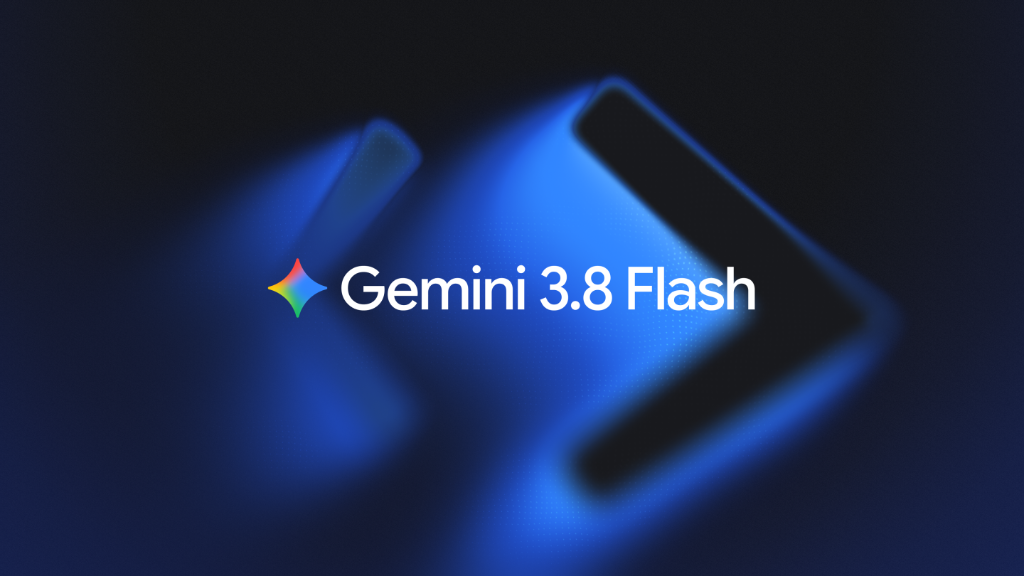
Google has released Gemini 3.8 Flash, and the company is clearly trying to make a point: the next AI battle is not only about bigger models. It is also about models that can do serious work at scale. Google DeepMind describes Gemini 3.8 Flash as its most intelligent workhorse model yet for coding and agents.
The model is generally available across the Gemini app, Gemini Enterprise Agent Platform, Google AI Studio, Gemini API, Gemini AI Mode and Google Antigravity. It supports text, images, video, audio and PDFs as input, with a 1 million-token input window and 64,000 output tokens. That makes it a practical model for long documents, software projects and more complex agentic workflows.
Google is highlighting improved performance on long-horizon software engineering, finance-agent work, legal-agent benchmarks and broad expert reasoning tasks. The message is simple: Flash is no longer just the cheaper, faster option for lighter tasks. Google wants developers to see it as a model that can handle meaningful work without immediately jumping to the most expensive tier.
But the cost question is more complicated. In AI, a model can keep the same per-token price and still become more expensive in real use if it produces longer answers, takes more turns or uses more tools to complete a job. That is why the AI infrastructure race and the coding-agent race are now connected. Better agents can create more value, but they can also consume far more compute.
That is the issue businesses will care about. A developer does not only ask how much a million tokens cost. The better question is how much it costs to finish a task correctly. If Gemini 3.8 Flash solves more work with fewer retries, the higher reasoning load may be worth it. If it becomes verbose or expensive across everyday workflows, the pricing advantage becomes less obvious.
The release also keeps pressure on OpenAI, Anthropic and Meta. Anthropic is trying to make its models cheaper and less restrictive, Meta is pushing Muse Spark into coding workflows, and OpenAI is dealing with both product expectations and safety concerns around more capable systems . Google cannot afford to look slow in that group.
For ordinary users, Gemini 3.8 Flash may simply feel like a smarter assistant. For developers and companies, it is another sign that the AI market is moving toward task economics. The real winner may not be the model with the lowest token sticker price. It may be the one that gets to a useful result with the least wasted motion.
That is why this release matters. Google is not just updating Gemini. It is trying to redefine what a workhorse model should do in the age of AI agents.
Related Reading
More contextual TechBooky stories selected from tags, categories and article context.
Paul Balo is the founder of TechBooky and a highly skilled wireless communications professional with a strong background in cloud computing, offering extensive experience in designing, implementing, and managing wireless communication systems.
We use cookies to ensure that we give you the best experience on our website. If you continue to use this site we will assume that you are happy with it.