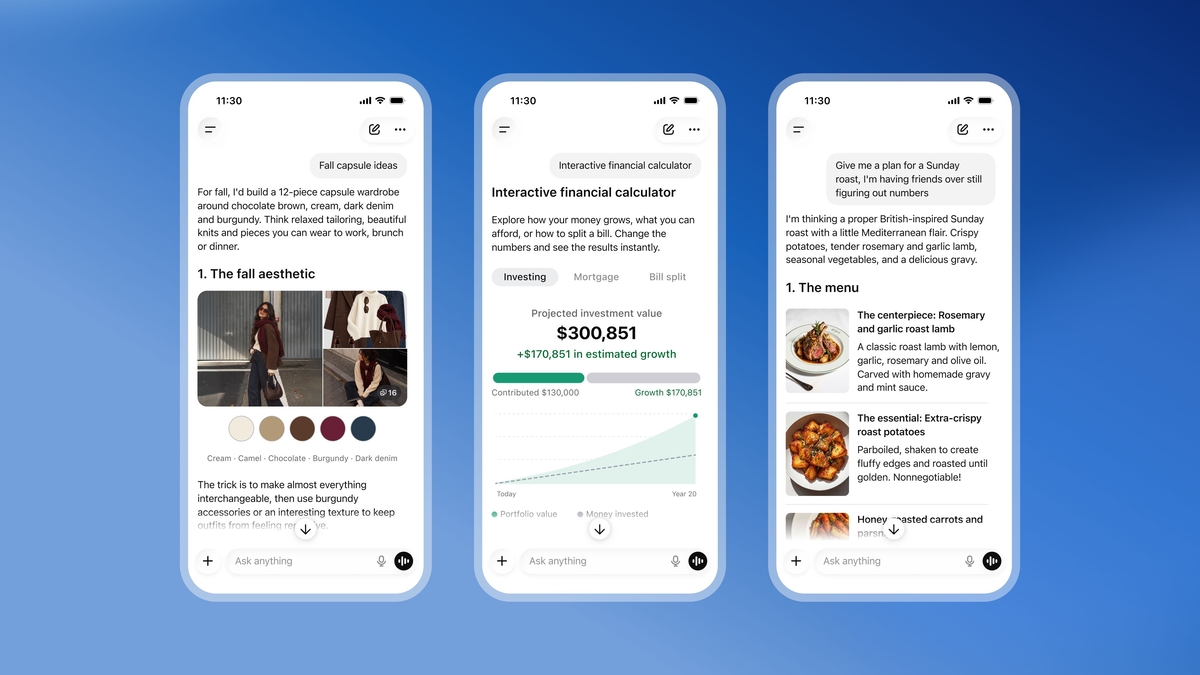
ChatGPT is getting a different shape. Instead of returning every answer as a stack of paragraphs, it can now put a chart, a diagram, a comparison or a small working tool into the conversation when that would make the answer more useful. OpenAI introduced the GPT-6 experience on October 7, calling the new approach Intelligent UI. The rollout reached paid ChatGPT tiers first and is due to expand to Free and Go users on October 8.
The examples are ordinary enough to explain the ambition. Ask for help comparing options and ChatGPT might arrange them side by side. Ask about a mathematical idea and it could produce an interactive diagram. Ask to split a dinner bill and it may build a small calculator inside the response. OpenAI says it can still answer in plain text when the question does not need anything more elaborate. The change is not simply a prettier chat window; it lets the answer become a usable interface.
That raises a practical question familiar to anyone who has watched AI generate convincing but faulty material. A calculator is only helpful if the arithmetic and assumptions are right. An attractive chart can make a weak source look authoritative. Readers should still check important figures and claims, particularly in health, finance or education. OpenAI says it trained GPT-6 to make better choices about when visual and interactive elements add value, but the usefulness of those choices will be tested in everyday use.
The company says the interfaces are assembled from native components and appear progressively as the model generates them. GPT-6 can also begin answering while it continues reasoning or using tools, allowing users to start reading before the entire response is ready. That is an attempt to ease one of the most noticeable trade-offs in powerful AI; a better answer often means a longer wait. OpenAI has not said every request will produce an interactive result.
Availability needs careful wording. Plus, Pro, Business and Enterprise users began receiving GPT-6 with Intelligent UI in the Chat tab on October 7, subject to rollout and workplace settings. Free and Go access begins rolling out on October 8. OpenAI says GPT-6 Sol powers the paid tiers and GPT-6 Luna powers Free and Go. Its Work and Codex products are not changing as part of this ChatGPT release, so users should not assume the new interface appears in every OpenAI product immediately.
For OpenAI, this is also a distribution move. The company has already pushed GPT-6 models toward developers; this release gives ordinary ChatGPT users a more visible reason to notice the new generation. It could make some everyday tasks easier without asking people to open a separate spreadsheet, charting app or simple utility. The risk is that a tool made on the fly may feel finished before its answer has been checked.
The most interesting test is whether people come to trust these interfaces for the right reasons. If GPT-6 can reliably choose when to show its work and when to keep things simple, ChatGPT may start to feel less like a chatbot and more like software that adapts to the task. That remains a promise to evaluate, not an outcome the launch itself proves.
Related Reading
More contextual TechBooky stories selected from tags, categories and article context.
Paul Balo is the founder of TechBooky and a highly skilled wireless communications professional with a strong background in cloud computing, offering extensive experience in designing, implementing, and managing wireless communication systems.
We use cookies to ensure that we give you the best experience on our website. If you continue to use this site we will assume that you are happy with it.