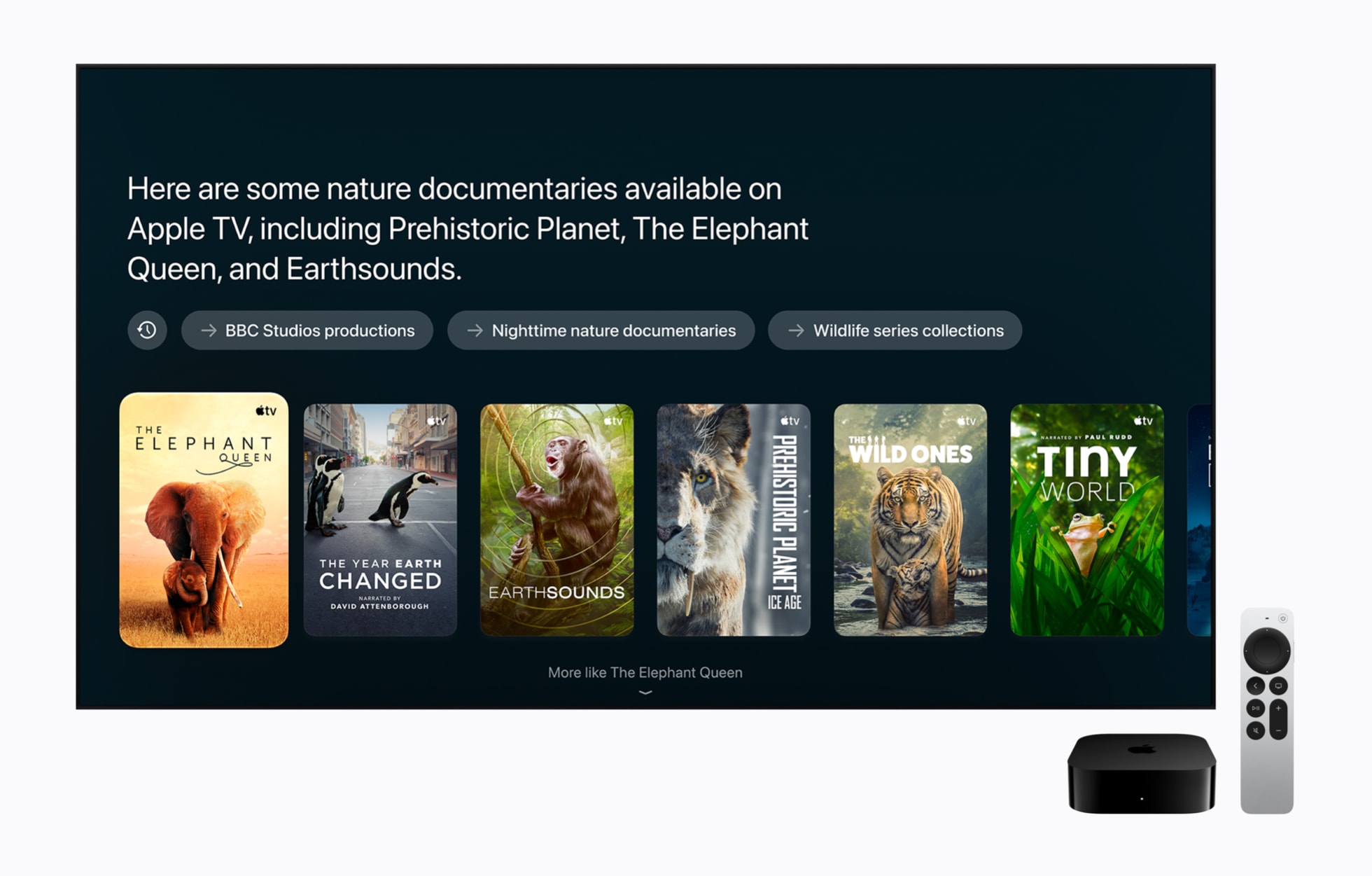
Apple has given its streaming box a more consequential job than loading films. The fourth-generation Apple TV 4K, announced on October 13, puts a conversational Siri on the television, adds microphones to the box itself and makes the device a more capable control point for the connected home. It starts at $299 in the US, can be pre-ordered now and reaches stores on November 13.
The pitch is simple: instead of hunting through menus with a remote, viewers should be able to ask for a programme, narrow the results with a follow-up question and get an answer without leaving the screen. Apple says Siri AI can show contextual suggestions while a show plays, and can use personal context for requests such as finding a programme recommended by a friend. That personal context requires a paired Apple Intelligence-enabled iPhone or iPad.
Three far-field microphones let people speak to the new Apple TV without pressing a button on the remote. Echo cancellation is meant to help the box hear a request while sound is playing. It is a notable change for a device that has historically relied on the Siri Remote for voice input, and it makes the living-room screen a more obvious place for Apple to put its next-generation assistant.
There is an important launch qualification. Siri AI is a beta feature in tvOS 27.2, and Apple says the Home app owner must have an Apple Intelligence-capable iPhone or iPad running current software with Siri AI enabled in a supported language. The beta will be available in English at launch in the US, Australia, Canada, India, New Zealand, Singapore, South Africa and the UK. Apple also says Siri AI will work on second-generation and later Apple TV 4K boxes, so the assistant alone may not justify replacing a recent model.
The A19 chip brings up to 50 percent faster CPU performance and twice the GPU performance of the previous generation, according to Apple. A dedicated AV1 decoder should make supported streams more efficient. The new Siri Remote gains Find My with Precision Finding and the option to make it play a sound, addressing a much more ordinary living-room problem.
The hardware also sits at the centre of Apple’s larger home plan. Apple TV 4K has Wi-Fi and Thread connectivity and can serve as a home hub for accessories and automations. With a compatible doorbell, a viewer can see who is outside and respond from the television. Apple says its HomeKit Secure Video system can provide AI-written camera activity descriptions and condensed notifications. Those features will depend on compatible equipment and account setup, not simply the purchase of a new streaming box.
For audio, the new Apple TV supports a four-speaker arrangement using HomePod mini 2 or second-generation HomePods, with matching front and rear pairs. The speakers are designed to identify their positions and calibrate their output. This could be attractive to existing HomePod owners, although four new speakers plus a $299 box are a substantial investment compared with the price of an ordinary streamer.
The strategic shift is clearer than the speed bump. As TechBooky has tracked in Apple’s Siri overhaul, the company wants its assistant to be present across devices. The television is now part of that effort, linking entertainment, voice control and smart-home management. The real test will be whether beta Siri responds reliably enough in a noisy living room to become something people actually use, not just another specification on the box.
Related Reading
More contextual TechBooky stories selected from tags, categories and article context.
Paul Balo is the founder of TechBooky and a highly skilled wireless communications professional with a strong background in cloud computing, offering extensive experience in designing, implementing, and managing wireless communication systems.
We use cookies to ensure that we give you the best experience on our website. If you continue to use this site we will assume that you are happy with it.