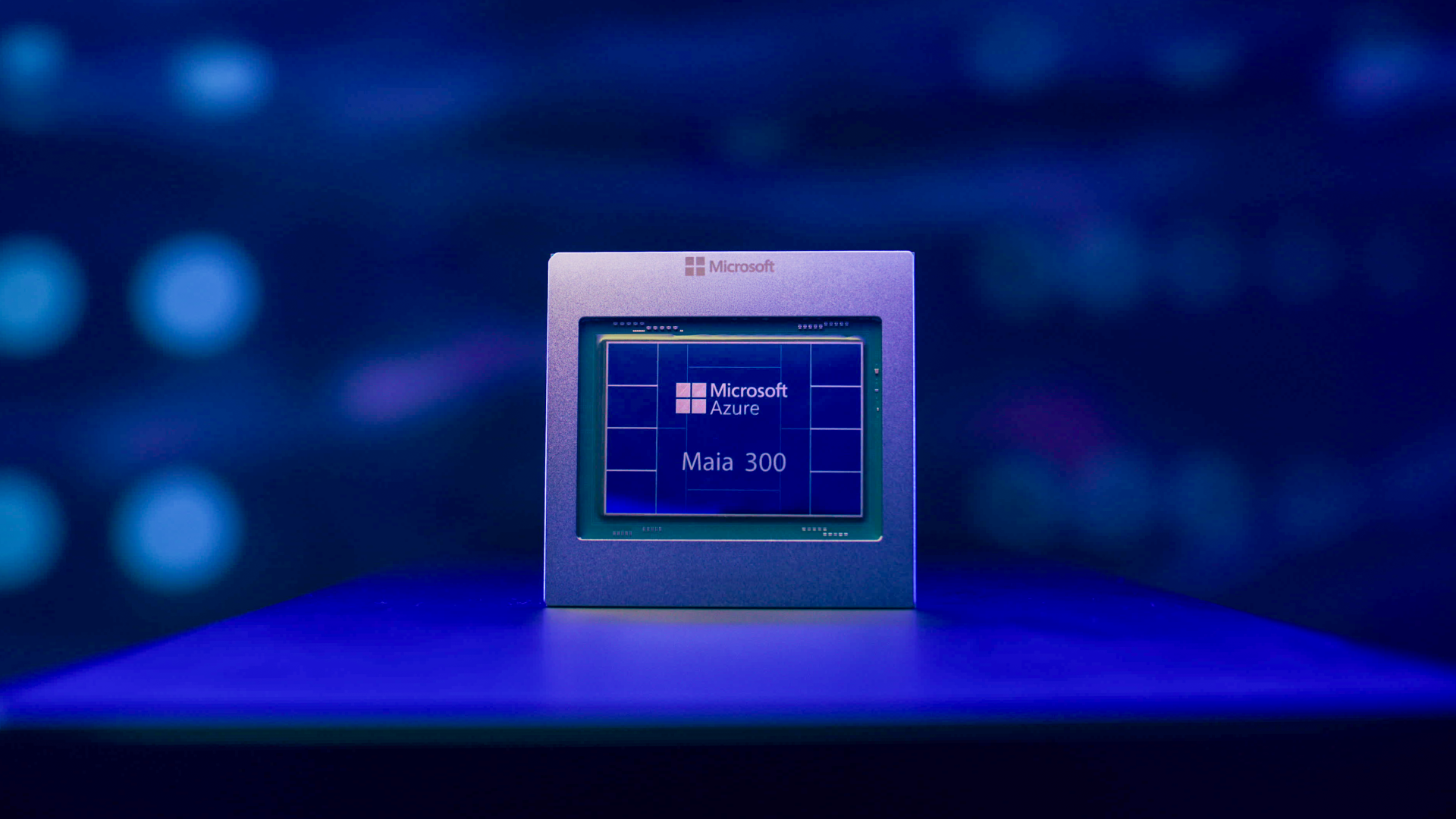
Microsoft has unveiled Maia 300, the third generation of its homegrown AI accelerator, and says the chip will become the primary inference system behind its products and services as deployments scale from 2027. The announcement puts a sharper number on a question facing every major AI company: how much intelligence can a data centre produce from the power it can actually secure?
In its announcement, Microsoft said Maia 300 is designed for the work that happens after an AI model is trained, including long conversations, reasoning and agents that perform several steps on a user’s behalf. It expects the system to deliver 40% more tokens per megawatt than leading GPU-based systems. That is Microsoft’s projection, not a result independently verified across competing deployments.
Inference is the continuous cost of serving AI to users. A chatbot response, a Copilot suggestion or an agent’s next action all consume computing capacity. As usage grows, even modest improvements in the energy required for each response can translate into substantial savings. Microsoft is therefore designing the chip, memory, networking, rack and software together instead of treating an accelerator as an interchangeable component.
The technical breakdown describes a chiplet design with its main compute section made on TSMC’s N2P process. Each accelerator has eight HBM4 memory stacks, providing 288GB of capacity and a peak bandwidth of 18TB per second. A rack holds 96 accelerators. Microsoft says that full configuration can deliver up to seven times the rack-scale token throughput of Maia 200.
These are substantial claims, but the comparisons need care. The sevenfold figure is against Microsoft’s previous Maia generation at rack scale, while the 40% tokens-per-megawatt expectation is against unspecified leading GPU systems. Neither should be read as proof that one Maia 300 chip is seven times faster than an Nvidia GPU.
Maia 200 is already running Microsoft workloads, including Copilot, the company says. Maia 300 will begin production deployment in 2027, with the broader Maia family expanding to multi-gigawatt scale. Microsoft also named GitHub Copilot, Microsoft Foundry, Teams and Dragon Copilot among the services its chip programme is intended to support. It has not announced a general release date for customers to rent Maia 300 capacity directly.
The strategy matters beyond a hardware launch. Microsoft still uses outside AI silicon, but owning a larger share of its inference stack could give it more control over supply, cost and product design. TechBooky has previously covered the interest in Maia 200 and the wider race to secure AI computing capacity. Maia 300 is Microsoft’s clearest statement yet that it wants its own chips to carry a much larger part of that demand.
Related Reading
More contextual TechBooky stories selected from tags, categories and article context.
Paul Balo is the founder of TechBooky and a highly skilled wireless communications professional with a strong background in cloud computing, offering extensive experience in designing, implementing, and managing wireless communication systems.
We use cookies to ensure that we give you the best experience on our website. If you continue to use this site we will assume that you are happy with it.