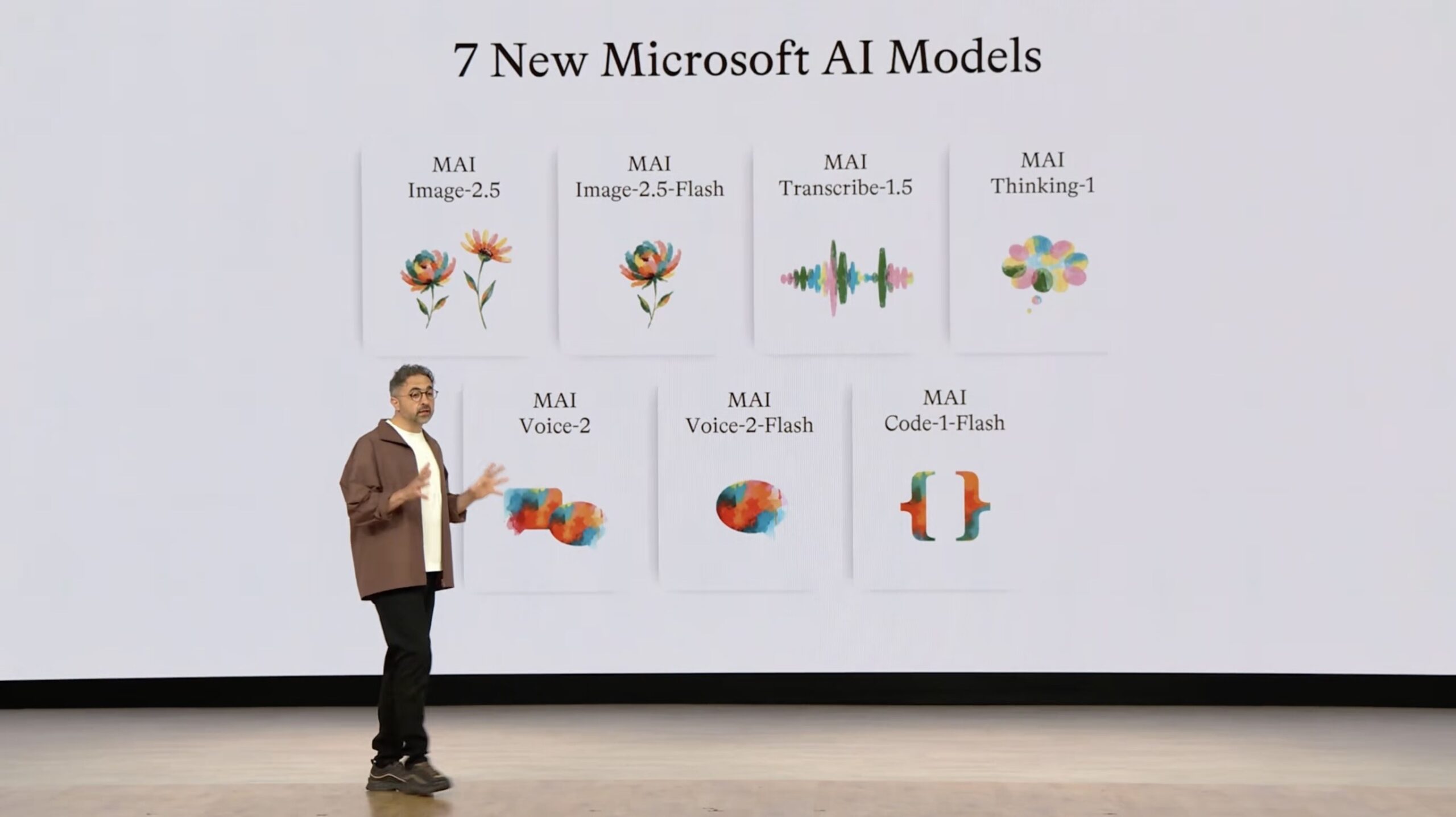
Microsoft used its Ignite conference on Tuesday to announce a broad new family of AI models, sharpening its position as a model builder as well as a distributor of other companies’ systems. The company describes the release as seven new models aimed at jobs ranging from coding and cyber defence to image editing and real-time speech. That official count is worth noting because early coverage described six models.
The move is less about a single model topping every benchmark than about giving enterprise customers a choice of specialised tools at prices they can use repeatedly. Microsoft says its new MAI Code 2 model reaches 98% of the performance of GPT-6.1 Sol on a set of everyday coding benchmarks at about 40% of the price. Those are Microsoft’s comparisons, not a guarantee that every software team will see the same result.
The line-up includes MAI Cyber 2 Flash for defensive security work, MAI Code 2 and Code 2 Flash for software tasks, MAI Image 2.7 for image editing, and MAI Realtime 1 for spoken interaction. Microsoft also highlighted transcription and decision-making models. MAI Realtime 1 starts at $0.01 per audio minute, according to the company, while the decision model is designed for routine routing and classification work that does not require an expensive general-purpose model.
Availability differs across the range. Microsoft says MAI Code 2 can be tried in GitHub Copilot, whereas Code 2 Flash is also in a limited Microsoft Foundry preview. MAI Image 2.7 is available through Foundry, while Realtime 1 can be tried in MAI Labs. Readers should check each model’s access terms before treating the family as a single product launch.
Microsoft’s strategy is to combine its own models with a cloud and software distribution network that already reaches developers, security teams and office workers. It can route simple tasks to smaller models while reserving costly frontier models for harder work. The commercial question is whether its claimed performance per dollar holds up in customer workloads, particularly when reliability, latency and review time are counted.
The announcement also raises the competitive stakes for OpenAI and Anthropic, whose models Microsoft has offered across parts of its ecosystem. At the same conference, Microsoft announced deeper controls for AI agents on Windows and new cyber-defence capabilities. Together, those releases suggest that the company wants to own more of the model, operating system and governance layers of enterprise AI.
For customers, the useful test will be practical rather than rhetorical. A cheaper model only creates value if it completes a task accurately, respects data controls and requires little human rework. Ignite provides the product claims; the next stage is measuring those claims in production.
Related Reading
More contextual TechBooky stories selected from tags, categories and article context.
We use cookies to ensure that we give you the best experience on our website. If you continue to use this site we will assume that you are happy with it.