Microsoft has introduced a new family of seven AI models at its Build developer conference, led by MAI-Thinking-1, a 35-billion-parameter system the company is positioning as its first dedicated “reasoning” model for businesses.
The launch marks Microsoft’s largest in-house AI rollout since it debuted its first proprietary models last August, and underscores how the company is trying to distinguish its technology with promises of legally safer, more transparent training data.
Onstage at Build, Microsoft AI chief Mustafa Suleyman described MAI-Thinking-1 as the company’s first reasoning model, designed to handle complex problem-solving across a wide range of tasks rather than being tuned specifically to excel on select benchmarks.
According to Suleyman, early independent testers preferred MAI-Thinking-1 in overall quality when compared side by side with Anthropic’s Claude Sonnet 4.6. The model has recorded a 97% score on the AIME benchmark, which assesses advanced mathematical and problem-solving capabilities. On SWE Bench Pro, a benchmark that evaluates how well AI agents resolve complex coding tasks MAI-Thinking-1 scored 53%.
That result places it above Anthropic’s Claude Opus 4.6, which stands at 51.9%, but below OpenAI’s GPT-5.4 at 59.1%, based on data from Scale Labs, the model performance tracking unit of Scale AI.
Beyond benchmark numbers, Microsoft is leaning heavily on how MAI-Thinking-1 was trained. Suleyman emphasized that the model was developed “entirely from the bottom,” meaning it was optimized broadly for reasoning instead of being fine-tuned to chase specific test scores. He also stressed that it was trained “with absolutely zero distillation.”
In AI development, “distillation” refers to using one model to train another potentially including models built by other companies. That can make it harder to trace the lineage of training data and behaviour. Microsoft is suggesting that skipping distillation could help customers avoid legal and compliance headaches later, particularly around questions of data sourcing and copyright.
The company’s core pitch to enterprises is that MAI-Thinking-1 comes with what Suleyman called an “enterprise-grade, clean, and commercially licensed data lineage,” framed as a foundation for deploying the model “in a very trustworthy way with complete confidence.” Microsoft has not yet laid out a detailed public breakdown of how it licensed all of the training data, but is clearly using traceable, licensed inputs as a differentiator for business buyers wary of regulatory and IP risks.
Seven-model lineup expands Microsoft’s in-house AI
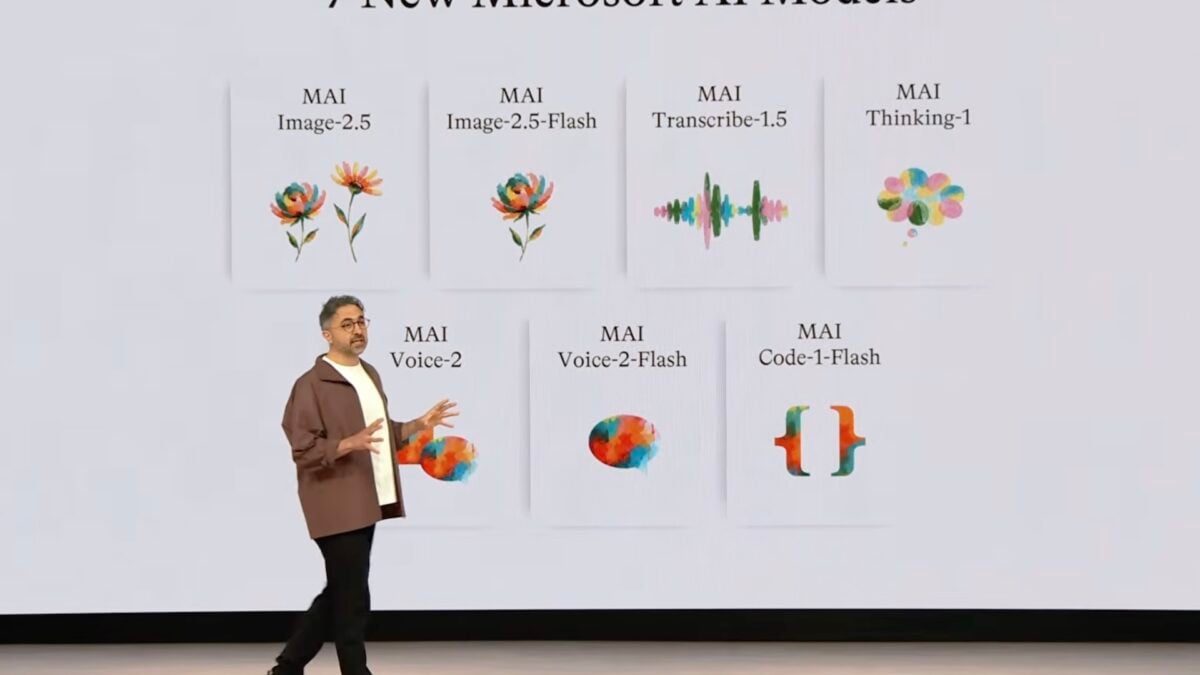
MAI-Thinking-1 is part of a broader set of seven models Microsoft announced at Build, spanning reasoning, images, speech, transcription, and code generation. The lineup includes:
MAI-Thinking-1 – A 35-billion-parameter reasoning model focused on broad problem-solving capabilities, with strong scores on AIME and SWE Bench Pro.
MAI-Image-2.5 and MAI-Image-2.5 Flash – Image-generation models that Suleyman said “deliver a step-change in quality.” At the time of writing, MAI-Image-2.5 holds the number three position on Arena.AI’s text-to-image leaderboard, just behind Google’s Nano Banana 2, according to the source material.
MAI-Transcribe-1.5 – A transcription model that Suleyman described as “the best transcription model in the world.” No specific benchmark figures were provided in the source material, but Microsoft is clearly positioning it at the high end of accuracy and performance.
MAI-Voice-2 and MAI-Voice-2 Flash – Speech-generation models, building on Microsoft’s earlier MAI-Voice-1 and MAI-Voice-1-preview systems introduced in August.
MAI-Code-1-Flash – A code generation model aimed at software development scenarios, complementing MAI-Thinking-1’s performance on coding-focused benchmarks like SWE Bench Pro.
Collectively, these models represent Microsoft’s most expansive step yet into AI systems developed entirely in-house. Before its MAI-branded models, the company’s AI story was dominated by its close partnership with OpenAI. Over time, that relationship has shifted, and Microsoft has increasingly put forward its own research, infrastructure, and branding.
The strategy appears to be paying off in market positioning. Microsoft is now one of the few long-established tech giants that has carved out a leading role in the current AI wave, while peers such as Apple and IBM have not moved as quickly into foundation models at similar scale, according to the source material.
Microsoft has wrapped these efforts under the banner of “humanist superintelligence,” a phrase it uses to frame its AI direction. In a November blog post, Suleyman wrote that the company wants to explore and prioritize ways “the most advanced forms of AI can keep humanity in control while at the same time accelerating our path towards tackling our most pressing global challenges.”
That framing echoes the enterprise-facing pitch behind MAI-Thinking-1: powerful, general-purpose models designed for reasoning and coding, backed by an emphasis on human agency and clearly licensed data. For corporate buyers facing intensifying scrutiny over how AI tools are trained and what legal exposure they may bring, Microsoft is betting that a focus on data lineage and non-distilled models will be as important as raw performance numbers.
Related Reading
More contextual TechBooky stories selected from tags, categories and article context.
Paul Balo is the founder of TechBooky and a highly skilled wireless communications professional with a strong background in cloud computing, offering extensive experience in designing, implementing, and managing wireless communication systems.
We use cookies to ensure that we give you the best experience on our website. If you continue to use this site we will assume that you are happy with it.