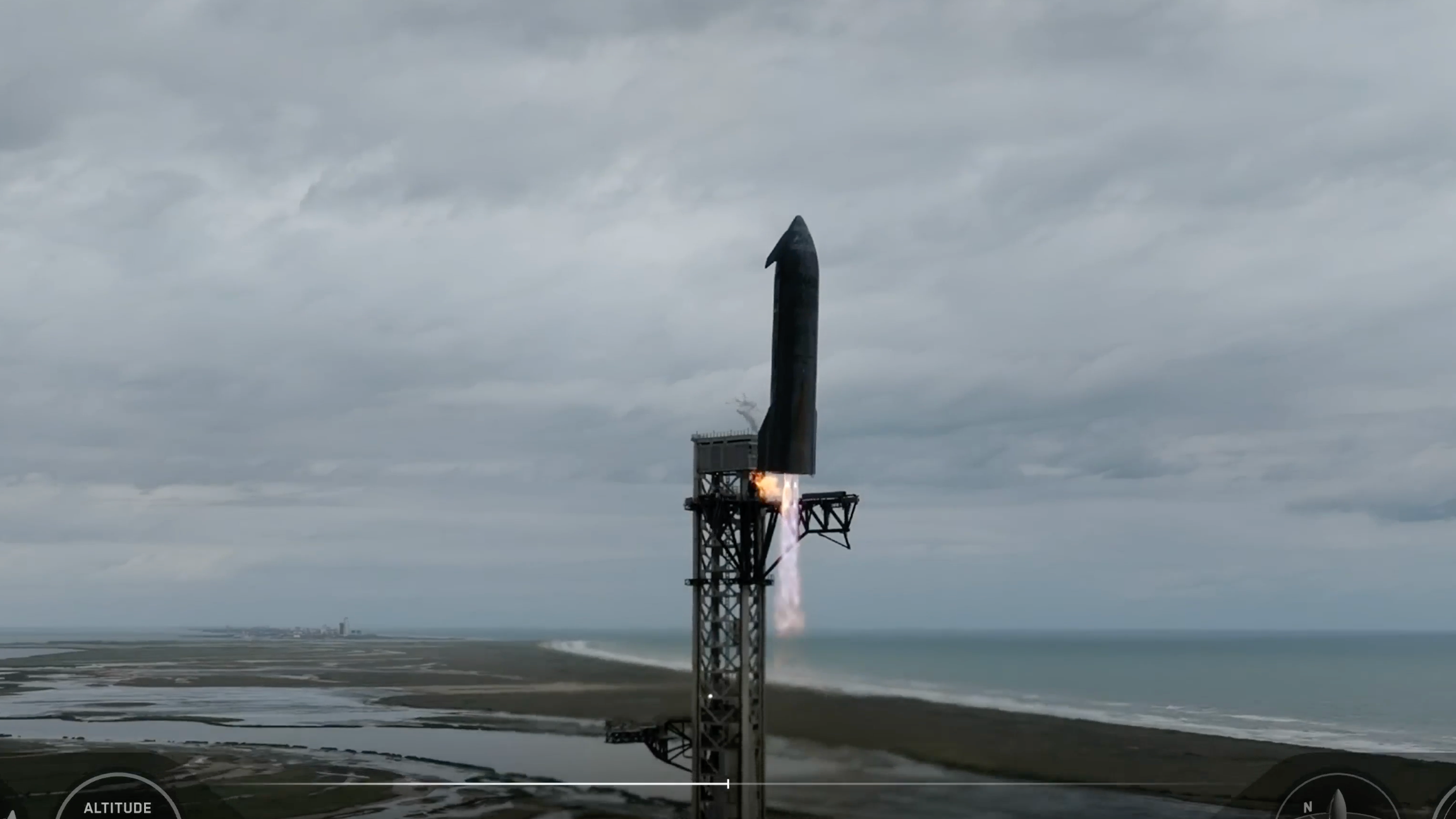
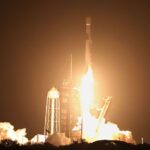
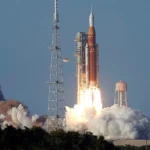
SpaceX has caught a Starship spacecraft with the mechanical arms of its launch tower after a flight around Earth, a first for the upper stage of its giant rocket. The achievement came with an important qualification. The Super Heavy booster was lost minutes after Friday’s launch, so the company did not complete the two-stage catch it had planned.
Flight 15 lifted off from Starbase, Texas, on 13 November. The ship separated from the booster, reached orbit and deployed 26 Starlink satellites. It then remained in space for roughly 22 hours before returning to the Texas launch site on Saturday, 14 November, where the tower’s arms caught it. The Associated Press reported the return and catch, while SpaceX’s flight plan had set out the more ambitious goal of recovering both stages.
SpaceX had previously caught Super Heavy boosters, but the upper-stage spacecraft posed a different problem. It had to survive orbital flight and re-entry, guide itself back to the launch site and slow enough for a precise catch beside the tower. Completing that sequence is a significant step towards a reusable Starship system. It is not yet proof that the ship can be refurbished quickly, flown again reliably or recovered on every mission.
The flight also moved beyond a recovery demonstration. Deploying operational Starlink satellites gives SpaceX a practical reason to repeat orbital missions while it develops the vehicle. Larger satellites and more frequent launches could eventually change the economics of its broadband network, but that depends on Starship becoming dependable in routine service, not on a single successful return.
The first stage failed to return to the tower and was destroyed over the Gulf of Mexico, according to AP. SpaceX has not yet published a final technical explanation. It would be premature to treat early comments about the boostback or landing sequence as a settled cause. The important distinction for now is that the ship was recovered while the booster was not.
That distinction goes to the heart of Starship’s business case. Recovering one stage saves valuable hardware and generates engineering data. Recovering both, inspecting them and flying them again at a high cadence is the harder promise behind SpaceX’s plans for cheaper launches, expanded Starlink capacity and future lunar missions. Flight 15 showed that one part of that chain can work after an orbital mission, while the other part remains unfinished on this flight.
The result is a notable advance from Starship’s first orbital flight, which TechBooky covered in September. That earlier mission returned early after an engine issue. This time the ship stayed in space, delivered its payload and made it back to the launch site. The comparison shows measurable progress, but it should not obscure the fresh booster failure.
The next test will be whether SpaceX can explain the booster loss, repeat the ship catch and demonstrate a complete recovery on the same flight. Until then, Flight 15 is best read as a historic upper-stage catch, not as the arrival of a fully reusable orbital rocket.
Related Reading
More contextual TechBooky stories selected from tags, categories and article context.
Paul Femi Balo is the founder and publisher of TechBooky. He covers artificial intelligence, African technology, digital infrastructure, enterprise technology and the global digital economy.
We use cookies to ensure that we give you the best experience on our website. If you continue to use this site we will assume that you are happy with it.