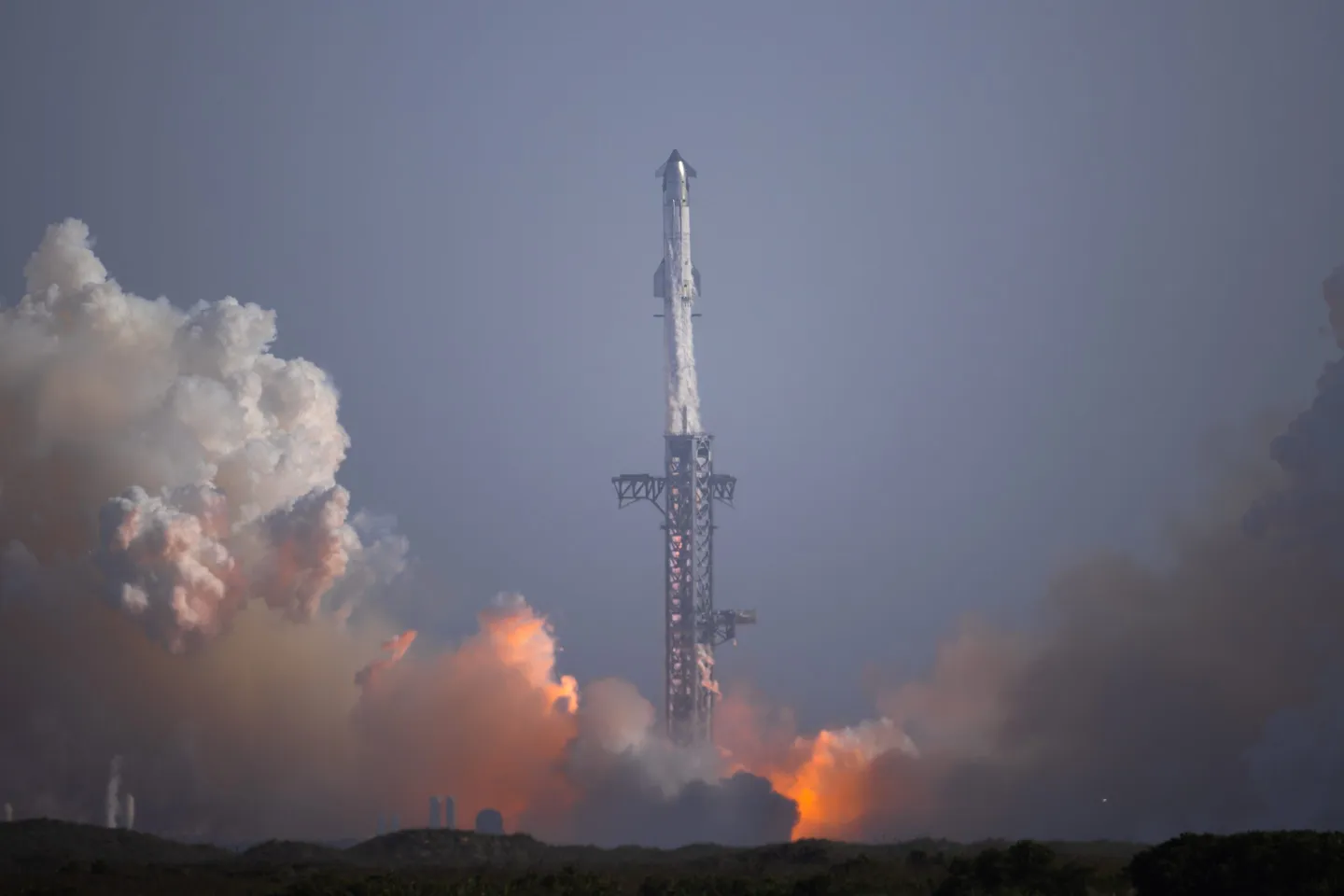
SpaceX’s latest Starship test flight delivered the kind of mixed result that now defines the company’s public-market story: real technical progress, followed by another reminder that reusable heavy-lift rockets remain brutally difficult. The company successfully deployed its first third-generation Starlink satellites during Starship’s 13th test flight, but the Super Heavy booster failed during a planned simulated landing in the Gulf of Mexico.
TechCrunch reported that the booster made it further than during SpaceX’s first V3 Starship flight in May, but could not properly fire all the engines needed for its simulated landing burn. It eventually exploded after hitting the water faster than planned. The upper stage performed better, deploying the new Starlink satellites, surviving reentry and completing a simulated landing in the Indian Ocean without the kind of destructive ending seen in earlier attempts.
That progress matters because Starship is central to SpaceX’s long-term Starlink economics. The company has said the new V3 Starlink satellites could deliver far more downlink capacity than the current satellites launched on Falcon 9. Starship is supposed to carry larger batches of those heavier satellites, lowering the cost of network expansion and making Starlink more powerful as a broadband, defence and potentially AI infrastructure platform.
The problem is that Starship’s economics depend heavily on reuse. If SpaceX can fly and rapidly reuse both the upper stage and Super Heavy booster, the cost of launching satellites could fall dramatically. If the booster keeps failing during recovery attempts, the company still gains test data, but the promised cost curve remains unfinished. That is especially important now because SpaceX is no longer only telling this story to private investors. It is a public company carrying one of the most ambitious valuations in technology.
TechBooky’s earlier coverage of SpaceX’s IPO filing noted that Starship is one of the biggest operational variables in the company’s valuation case. SpaceX has presented Starship as the system that could transform satellite deployment, lunar missions, Mars plans, defence logistics and future space-based infrastructure. That is a huge amount of strategic weight to place on a rocket that is still being tested in public.
The new Starlink V3 deployment is still a useful milestone. Even though the satellites later burned up because Starship has not yet reached a stable operational orbit, SpaceX reportedly communicated with them while they were in space. That gives the company flight data for a more capable generation of Starlink hardware. For a network that depends on constant satellite replacement and capacity upgrades, every test that validates payload deployment has value.
Investors will still focus on the booster. SpaceX shares reportedly dipped after the booster failure before paring some losses in after-hours trading. That reaction is rational. Public investors can tolerate experimental failures if the learning curve is clear, but they will also measure how quickly SpaceX turns test data into reliable reusability. The company has always used a fly, fail and fix approach. The difference now is that every failure lands inside a market narrative about whether SpaceX can justify its post-IPO valuation.
The broader issue is that Starship has become more than a rocket programme. It is tied to Starlink’s capacity expansion, SpaceX’s defence pitch, Musk’s AI infrastructure ideas and even the discussion around orbital data centres. TechBooky’s explainer on orbital data centres made the same point: cheap, frequent and heavy launch capacity is the condition that makes many of those futuristic plans even remotely plausible.
Friday’s flight therefore leaves SpaceX in a familiar position. The company can point to clear progress on Starship and Starlink V3, but it still has to prove that the system can be reused at the scale its valuation assumes. That is not a small technical footnote. It is the centre of the SpaceX story.
Related Reading
More contextual TechBooky stories selected from tags, categories and article context.
Paul Femi Balo is the founder and publisher of TechBooky. He covers artificial intelligence, African technology, digital infrastructure, enterprise technology and the global digital economy.
We use cookies to ensure that we give you the best experience on our website. If you continue to use this site we will assume that you are happy with it.