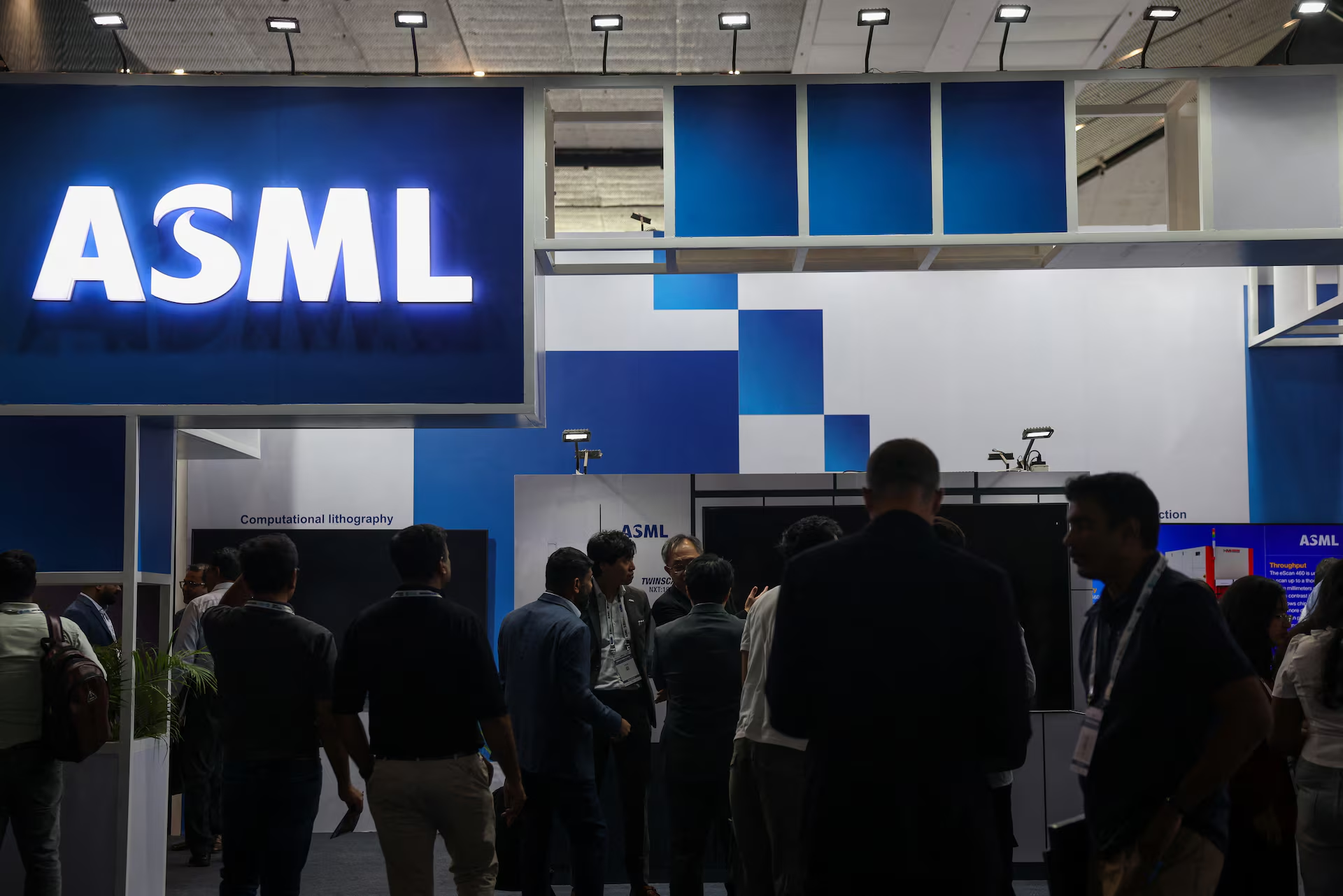
ASML has delivered a striking measure of how far the AI chip boom reaches. The Dutch company reported record third-quarter sales of EUR 11.7 billion and net income of EUR 5.0 billion on Wednesday, October 14. Yet the number that may matter most is not in the quarterly income statement: ASML says the supply it currently plans for 2027 and 2028 will not be enough to meet customers’ demand.
In its earnings announcement, ASML put its third-quarter gross margin at 57.5%. Sales from servicing and upgrading machines already installed at customer sites reached EUR 3.3 billion, above its guidance. That installed-base business is one reason the AI buildout is producing revenue for ASML even as chipmakers wait for new tools to be built and delivered.
Chief executive Christophe Fouquet said customers are increasing their short- and medium-term equipment forecasts, driven mainly by their expectations for AI investment. Some have expressed interest in placing orders for 2029 and even 2030. Interest is not the same as a firm order or guaranteed future revenue, but the unusually distant planning horizon explains why ASML is examining another increase in production capacity for 2028.
ASML makes the advanced lithography equipment used to print intricate patterns on chips. Its extreme ultraviolet systems are especially important for leading-edge processors, while other machines and upgrades support a broader range of logic and memory production. As chipmakers expand capacity for AI accelerators and the memory that feeds them, demand for the equipment behind those factories rises too. The bottleneck is not simply a question of selling more machines; complex supply chains and long manufacturing cycles limit how quickly they can be delivered.
The company expects fourth-quarter sales of EUR 14.2 billion to EUR 15.2 billion, with a gross margin around 57%. For 2026 as a whole it now forecasts EUR 44 billion to EUR 45 billion in sales and a gross margin around 56%. The new annual range raises the lower end of the EUR 43 billion to EUR 45 billion outlook it gave in July, rather than lifting the ceiling. TechBooky covered that earlier upgrade; today’s results add the sharper capacity warning.
For investors and the chip industry, the figures offer both reassurance and a caution. Demand from AI infrastructure is translating into substantial sales for a key equipment supplier, not just into spending promises by cloud companies. At the same time, a customer asking for a tool years ahead does not mean a data centre can be built or filled with chips on that timetable. Factory capacity, power, memory and packaging still have to come together.
ASML has already discussed a 30% increase in capacity for certain EUV and deep ultraviolet tools in 2027 and is investigating further expansion in 2028. Whether it can move faster without compromising delivery or margins will become an important test. For now, its latest quarter suggests the semiconductor supply chain remains one of the clearest places to see AI spending turn into real orders, and one of the clearest places to see its limits.
Related Reading
More contextual TechBooky stories selected from tags, categories and article context.
Paul Balo is the founder of TechBooky and a highly skilled wireless communications professional with a strong background in cloud computing, offering extensive experience in designing, implementing, and managing wireless communication systems.
We use cookies to ensure that we give you the best experience on our website. If you continue to use this site we will assume that you are happy with it.