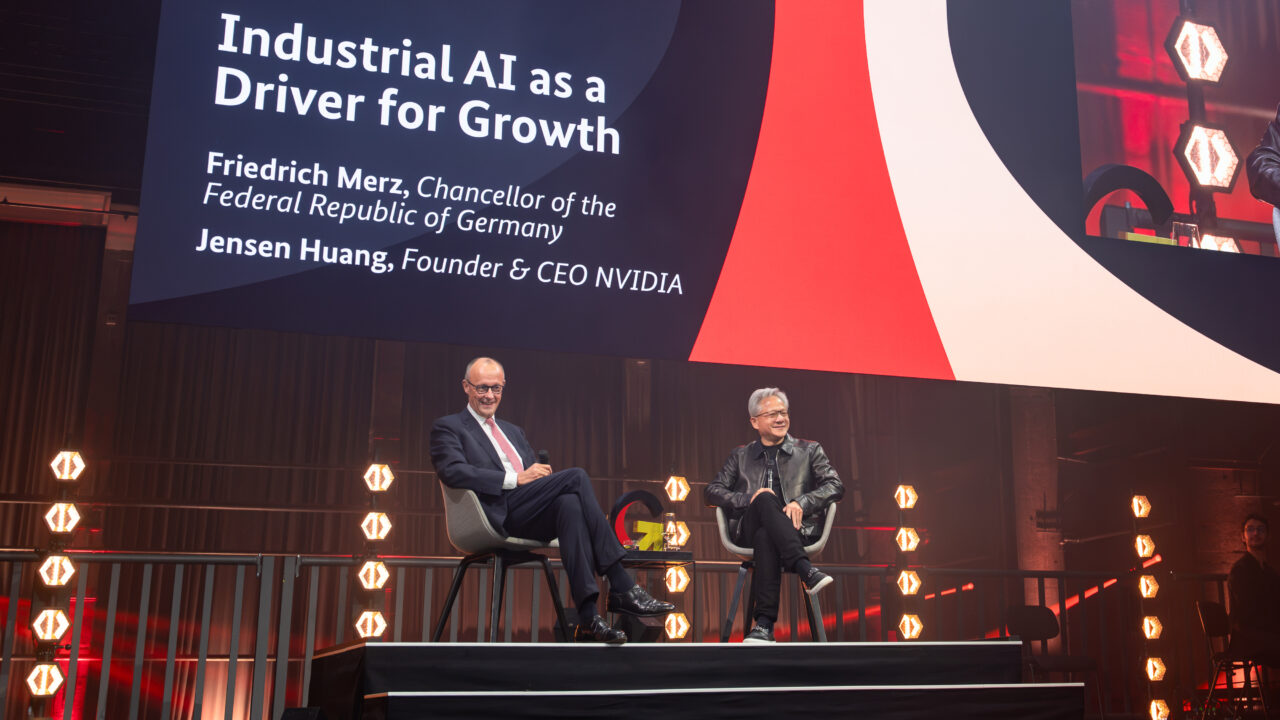
Nvidia is putting Germany’s factories at the centre of its next AI pitch. During a visit to Berlin on October 19, chief executive Jensen Huang joined Chancellor Friedrich Merz as the company and German partners outlined a push to bring physical AI into manufacturing. The move gives a more concrete setting to Huang’s argument that the next wave of artificial intelligence will extend beyond chatbots and into machines that plan, sense and act in the real world.
Nvidia says a joint declaration of intent with Germany’s federal government and its Industry 4.0 Platform will support the development of models for physical AI and adoption among manufacturers, including small and medium-sized firms. A declaration sets direction; it is not evidence that factories have already deployed the technology at scale.
The distinction matters because Germany has a deep industrial base but turning demonstrations into repeatable factory systems is hard. A model that can answer a question is not automatically capable of understanding equipment, production constraints, worker safety and real-time changes on an assembly line. Physical AI is an umbrella term for systems that perceive or simulate the physical world and, in some cases, help machines take action within it.
Huang’s Germany visit connected Nvidia’s software and computing ambitions to an economy known for manufacturing expertise. Nvidia also highlighted work with Siemens in Erlangen on factory applications, including planning agents and digital twins. A digital twin is a virtual model of an industrial process or site that can be used to test changes before applying them to physical operations.
Nvidia said it plans to invest in four German startups: Agile Robots, Avelios Medical, Mirelo and Reflex Aerospace. These are planned investments, and the company did not give a combined figure in its announcement. The list shows how broadly Nvidia defines the opportunity, spanning robotics, medical technology, audio AI and space systems. It should not be mistaken for a disclosed funding round or a finished industrial rollout.
The German government’s interest is also about access to industrial data. Merz urged the Mittelstand, the country’s network of smaller and medium-sized businesses, to open more company data for AI development. That could help build tools that understand actual production settings, but it raises familiar questions about confidentiality, control and how much value participating firms retain.
Nvidia already has a broader robotics strategy. TechBooky has reported on the company’s push to supply the technology behind physical AI. Germany gives that strategy a prominent industrial partner and a test of whether simulation, models and AI infrastructure can solve problems manufacturers will pay to address.
Success will depend on more than a high-profile announcement. Factory operators will need systems that work with existing equipment, meet safety requirements and produce measurable gains in quality or productivity. Smaller firms may also need affordable access to computing and staff who can maintain these tools. Germany’s declaration points to a direction of travel; the important evidence will be the deployments that follow.
Related Reading
More contextual TechBooky stories selected from tags, categories and article context.
Paul Femi Balo is the founder and publisher of TechBooky. He covers artificial intelligence, African technology, digital infrastructure, enterprise technology and the global digital economy.
We use cookies to ensure that we give you the best experience on our website. If you continue to use this site we will assume that you are happy with it.