With its Articles feature, Elon Musk’s X allows you to create lengthy material, but only if you’re a business or a paid subscriber. A distinct approach is taken by the decentralized social networking business Bluesky.
A new version of Bluesky’s app that interfaces with Standard.site, a community effort for creating long-form content using the same underlying protocol that powers Bluesky, was released on Thursday.
This feature, which was made available in a recent program update, enables Bluesky’s 44.5 million registered users to find, view, and interact with full-length articles, blogs, and newsletters from within their feeds.
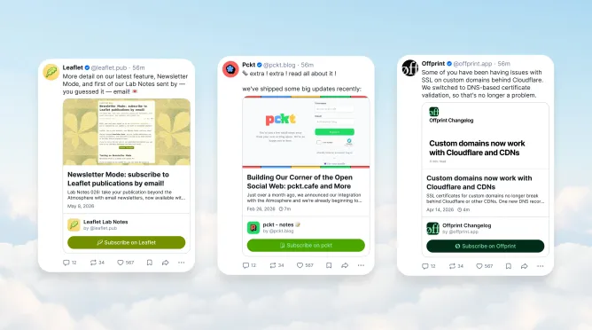
As a result, users of Bluesky can now browse information that goes beyond microblogs, or the brief posts for which Bluesky is renowned. Rather, they can read newsletters, blog entries, and articles distributed throughout the “Atmosphere,” a larger network of AT Protocol-powered applications. This includes websites like Leaflet, pckt, and Offprint, which serve independent authors and publishers who wish to take ownership of their work and increase its dissemination on the open web.
At first, these articles will show up as dynamic link cards, which are just an improved preview. This is only the beginning, according to Bluesky, and the functionality will be enhanced over time.
This is the second time that Bluesky’s capabilities have been expanded based on other community-built projects. Thanks to a similar integration, a business named Germ became the first private messaging service that could be launched straight from Bluesky’s app in February.
Bluesky is able to take advantage of other apps and services that are also utilizing the AT Protocol by developing the technological infrastructure in addition to its social networking client application. The third parties can take advantage of the distribution offered by Bluesky’s network of over 44.5 million registered users, so that’s not a bad deal either.
Shortly after WordPress announced its own plug-in earlier this month that enables any WordPress site to publish to the Atmosphere, the company expanded to include long-form content. (The plug-in complements another WordPress that is currently available for publishing to open social sites like Mastodon that are supported by an alternative protocol, ActivityPub.)
Like Bluesky, WordPress’s integration relied on Standard.site’s lexical records, which essentially implies that your blog becomes data on the AT Protocol itself rather than only a link that you share on an app such as Bluesky. As a result, users of anyprogram that is compatible with the AT Protocol may be able to view WordPress blog postings.
The startup’s concept for the open social web, in which data is freely distributed, available from any client, and allows users to switch between personal data servers (PDS) whenever they want, is becoming increasingly apparent with this integration coming to Bluesky. (Although Bluesky was the original PDS, Eurosky, Blacksky, Northsky, and other companies now offer alternatives.)
That is undoubtedly different from X’s approach to material, whether it be long-form or not, which stays contained within its app and can only be incorporated on other websites.
But X has a distribution advantage thanks to its 550 million monthly active users, which Bluesky’s open social competition would never be able to match.
The new Bluesky update (v1.122) also brings several other features, the company said, such as a revamped GIF picker and photo viewer, broader account-level moderation labels, and a fix for a bug that was silently dropping some iOS video uploads.
Bluesky now enables decentralized long-form content with dynamic link cards and WordPress interoperability, though it still trails X’s 550 million monthly active users.
Related Reading
More contextual TechBooky stories selected from tags, categories and article context.
We use cookies to ensure that we give you the best experience on our website. If you continue to use this site we will assume that you are happy with it.