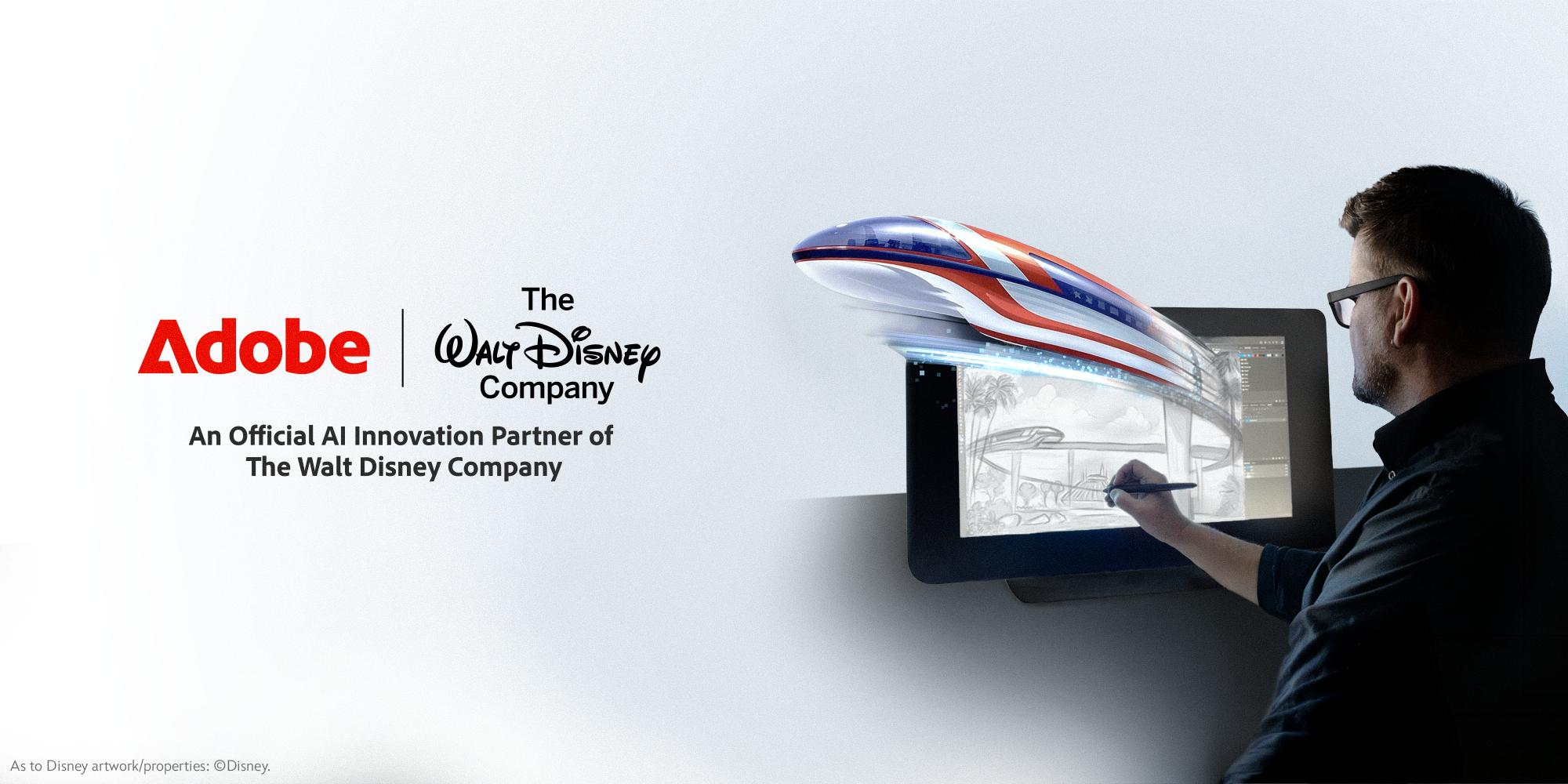
Disney and Adobe have signed a multi-year alliance that will bring custom generative AI tools deeper into Disney’s creative and production work. The agreement, announced on 9 November at Adobe MAX, makes Adobe an official AI innovation partner and gives Disney access to Firefly Foundry models, creative software and dedicated engineering support. It is a broader arrangement than the two companies’ earlier work on theme park design, but it is not an announcement that AI will replace Disney’s artists or produce finished films on its own.
The centrepiece is Adobe Firefly Foundry. According to Adobe’s announcement, the companies will develop proprietary models tailored to Disney properties, with knowledge of characters, settings and visual styles. Adobe describes the process as “human-centred” and “artist-led”, and says the aim is commercially safe, production-ready output. Those are the companies’ goals, not an independent finding that every generated asset is ready to use without review.
This relationship did not begin today. Adobe and Walt Disney Imagineering announced a narrower collaboration in June to accelerate design and pre-production visualisation for parks and experiences. Imagineering is already using a sketch-to-image model that turns hand-drawn concepts into rendered 2D artwork, alongside a custom image model designed to produce assets that remain consistent with a franchise’s established look. The new deal takes that work into a wider set of Disney teams and workflows.
For a studio with valuable characters and carefully controlled worlds, consistency matters as much as speed. A generic image generator may create a plausible character while getting costume details, proportions or a setting wrong. Models adapted to authorised Disney material could make it easier for artists to explore variations without repeatedly correcting those elements. Disney has said its Firefly Foundry work draws on its own creative assets, while Adobe says the models are built for rights-conscious commercial use. The companies have not disclosed the financial terms of the alliance or a timetable for deploying every planned tool.
The expanded partnership includes early access to Adobe Firefly, Premiere and Photoshop, as well as research and engineering resources for Disney’s production pipeline. Adobe will also join The Walt Disney Studios’ StudioLAB programme, where creative and technical teams prototype internal tools. ESPN Edge, the sports broadcaster’s innovation centre, will explore how AI might improve fan engagement and find new uses for ESPN’s archive. These StudioLAB and ESPN projects are described as collaborations and experiments; the announcement does not identify a finished consumer product.
The deal also contains conventional commercial elements, including marketing activity across Disney’s platforms and appearances at industry events. That makes it both a technology agreement and a strategic alliance. Adobe gains a prominent showcase for its enterprise AI approach, while Disney gets tools developed around its own intellectual property rather than a public, one-size-fits-all model.
The distinction is particularly important in entertainment, where generative AI has prompted disputes over copyright, training data and creative jobs. Giving artists a controlled way to test concepts may be useful, but the quality of the eventual work will depend on human judgement and on how Disney governs its assets and approvals. Adobe’s description of a model as “artist-led” does not, by itself, answer every question about how workers, performers and rights holders will be affected.
The real measure of this deal will be whether custom models help Disney teams move from an idea to an approved design faster without eroding the craft or control behind the final result. Imagineering offers an early practical example. StudioLAB and ESPN Edge will show whether the same approach can travel across Disney’s much larger production and media business.
Related Reading
More contextual TechBooky stories selected from tags, categories and article context.
Paul Femi Balo is the founder and publisher of TechBooky. He covers artificial intelligence, African technology, digital infrastructure, enterprise technology and the global digital economy.
We use cookies to ensure that we give you the best experience on our website. If you continue to use this site we will assume that you are happy with it.