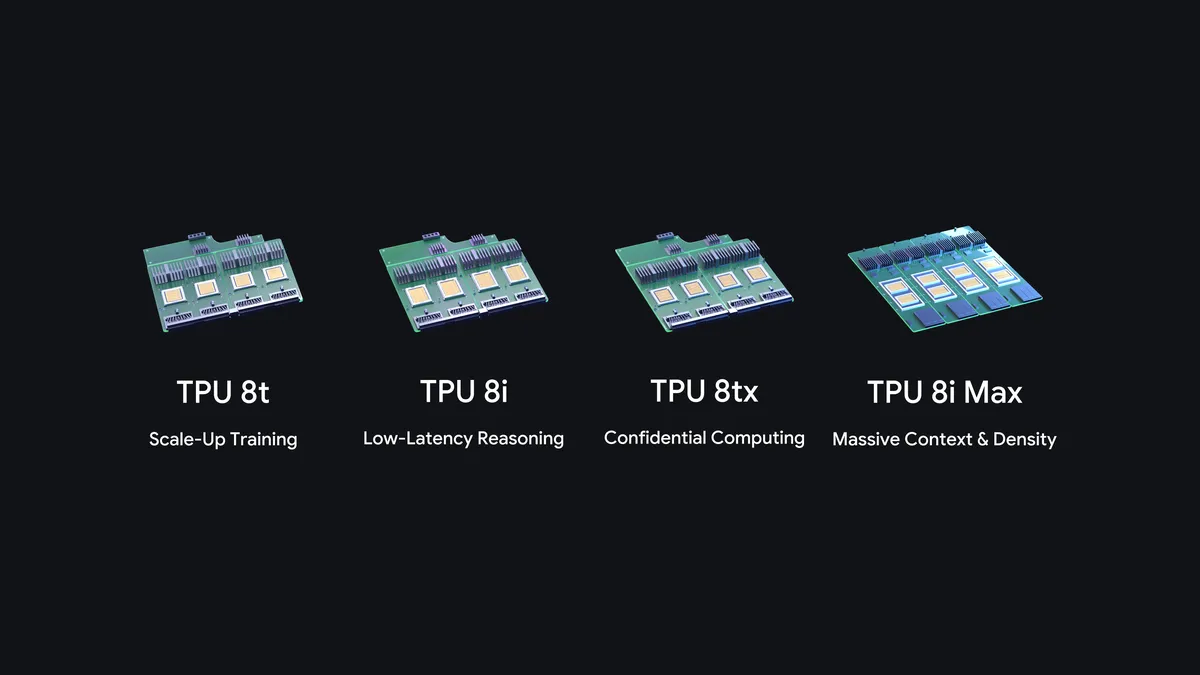
Google has expanded its eighth-generation AI hardware line-up with two new TPU systems, one designed for confidential computing and the other for the large memory demands of AI agents. The company announced TPU 8tx and TPU 8i Max on Monday, taking its portfolio to four systems this year.
The distinction is important. These are not two entirely new chip designs. Google has reconfigured the packaging and surrounding infrastructure of existing eighth-generation silicon to serve different workloads. It says this modular approach lets it respond to customer needs more quickly than a fresh chip design cycle would allow.
TPU 8tx targets secure and confidential inference, including government and regulated enterprise work that involves proprietary models or sensitive information. Google says its hardware-level confidential computing features are also intended for private fine-tuning and secure agent execution. The claim speaks to a practical obstacle to wider enterprise AI adoption: customers may want AI capability without exposing their data while it is being processed.
TPU 8i Max addresses a different constraint. Google combines two low-latency TPU 8i chips in one package and says the result doubles compute, on-chip SRAM and high-bandwidth memory bandwidth relative to TPU 8i. The company is pitching it for applications that need to keep very large contexts available, such as agents working across a substantial codebase or hours of video.
Neither description is an independent performance assessment. Google has not supplied a public price list or a clear general-availability timetable for the two configurations in its announcement. Customers will need real-world benchmarks and total operating costs before deciding how the systems compare with other accelerators.
Google originally developed TPUs for its own services, but says its chip business now has nearly 100 customers. That gives the company a stronger position as AI developers look beyond a single hardware supplier. The competitive question is no longer just which chip is fastest. Security, memory capacity, software compatibility and the cost of running agents at scale increasingly shape buying decisions.
The launch also extends Google’s earlier division of labour between TPU 8t for training and TPU 8i for inference. With 8tx and 8i Max, it is adding specialist systems without claiming a whole new generation of silicon. For customers, that may be more useful than another headline benchmark if it translates into dependable deployment for sensitive, long-running AI work.
Related Reading
More contextual TechBooky stories selected from tags, categories and article context.
Paul Femi Balo is the founder and publisher of TechBooky. He covers artificial intelligence, African technology, digital infrastructure, enterprise technology and the global digital economy.
We use cookies to ensure that we give you the best experience on our website. If you continue to use this site we will assume that you are happy with it.