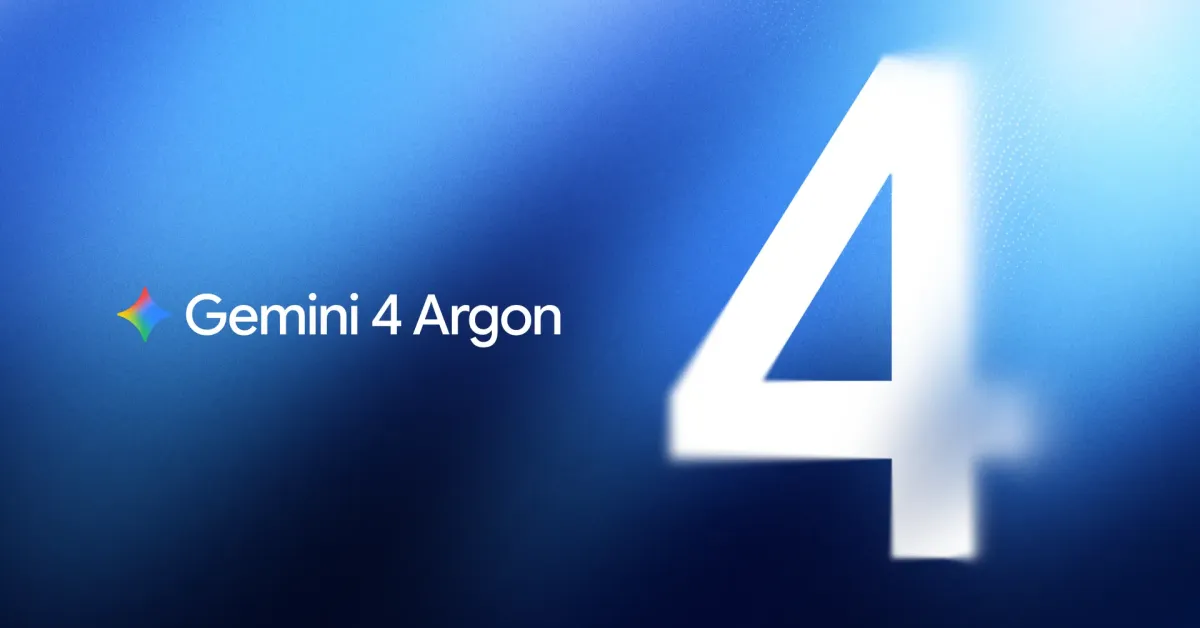
Google has introduced Gemini 4 Argon, its new frontier AI model, but this is not a release that most people can try today. The company is putting it first in the hands of a limited group of trusted cybersecurity defenders while it tests the safeguards needed for wider access.
That cautious launch is as much a part of the story as the model itself. In its September 30 announcement, Google describes Argon as built for work that can stretch across many steps, including software engineering, legal and financial research, and finding and fixing security flaws. It is a different pitch from simply giving a chatbot a smarter answer. Google wants an AI system that can stay with a difficult job long enough to finish it.
One striking specification is a proposed output limit of one million tokens, up from 64,000 on the previous model Google compares it with. That is output capacity, not a promise that every response will be useful or economical at that length. It could, however, allow a model to work through substantial coding or research tasks without stopping because it has run out of room to generate the next step.
Google says its engineers have already used Argon on code migrations, debugging and internal efficiency projects. The company cites a 77.9% result on DeepSWE v1.1 for longer software-engineering tasks and says Argon leads several evaluations of finance, legal and enterprise work. Those are promising figures, but they are benchmarks and company-reported examples. Independent use will tell us more about reliability, cost and how often a human still has to step in.
The cybersecurity angle explains the unusual rollout. Google says Argon can autonomously identify, validate and patch critical vulnerabilities. Wiz is already using the model in its Scan for Good initiative, according to Google, and the company says an early test found a serious issue in healthcare software that other frontier models had missed. The same capabilities that help defenders can be dangerous if they are misused. That is why Google is limiting access and continuing its pre-release safety work.
Google has also stated an introductory API price of $2 per million input tokens and $10 per million output tokens, with a 95% discount on cached input. The company says standard pricing will rise after the introductory period. Those figures matter to developers, but the practical price of a long-running agent depends on how many tokens and tool calls it needs to complete a task. As we noted when looking at Gemini 3.8 Flash’s cost question, a low token rate does not automatically mean a cheap finished job.
Google says broader access will start with paid API customers and Google AI Ultra subscribers after further testing, but it has not given a public release date. For now, Gemini 4 Argon is a significant announcement, not a model generally available in the Gemini app. The bigger question is whether Google can turn its early results into dependable work for ordinary developers and businesses without making the cyber risks harder to control.
Related Reading
More contextual TechBooky stories selected from tags, categories and article context.
Paul Balo is the founder of TechBooky and a highly skilled wireless communications professional with a strong background in cloud computing, offering extensive experience in designing, implementing, and managing wireless communication systems.
We use cookies to ensure that we give you the best experience on our website. If you continue to use this site we will assume that you are happy with it.