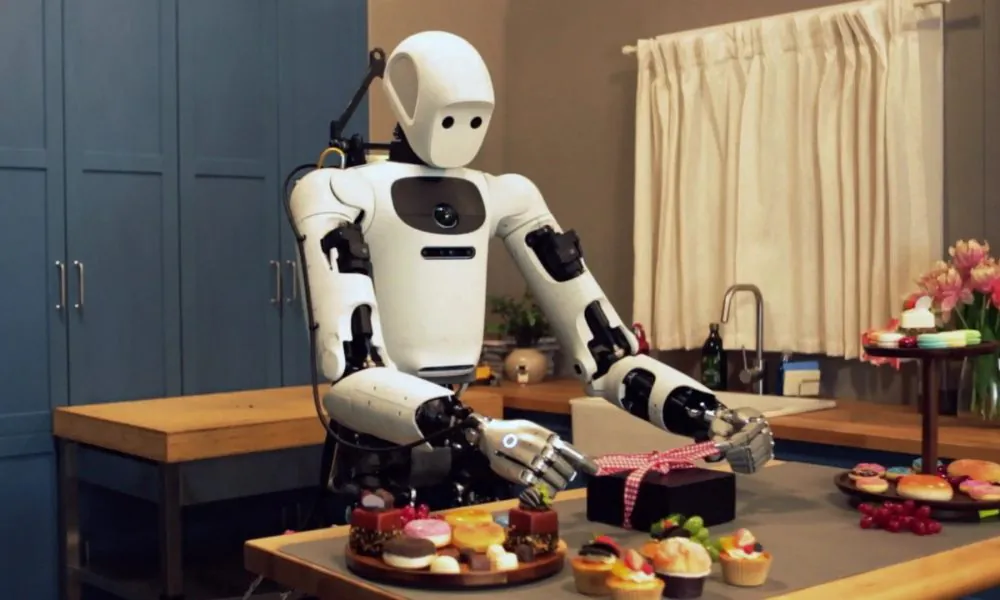
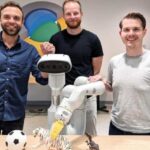
Google DeepMind has introduced Gemini Robotics 2.5, an AI model designed to help robots learn more physical tasks and carry them out with greater dexterity. The most striking claim is not a laboratory demonstration. Google says an Apptronik Apollo 2 humanoid used the system to sort car parts on Mercedes-Benz production lines in Hungary and Germany, achieving a 96% success rate in a proof of concept.
That is an important step for physical AI, but it is not evidence that Mercedes-Benz has replaced factory workers or rolled out the robots across its plants. The reported result comes from a specific pilot involving automotive kitting, the repetitive work of taking parts from bins and arranging them for assembly. Neither Google nor its partners has disclosed the duration of the trial, the number of completed cycles or a commercial deployment timetable.
In its 10 November announcement, Google described Gemini Robotics 2.5 as a vision-language-action model. Put simply, it interprets what a robot sees and hears, then produces movements rather than only a written answer. A separate embodied reasoning system tracks the broader task while the action model controls the machine’s arms and hands. Google says the model works across different robot designs, including Apptronik’s humanoid and a two-armed research platform.
The company evaluated the new model on more than 200 tasks. Across its tests, it reports success rates 30% to 100% higher than previous baselines, depending on the task, and completion times 20% to 30% faster. Some demonstrations involve deceptively difficult jobs such as handling flexible objects or using tongs. These are company-run evaluations, however, and performance in a controlled test does not automatically translate to a busy production line with changing layouts, people and unexpected obstacles.
At Mercedes-Benz, Apollo 2 reportedly reached into supply bins, picked up metal brackets and placed them into sequencing containers. Google says the robot corrected for gaps while working. This is more meaningful than a single scripted movement because a useful industrial robot must cope with variation. Yet a 96% success rate also leaves failures to manage. The commercial question is what happens when the robot misses a part, how quickly a person can intervene and whether the system improves overall throughput after its cost and downtime are counted.
Google also says it has improved the model’s ability to avoid hazards and refuse unsafe instructions. It is releasing a benchmark for attempts to trick robots into carrying out dangerous actions. Those safeguards matter more in a shared workplace than they do in a chatbot. Physical mistakes can damage equipment or injure people, so independent testing and site-specific controls will be essential before a pilot becomes routine operations.
The update fits a wider push to move AI from screens into machinery. TechBooky has also examined Nvidia’s physical AI ambitions in German factories. The distinction is that Google is now pointing to a particular robot task on active Mercedes-Benz lines, while still withholding the operating figures needed to judge a scaled business case.
Gemini Robotics 2.5 is rolling out to Google’s robotics partners, not to consumers as a standalone product. The next meaningful proof will be sustained, independently assessed work across more tasks and sites, with published data on error recovery, safety, maintenance and cost. For now, the Mercedes-Benz trial shows that humanoid robots are becoming more adaptable, not that the factory floor has been automated overnight.
Related Reading
More contextual TechBooky stories selected from tags, categories and article context.
Paul Femi Balo is the founder and publisher of TechBooky. He covers artificial intelligence, African technology, digital infrastructure, enterprise technology and the global digital economy.
We use cookies to ensure that we give you the best experience on our website. If you continue to use this site we will assume that you are happy with it.