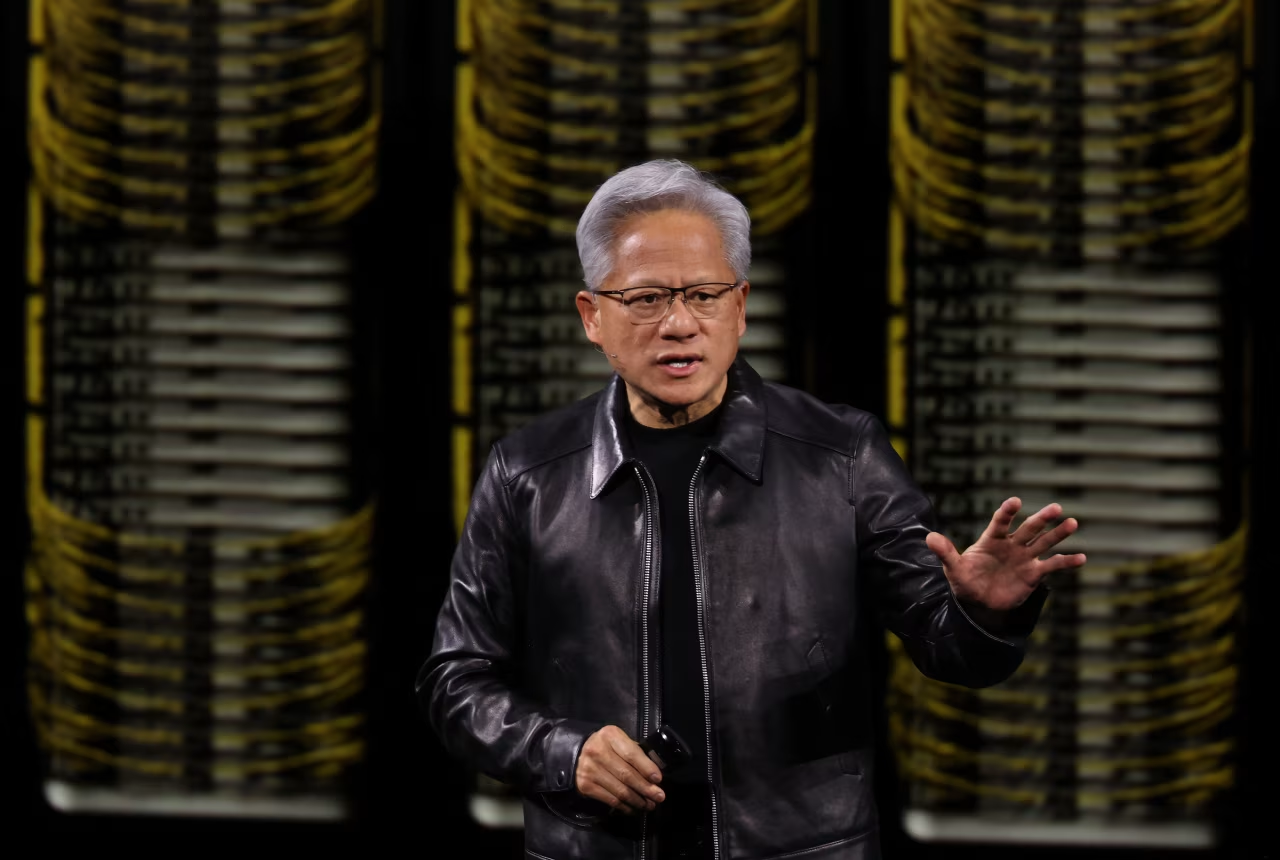
Nvidia’s quarterly earnings on Tuesday will be the first since Jensen Huang stepped down as chief executive. That makes an already closely watched measure of artificial intelligence spending a test of leadership continuity at the world’s dominant AI chip supplier.
The company said it will report results for its fiscal third quarter, which ended on 25 October, before a conference call at 2pm Pacific time on 17 November. Colette Kress is serving as interim chief executive while the board searches for a permanent successor. Investors will be listening for evidence that customer demand and Nvidia’s product roadmap remain intact through the transition.
Nvidia’s previous quarter provided a formidable comparison. Revenue reached $96.2 billion, up 106% from a year earlier, while data centre revenue was $89 billion. The company guided for approximately $108 billion in third-quarter revenue, plus or minus 2%, and said that forecast assumed no data centre compute revenue from China.
The headline sales figure will matter, but so will the composition of growth. Cloud providers and AI developers have been committing huge sums to computing infrastructure. Investors need to know whether Nvidia can keep supplying systems at scale, protect margins and turn orders into delivered revenue. Any change to its China assumptions could also affect the interpretation of the forecast.
Those are questions, not predictions. The quarterly figures have not yet been released, and a strong or weak result cannot be inferred from the company’s earlier guidance. The written release and call should clarify how management sees demand, supply and product availability in the months ahead.
Huang’s departure has added an unusual governance question to the normal earnings debate. Nvidia said Kress would hold the chief executive role on an interim basis and that its board would consider internal and external candidates. Analysts and shareholders will want to understand how decision-making works during that search, but the company has not named a permanent replacement.
For customers, continuity may be more important than the identity of the next chief executive in the short term. Large AI installations are planned over years, and buyers need confidence in support, networking, software and future chips as well as the current shipment schedule. A management transition could matter if it changes execution or the pace of investment, but the earnings announcement will provide the first public financial checkpoint rather than a definitive verdict.
The stakes are broader than Nvidia. Its results have become a read-through for spending across cloud computing, chip manufacturing and the AI software market. If demand remains exceptionally strong, the industry’s capital expenditure plans gain another supporting data point. If growth slows, investors will ask whether the build-out is entering a more selective phase. Neither outcome should be treated as settled before Tuesday’s figures arrive.
Paul Femi Balo is the founder and publisher of TechBooky. He covers artificial intelligence, African technology, digital infrastructure, enterprise technology and the global digital economy.
We use cookies to ensure that we give you the best experience on our website. If you continue to use this site we will assume that you are happy with it.