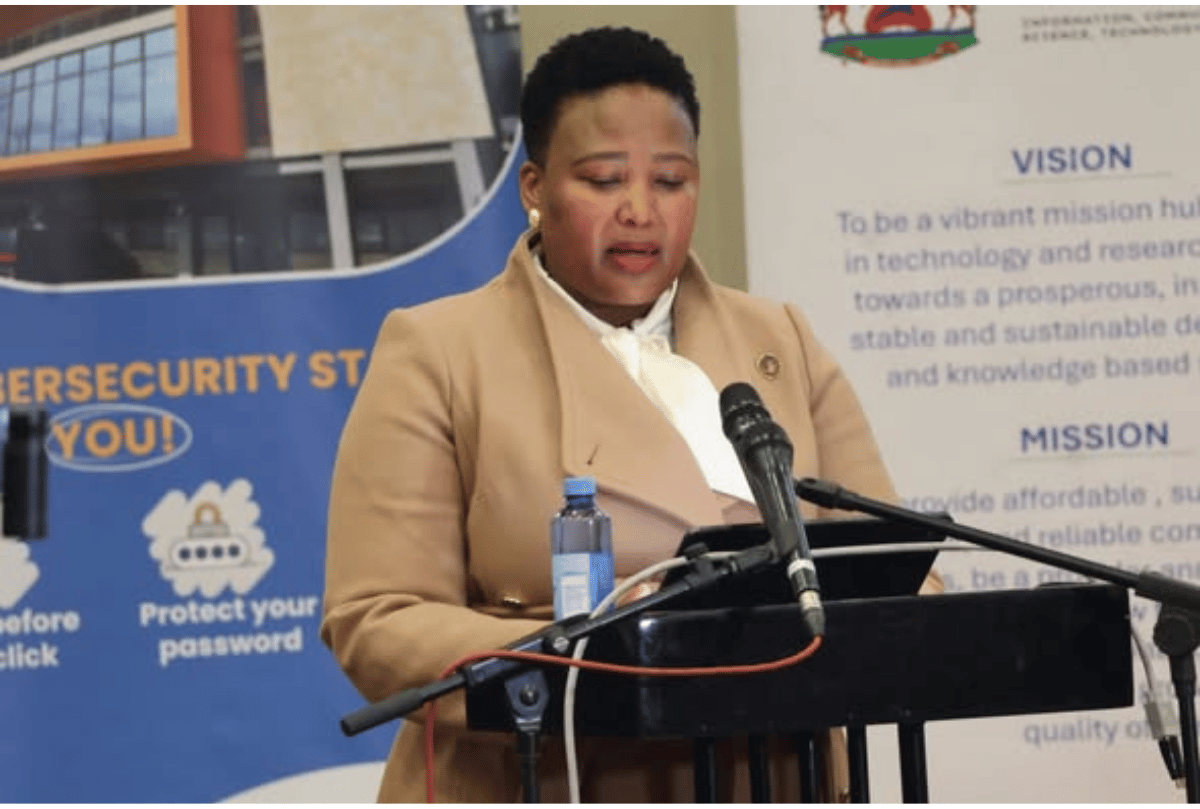
Lesotho has taken a practical step toward strengthening its digital economy by launching a national cyber incident response capability. It is the kind of move that may not sound as flashy as a new AI model or satellite network, but it matters because digital transformation cannot scale if citizens, banks, agencies and businesses do not trust the systems underneath it.
The Ministry of Information, Communications, Science, Technology and Innovation has launched LesComCSIRT and the inaugural National Cybersecurity Forum. The Lesotho Communications Computer Security Incident Response Team also lists the launch on its official site, marking a formal step toward coordinated national cyber response.
A CSIRT is not just a government badge. It is the team that helps a country detect, warn about and respond to cyber incidents. When government portals are attacked, banks face fraud campaigns, telecoms see network abuse or public institutions suffer breaches, a national CSIRT can coordinate alerts, technical guidance, incident response and information sharing. Without that structure, every institution is left to fight too much on its own.
That matters more now because African economies are digitizing quickly. Payments, telecoms, public records, digital IDs, health systems and tax platforms are all moving online. Lesotho own digital transformation agenda will depend on whether those systems are secure enough for citizens and investors to use with confidence. Cybersecurity is no longer a technical add-on. It is part of national infrastructure.
The launch also comes at a time when cyber threats are becoming more automated and more AI-assisted. Phishing, credential theft, impersonation and malware are easier to scale when attackers can generate convincing messages, automate reconnaissance and target weak systems faster. Smaller economies are not exempt from this because attackers often go where defenses are weaker, not only where the largest financial reward sits.
This is why the National Cybersecurity Forum is useful alongside the CSIRT. A response team needs more than technical tools. It needs cooperation between government, telecom operators, banks, critical infrastructure providers, universities and private companies. Cyber incidents often move across sectors, so the response has to move across sectors too.
Lesotho is not alone in this regional shift. Uganda recently launched its own 2026 cybersecurity framework, while other African governments are updating cyber laws, building CERTs and pushing institutions to improve resilience. The pattern is clear: as digital services become essential, cybersecurity becomes a public policy priority rather than only an IT department concern.
The financial sector will be one of the biggest beneficiaries if the system works well. Mobile money, bank apps, digital payments and online lending depend on trust. A single major breach can slow adoption and give users a reason to return to cash. That is why the cybersecurity conversation sits close to fintech development across Africa. Countries that want stronger digital payments need stronger incident response, fraud coordination and public awareness.
There is also an investment angle. Companies looking to build data centres, cloud services, fintech products or outsourced digital operations pay attention to cyber maturity. A country with clear response structures and active public-private coordination looks less risky than one where incidents disappear into silence. Lesotho can use this launch to improve its credibility, but only if the CSIRT is funded, staffed and allowed to work consistently.
The hard part starts after the ceremony. A national CSIRT needs skilled people, reporting channels, threat intelligence, legal clarity, trust from private companies and a habit of publishing useful advisories. It also needs to avoid becoming only a symbolic institution. Cybersecurity improves through repetition: exercises, drills, incident reviews, vulnerability handling and regular communication.
Lesotho launch is still worth taking seriously. The country is acknowledging that digital growth and cyber resilience have to develop together. As AI, cloud, payments and public digital services spread across Africa, governments that build response capacity early will be better placed to handle the attacks that inevitably follow.
Related Reading
More contextual TechBooky stories selected from tags, categories and article context.
Paul Balo is the founder of TechBooky and a highly skilled wireless communications professional with a strong background in cloud computing, offering extensive experience in designing, implementing, and managing wireless communication systems.
We use cookies to ensure that we give you the best experience on our website. If you continue to use this site we will assume that you are happy with it.