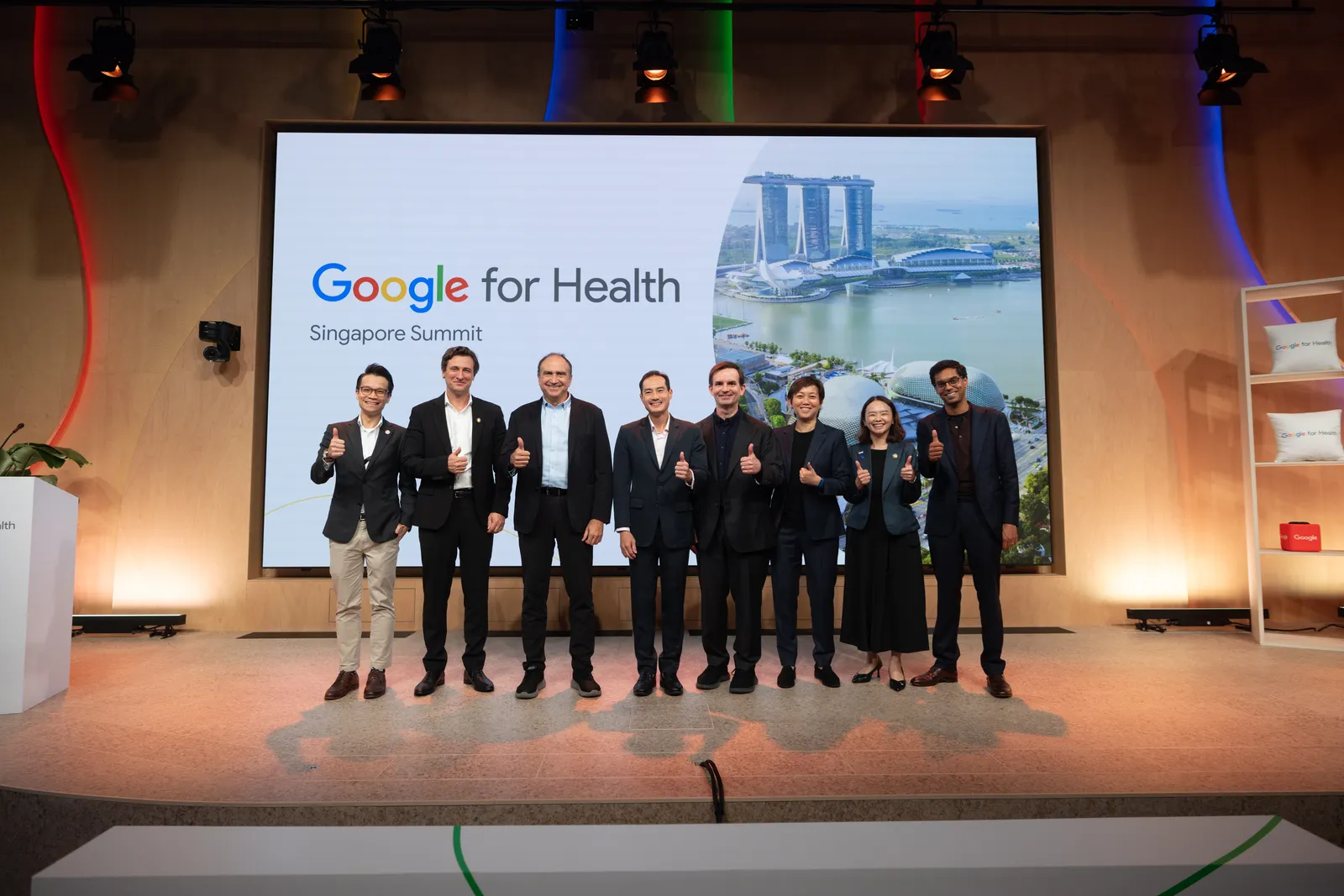
Google is expanding its healthcare AI work in Singapore with a new research hub, a clinician-support evaluation and a project to identify health risks earlier. Announced on 29 October at the Google for Health Summit, the package reaches beyond a chatbot for doctors. It tests whether advanced models can be made useful inside a public health system while keeping clinicians responsible for care and patient data under local control.
The distinction between an announcement and a working clinical service matters here. Google says its researchers are establishing a local hub, while its partners are evaluating tools for medical work. Singapore’s Ministry of Health described the most ambitious co-clinician idea as beginning in simulation, before any progression into real-world patient-management workflows. Neither organisation has announced a nationwide clinical rollout or evidence that the new tools improve patient outcomes.
According to Google’s announcement, the research hub will bring together scientists and software engineers in Singapore to work on foundational AI models and scientific discovery. Google says it will collaborate with the National University of Singapore and Nanyang Technological University. It also intends to expand health research using open models such as MedGemma, which local organisations can adapt while retaining control of their data.
Google.org and Google DeepMind have committed $7 million to the Philanthropy Asia Alliance’s Health for Human Potential Coalition. Google says $1 million of that amount will support PathGen, a disease-threat detection platform intended to share public-health intelligence without forcing participating countries to surrender local data control. The funding is a research and public-health commitment, not a claim that an AI system can already diagnose patients at scale.
On the clinical side, Google DeepMind is working with the National University Health System to evaluate an AI co-clinician. Its initial role is to bring together relevant medical guidelines and research, and help doctors address clinical questions. Separately, Google Cloud and NHG Health are exploring predictive tools that could spot risks such as chronic conditions across groups of residents. Google says those insights would feed an AI health coach on NHG HealthBot, powered by Gemini Enterprise for Customer Experience, to offer lifestyle guidance and preventive reminders.
A model that retrieves a useful paper is one thing. A system that influences a patient’s care pathway is another. In remarks at the summit, Singapore’s Senior Minister of State Tan Kiat How said any move towards more active AI participation in care must begin with simulation and rigorous evaluation. The questions include whether an action is appropriate, when the tool should escalate a case and which decisions must remain with a professional.
Those concerns extend to the proposed health coach. Identifying someone at higher risk is not the same as delivering better care. False alerts could worry patients or burden staff, while a missed risk could create false reassurance. The partners will need evidence about accuracy across different populations, whether people follow up on advice, how urgent issues reach clinicians and how the tools perform once they leave controlled tests. The ministry says continuing monitoring would be needed even after deployment.
Data governance is equally important. Singapore has connected health information and public infrastructure that could help researchers test systems in real settings, but sensitive medical records require clear limits on access and use. Google’s emphasis on local data sovereignty through adaptable models addresses part of that question. It does not, by itself, settle issues of consent, auditability or responsibility when a recommendation is wrong.
The Singapore work is notable because it joins model development to hospitals and population-health services rather than presenting a standalone AI product as a cure for healthcare pressure. Google is already working on health AI in other settings. TechBooky recently examined its offline tuberculosis-screening work in South Africa, where the crucial question was whether flagged patients could reach confirmatory testing and treatment. The same principle applies in Singapore. A helpful answer from AI only matters if the health system can act on it safely.
For now, Singapore offers a substantial research partnership and a test of how AI might support doctors and preventive care. The next meaningful milestones are published evaluation results, clear safeguards for patient information and evidence that clinicians and residents benefit in practice. Until then, the co-clinician and predictive-care plans should be understood as work in progress, not as proof that AI is running Singapore’s healthcare system.
Related Reading
More contextual TechBooky stories selected from tags, categories and article context.
Paul Femi Balo is the founder and publisher of TechBooky. He covers artificial intelligence, African technology, digital infrastructure, enterprise technology and the global digital economy.
We use cookies to ensure that we give you the best experience on our website. If you continue to use this site we will assume that you are happy with it.