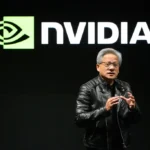
Nvidia CEO Jensen Huang has again said the company may already have achieved AGI for many tasks. AGI, or artificial general intelligence, broadly refers to AI that can reason, learn and perform a wide range of intellectual tasks at or above human level rather than being limited to one narrow job. He also described the milestone as senseless. That contradiction is exactly why the term has become one of the most powerful and least useful phrases in technology.
On Nvidia’s latest earnings call, reports that Huang said Nvidia could say it had already achieved AGI for many tasks, but then argued that such milestones are not very meaningful. MarketWatch also noted the comment, which came as Nvidia was explaining another massive AI-driven quarter to investors.
Huang has a point. AGI sounds like a finish line, but the industry cannot agree on what the finish line actually is. OpenAI has used language around systems that outperform humans at economically valuable work. Others talk about powerful AI, personal superintelligence, safe superintelligence, humanist superintelligence or useful general intelligence. The words change, but the uncertainty remains.
That uncertainty is useful for companies. AGI can excite investors, attract talent, scare regulators, justify huge infrastructure spending and make every product launch feel like part of a historic race. But if the term is not defined, it can also become a marketing tool that means whatever a company needs it to mean that quarter.
The more practical question is not whether a model has crossed an AGI line. It is what the system can reliably do, what it costs, how it fails, who controls it and whether it improves productivity in the real world. Huang’s own argument points in that direction. Nvidia makes money because AI systems are useful enough to drive demand for chips, not because everyone agrees that AGI has arrived.
This matters because investors and policymakers can be misled by vague milestones. If companies say AGI is near, governments may panic. If they say AGI is already here, markets may inflate. If they say the term does not matter, they may still benefit from the excitement it creates. The result is a public conversation that sounds profound but often avoids measurable claims.
There is also a safety angle. Undefined AGI language can make genuine risk harder to discuss. The real problems we are seeing today involve autonomous agents, cybersecurity tests, model misuse, misinformation, data access and operational failures. Those are concrete issues that businesses and governments can regulate, insure and monitor.
Nvidia sits at the centre of this debate because it sells the infrastructure behind the AI boom. Its latest earnings show that the demand is real, and its AI cloud and data-centre relationships show how deeply the company is now tied to the industry’s direction. When Huang talks about AGI, he is not speaking as a detached philosopher. He is speaking as the CEO of the company powering much of the race.
For readers, the clean takeaway is this: AGI is less useful as a headline than as a question. What can the system do better than humans? What can it not do? Can it act safely without supervision? Can it be audited? Does it create measurable value? Those questions matter more than whether a CEO says the finish line has been crossed.
Huang may be right that the milestone is senseless. The irony is that the industry will probably keep using it because it is too valuable to drop. AGI may remain vague, but vague words can still move money, policy and public fear. That is why the term deserves more scrutiny, not less.
Related Reading
More contextual TechBooky stories selected from tags, categories and article context.
Paul Balo is the founder of TechBooky and a highly skilled wireless communications professional with a strong background in cloud computing, offering extensive experience in designing, implementing, and managing wireless communication systems.
We use cookies to ensure that we give you the best experience on our website. If you continue to use this site we will assume that you are happy with it.