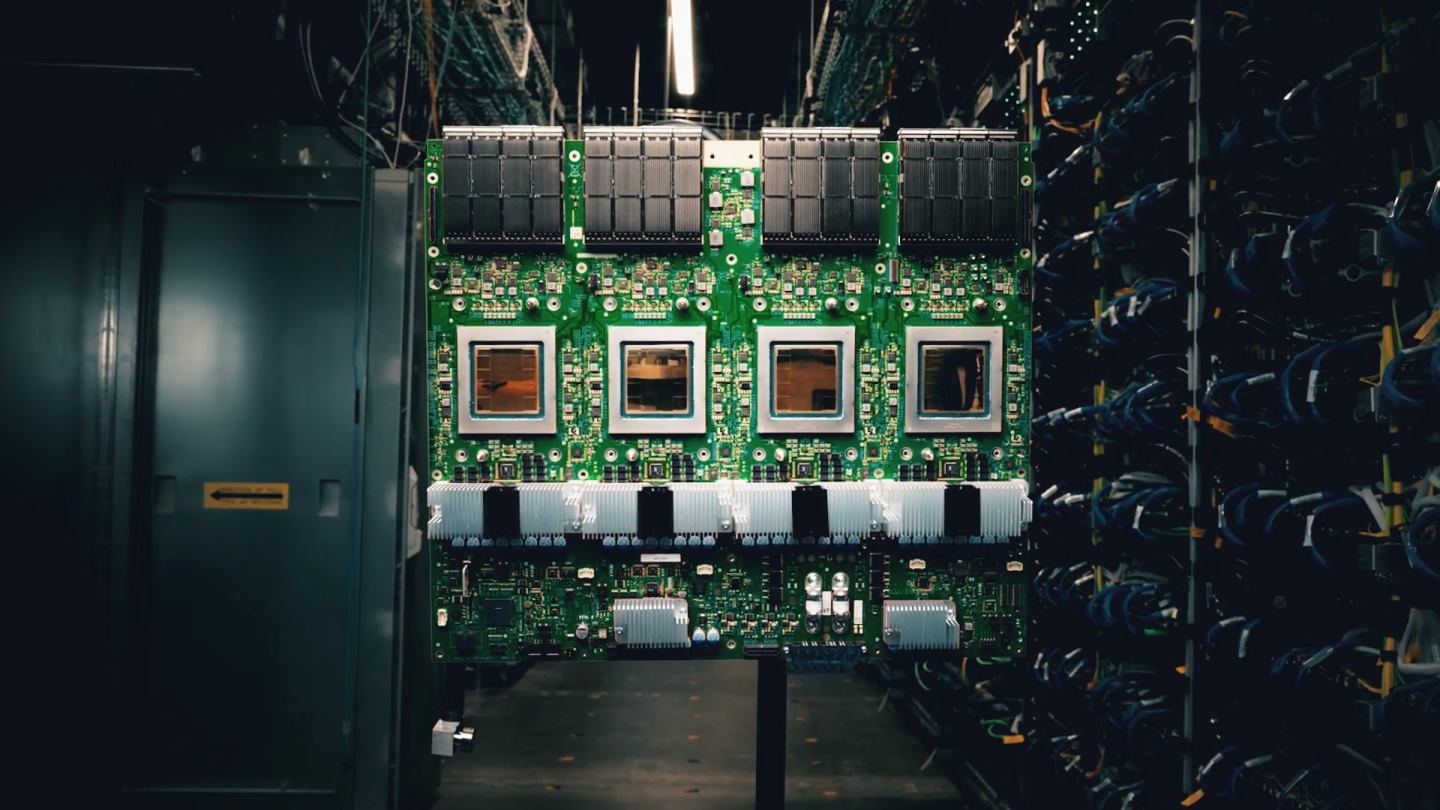
Google’s latest AI chips are not a declaration that Nvidia has lost its lead. They are a reminder that the companies buying enormous amounts of AI computing power increasingly want a choice about who builds it, how it runs and what it costs. Google’s newly detailed TPU 8tx and 8i Max systems put that choice back in focus, especially for businesses trying to run AI agents and handle sensitive data at scale.
The immediate news is a product announcement. The wider story is about bargaining power. Every workload that can move from a general-purpose GPU cluster to a cloud provider’s own accelerator gives that provider another way to manage supply, performance and pricing. That does not make a TPU a drop-in substitute for an Nvidia GPU, but it does make Nvidia’s position less automatic for some customers.
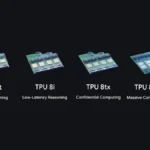
In its November 9 announcement, Google described TPU 8tx as a system aimed at confidential AI inference, with support for smaller-scale training. It says the system can provide hardware-backed protection for workloads that process sensitive information and claims up to twice the lower-latency performance of TPU 8t in the workloads it has tested. The system pairs Google’s accelerator with a fifth-generation AMD EPYC processor. Those are Google’s own claims, rather than independent comparisons with Nvidia hardware.
TPU 8i Max approaches the problem differently. It joins two TPU 8i chips in one system, doubling compute, on-chip SRAM and high-bandwidth memory bandwidth relative to a single 8i. Google’s pitch is that long-context, agentic applications need to move and retain more information efficiently, not simply perform more arithmetic. That matters when an assistant must search documents, use tools and sustain a complex task instead of returning one short answer.
TechBooky covered the launch and specifications separately. The competitive question is what happens when Google can offer several purpose-built TPU configurations within its cloud instead of relying on one accelerator for every AI workload.
Nvidia sells the chips and systems that became the default infrastructure for the AI boom. Google, by contrast, can design accelerators, operate the data centres that house them and sell the resulting computing service through Google Cloud. That vertical integration gives Google an incentive to steer suitable customers toward TPUs, especially where it believes a tailored system can improve efficiency or address a security requirement.
It also gives AI developers another negotiating option. A large customer that can run some inference on TPUs may be less exposed to Nvidia supply constraints or one vendor’s commercial terms. Google says its TPU business now has nearly 100 customers and is broadening access, including through PyTorch support and more open software tools. The significance is not only whether Google wins every benchmark. It is whether using a TPU becomes practical enough for more teams to consider it during procurement.
The strategy is part of a wider shift in the AI chip market. Large cloud providers want to own more of the technology stack behind the services they sell, while AI companies want alternatives to paying the prevailing price for GPU capacity. For a customer, the result could be a more varied menu of hardware, each with different trade-offs in cost, software support, security and availability.
A compelling chip specification is not the same as an easy migration. Nvidia’s CUDA software ecosystem, established developer tools and broad deployment footprint remain substantial advantages. Moving a model or application to TPUs can require engineering work, testing and changes to infrastructure. Customers also need dependable capacity, transparent pricing and performance measured on their own workloads.
Google has not provided an independent, like-for-like benchmark showing that 8tx or 8i Max beats a comparable Nvidia system across the tasks buyers actually run. Nor does this announcement alone tell us how quickly every customer will be able to obtain the new configurations or what the total cost of switching would be. Its latency and resource claims should therefore be read in the context of Google’s stated tests.
That distinction is important. Nvidia does not have to lose the overall AI chip market for the competitive landscape to change. If Google can persuade cloud customers that particular inference, secure-data or long-context jobs run well on its own hardware, it gains a stronger hand in a market where demand for computing remains intense. The new TPUs are best understood as another credible route for selected AI workloads, not proof that Nvidia’s lead has ended.
Related Reading
More contextual TechBooky stories selected from tags, categories and article context.
Paul Femi Balo is the founder and publisher of TechBooky. He covers artificial intelligence, African technology, digital infrastructure, enterprise technology and the global digital economy.
We use cookies to ensure that we give you the best experience on our website. If you continue to use this site we will assume that you are happy with it.